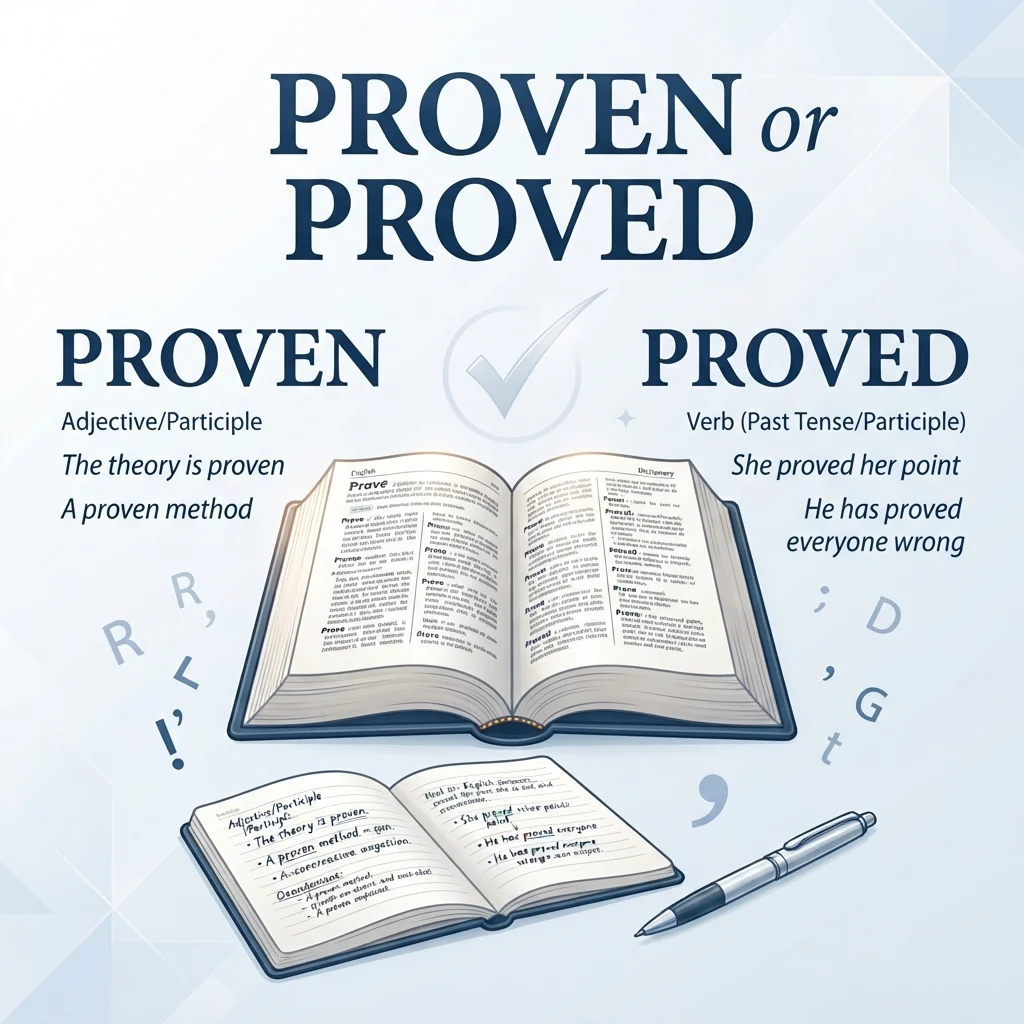
Proven and proved are both correct forms of “prove,” but “proved” is usually the simple past form, while “proven” is commonly used as a past participle after forms of “have” or as an adjective.
Proven or proved—which one should you use? The answer depends on how the word functions in your sentence. Proved is the regular past-tense form: “She proved her point.” Proven is commonly used after have, has, or had: “She has proven her point.” However, proved can also be used as a past participle, so both forms can be grammatically correct in certain contexts.
This small difference can easily cause confusion, especially when you’re writing essays, articles, emails, academic content, or professional documents. Choosing the right form doesn’t have to be difficult once you understand the simple grammar rule behind proven vs. proved.
In this guide, you’ll discover the difference between proven and proved, exactly when to use each form, clear examples, common mistakes, and the situations where one sounds more natural than the other. You’ll also learn why phrases such as “has proven” and “has proved” can both appear in English. By the end, you’ll be able to choose between proven or proved confidently and write clearer, more natural sentences without second-guessing yourself.
Proven or Proved meanings
Proved and proven are both correct forms of the verb prove.
The main difference is how they are used.
- Proved is the simple past form.
- Proved can also be a past participle.
- Proven is commonly used as a past participle, especially before a noun or after forms of be or have.
Examples with “proved”
- She proved her point.
- He proved that the story was true.
- The test proved successful.
- They have proved their ability.
Examples with “proven”
- The method has been proven effective.
- She is a proven leader.
- This is a proven strategy.
- The treatment has proven useful.
Quick rule: Use proved for the simple past. Use proven freely as a past participle, especially in phrases such as “proven effective” and “a proven method.”
The Origin of Proven or Proved
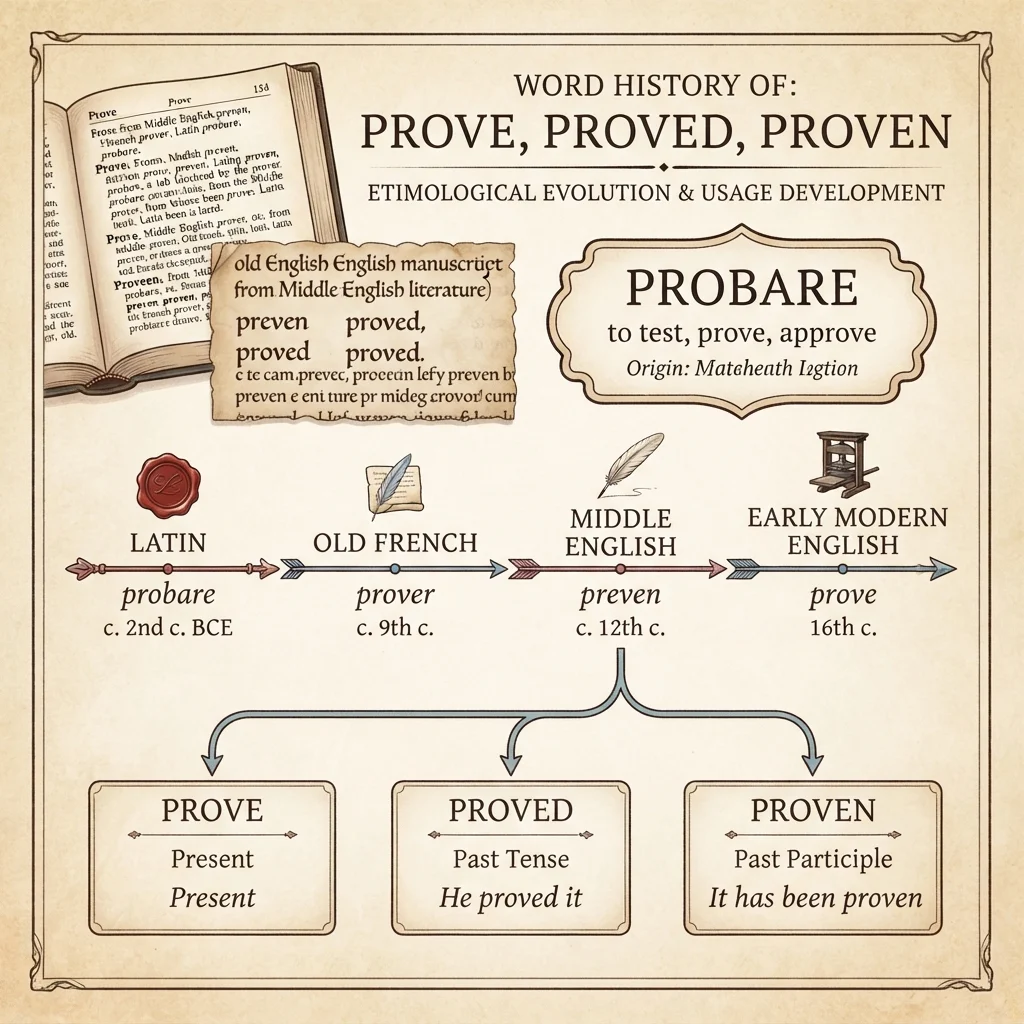
Both proven and proved come from the verb prove.
The word prove entered English through Anglo-French and Old French. It is related to the Latin word probare, meaning “to test,” “to approve,” or “to show something is good.”
Over time, English developed different forms of the verb.
The regular form became:
prove → proved → proved
But proven also developed as a past participle.
This is not unusual in English. Some verbs have more than one accepted past participle. Proven became especially common in certain types of writing.
For example:
The idea has been proven useful.
You can also find:
The idea has been proved useful.
Both can be understood, but proven is very common in this structure.
The spelling difference does not come from British English changing the spelling and American English changing it again. Instead, the two forms developed as accepted forms of the same verb.
British English vs American English Spelling
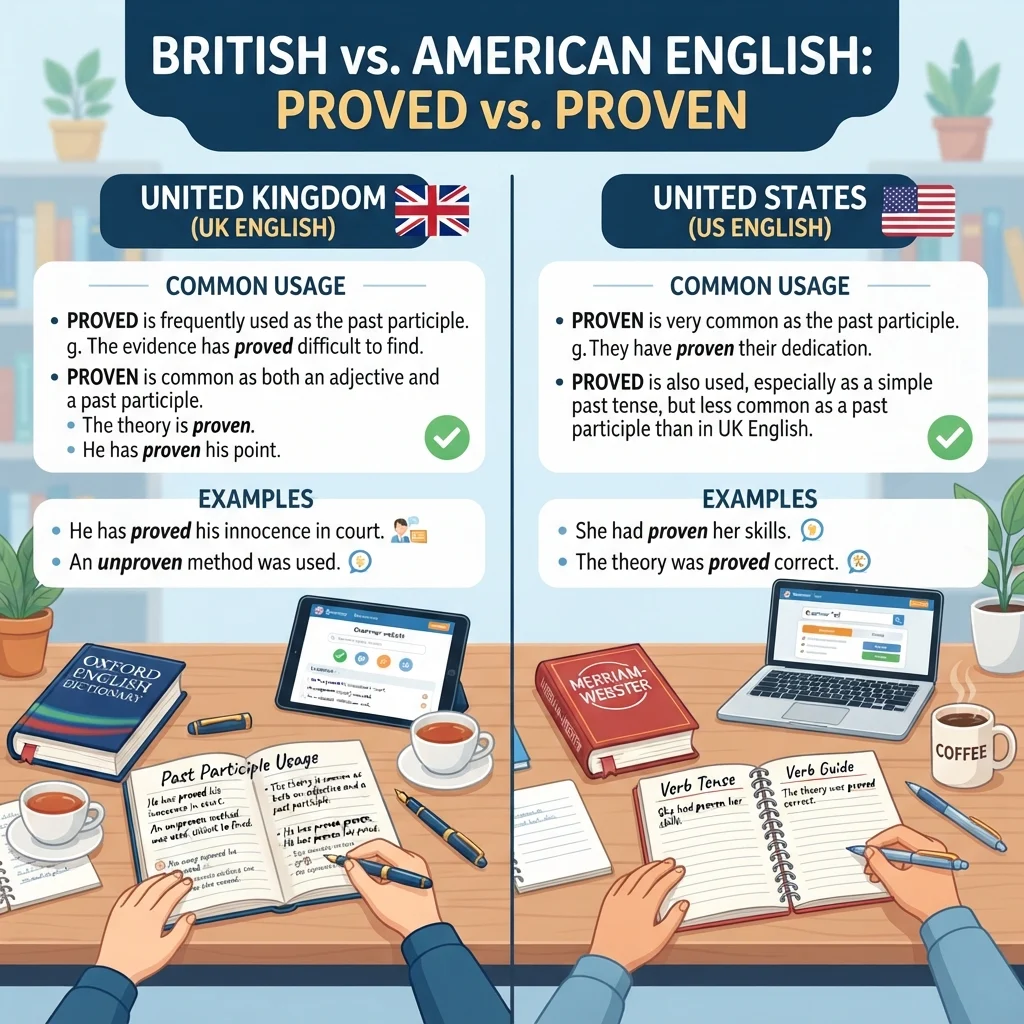
British and American English generally accept both proved and proven.
The difference is more about usage and style than spelling.
| Form | British English | American English | Common use |
|---|---|---|---|
| proved | Yes | Yes | Simple past and past participle |
| proven | Yes | Yes | Past participle and adjective |
| prove | Yes | Yes | Present/base form |
| proving | Yes | Yes | Present participle |
British English Examples
- The theory was proved correct.
- The theory has been proven correct.
- She is a proven expert.
- He proved his point.
American English Examples
- The theory was proved correct.
- The theory has been proven correct.
- She is a proven expert.
- He proved his point.
So, there is no simple rule saying proved = British and proven = American.
Both forms are used in both varieties of English.
Which Spelling Should You Use?
Your choice depends mainly on the sentence and your audience.
For US English
Proven is very common when it works as a past participle or adjective.
Example:
- This is a proven method.
Use proved for the simple past:
- The test proved the theory.
For UK English
British English also uses both forms.
Examples:
- She proved her point.
- The method has been proven useful.
For Commonwealth English
Countries such as Canada, Australia, and New Zealand may use both forms as well.
For global writing
If your audience is international, proven is a safe and familiar choice in phrases such as:
- proven method
- proven results
- proven effective
- proven successful
But do not replace every instance of proved with proven. The simple past usually needs proved.
Common Mistakes with Proven or Proved
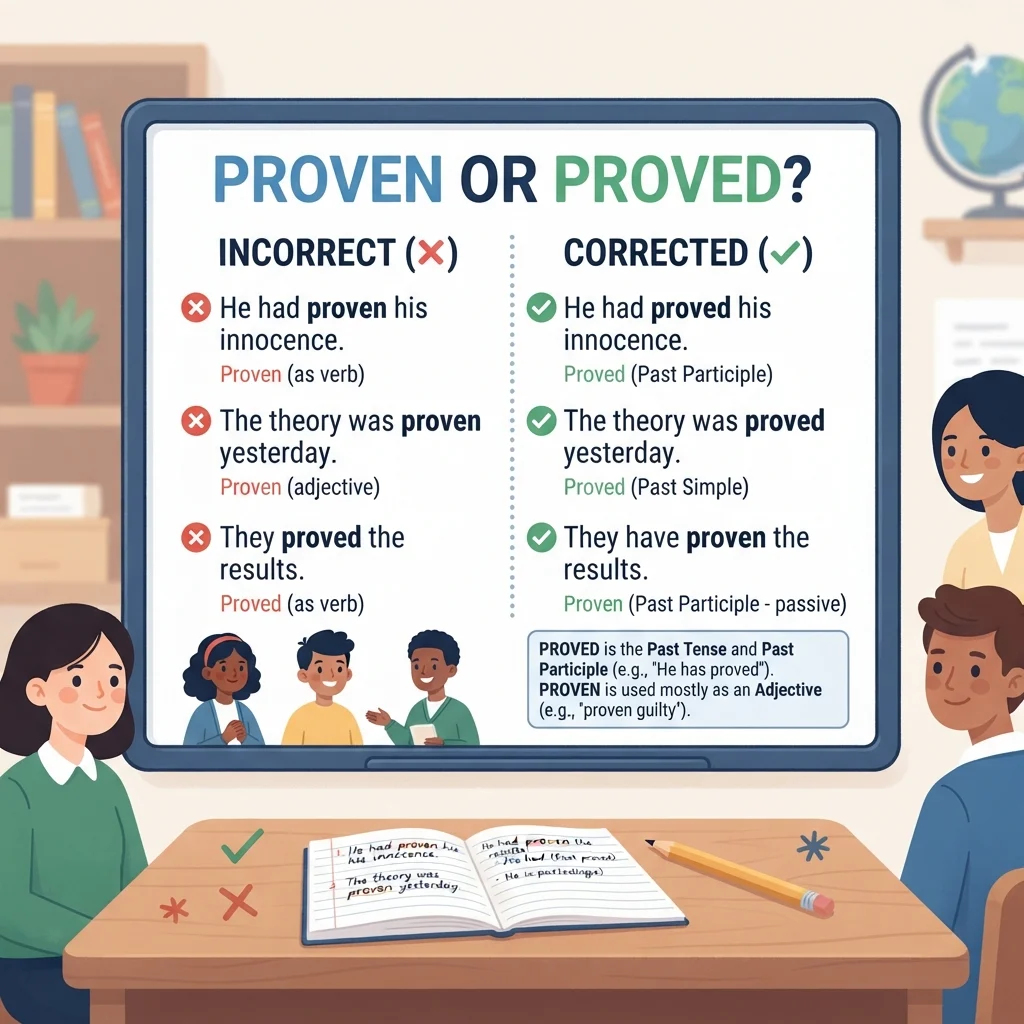
Mistake 1: Using “proven” as the simple past
❌ He proven his point yesterday.
✅ He proved his point yesterday.
Why?
The simple past form is proved.
Mistake 2: Thinking “proved” is always wrong
❌ This method is proved effective.
While this can occur in some styles, proven is often more natural here.
✅ This method is proven effective.
Mistake 3: Confusing “proven” with “prove”
❌ The results proven the theory.
✅ The results proved the theory.
Mistake 4: Changing every “proved” to “proven”
❌ She proven that she was right.
✅ She proved that she was right.
The sentence uses the simple past, so proved is needed.
Mistake 5: Forgetting the adjective use
Proven can also describe a noun.
✅ He is a proven expert.
✅ This is a proven solution.
Here, proven means that something has already shown its value, quality, or effectiveness.
Proven or Proved in Everyday Examples
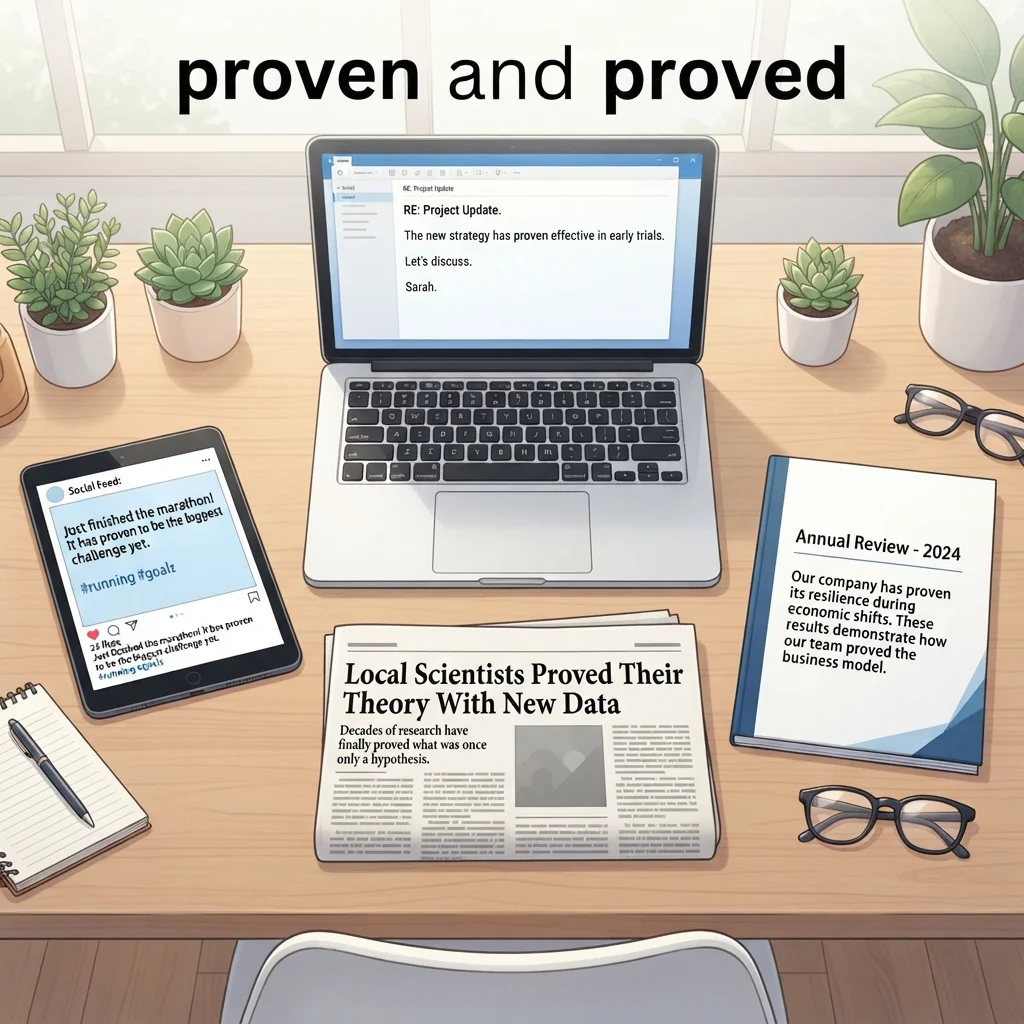
Knowing the difference becomes easier when you see the words in real situations.
In Emails
Proved:
The report proved that the problem was caused by an error.
Proven:
We recommend this proven approach for future projects.
In News Writing
Proved:
The investigation proved that the claim was false.
Proven:
The company used a proven system to improve results.
On Social Media
People often use proven in short statements:
A proven way to stay organized.
This is a proven trick for better results.
In Formal Writing
Both forms can appear:
The research proved the original assumption incorrect.
The study used a proven research method.
The key is to look at the grammatical role of the word.
Proven or Proved – Comparison Table
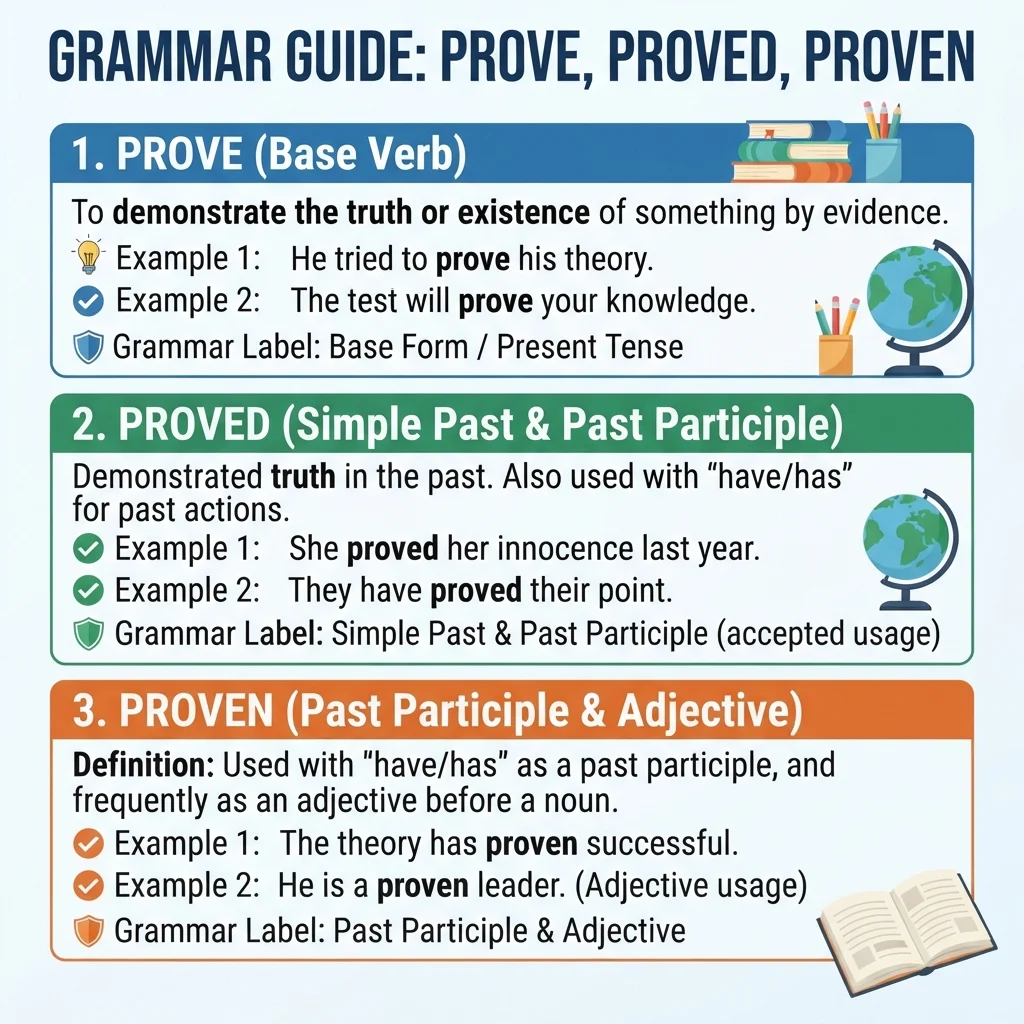
| Word | Correct? | Main role | Example |
|---|---|---|---|
| prove | Yes | Base verb | We can prove the claim. |
| proved | Yes | Simple past | She proved her point. |
| proved | Yes | Past participle | The claim has been proved. |
| proven | Yes | Past participle | The method has been proven useful. |
| proven | Yes | Adjective | It is a proven method. |
| prooved | No | Incorrect spelling | ❌ prooved |
| proveed | No | Incorrect spelling | ❌ proveed |
Side-by-Side Examples
| Proved | Proven |
|---|---|
| He proved his point. | He used a proven method. |
| The test proved successful. | The method has been proven successful. |
| She proved the claim false. | She is a proven expert. |
| They proved their ability. | Their ability has been proven. |
Proven or Proved – Google Trends & Usage Data
Searches for proven or proved usually come from people who want to check grammar, spelling, or sentence structure.
The question appears in different English-speaking regions because both forms are accepted. Usage can also depend on context.
Proved is strongly associated with the simple past:
He proved his point.
Proven is especially common in fixed phrases and descriptive expressions:
a proven method
proven effective
proven successful
a proven track record
Online searches may also vary by country because people learn either British or American English at school.
For professional writing, the best approach is not to choose based only on country. First, check the grammar of the sentence. Then use the form that fits your chosen English style.
FAQs About Proven or Proved
1. Is “proven” a correct word?
Yes. Proven is a correct and widely used form of prove. It is commonly used as a past participle and adjective.
2. Is “proved” grammatically correct?
Yes. Proved is the regular past tense of prove and can also be used as a past participle.
3. Which is correct: “has proven” or “has proved”?
Both are correct. Has proven is very common, especially in modern English.
4. Which is correct: “he proved” or “he proven”?
He proved is correct for the simple past.
Correct:
He proved his point.
Incorrect:
He proven his point.
5. Is “proven” American English?
Not only American English. Proven is also used in British English and other varieties of English.
6. Can “proven” be used before a noun?
Yes. This is very common.
Examples:
- a proven method
- a proven expert
- a proven solution
7. Should I use “proved” or “proven” in formal writing?
Both can be correct. Use proved for the simple past and proven when it works naturally as a past participle or adjective. Most importantly, keep your grammar and style consistent.
Conclusion
The choice between proven or proved becomes simple once you understand their roles. Proved is the regular simple past form of prove, so sentences such as “She proved her point” are correct. Proved can also work as a past participle.
Proven is also a correct form. It is widely used as a past participle and is especially common in phrases such as “a proven method,” “proven effective,” and “proven successful.”
British and American English both use proved and proven, so the difference is not simply a UK-versus-US spelling rule. Your sentence structure matters more than your location.
For clear writing, remember this easy rule: use “proved” for the simple past, and use “proven” when it works naturally as a past participle or adjective. Once you learn these patterns, choosing between the two forms becomes much easier.

Elizabeth Bowen is a creative writer at funcaptionz.com, sharing thoughtful English captions, short content, and inspiring ideas for modern readers.









