
🎉 “Hurray” and “hooray” are both correct spellings used to express joy, excitement, or celebration. “Hooray” is the more common modern spelling, while “hurray” is an accepted variant.
Hurray or hooray—which spelling should you use? If these two words have ever made you stop and wonder whether one is wrong, you’re definitely not alone. Both hurray and hooray are interjections used when cheering, celebrating good news, showing excitement, or expressing approval. The main difference is not their meaning but their spelling and frequency of use.
Hooray is the spelling you’ll encounter more often in contemporary English, while hurray is also correct and can be used in the same kinds of situations. For example, you might write, “Hooray! We finally finished the project!” to show excitement or celebration.
So, hurray or hooray? If you want the more familiar spelling for general modern writing, hooray is usually the straightforward choice. However, choosing hurray does not automatically make your sentence incorrect.
In this guide, you’ll learn the meaning, spelling, pronunciation, origin, usage, and examples of hurray and hooray, along with a clear explanation of when to use each form. You’ll also see how the two spellings compare in British and American English and discover common mistakes to avoid. By the end, you won’t have to second-guess yourself the next time you need to write a cheerful “Hooray!” or “Hurray!” 🎉
Hurray or Hooray meanings
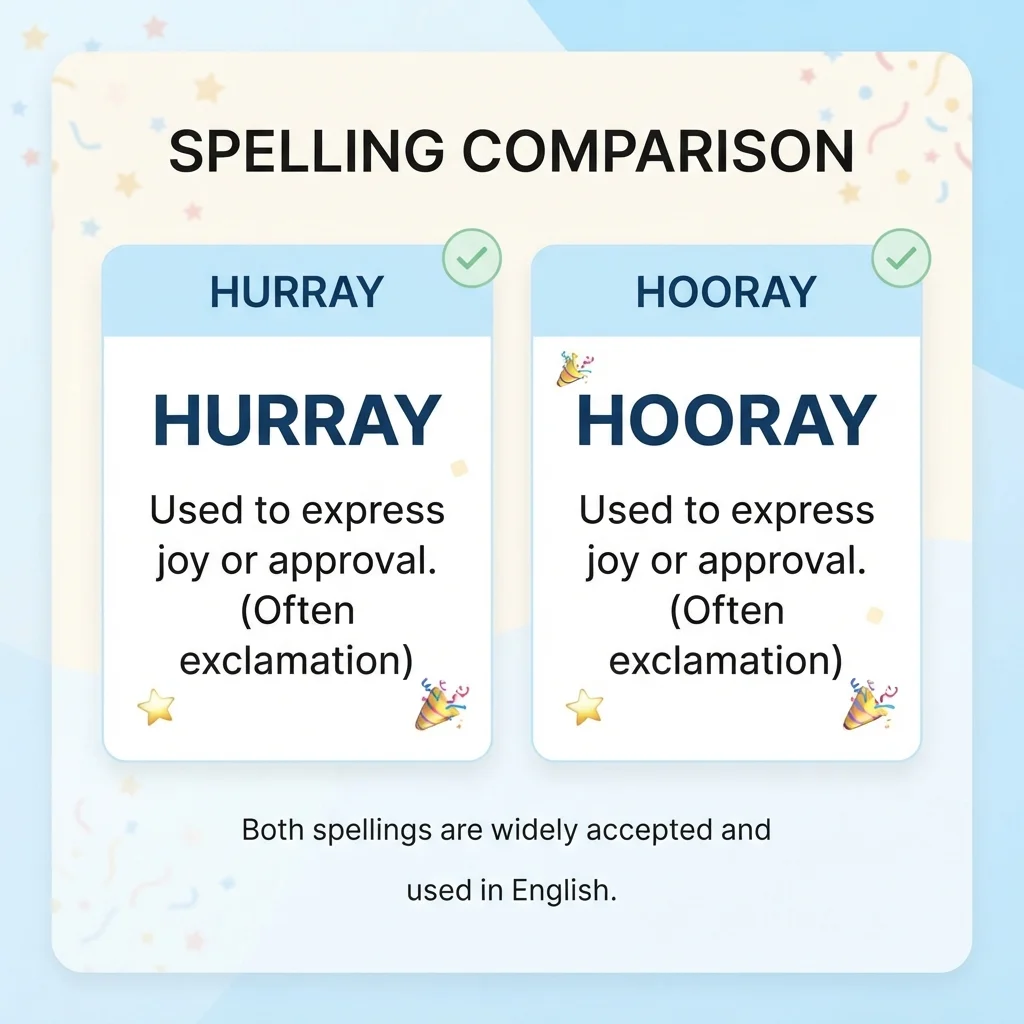
Hurray and hooray are both correct spellings.
Both words are used as an exclamation to show:
- Happiness
- Excitement
- Joy
- Approval
- Celebration
- Victory
Examples
Hooray! We passed the exam.
Hurray! Our team won the game.
The meaning does not change when you switch between the two spellings.
Hooray is a very common form, while hurray is also standard and widely understood.
You may also see hurrah, which is another related spelling.
Quick answer
| Spelling | Correct? | Meaning |
|---|---|---|
| Hooray | Yes | Joy or celebration |
| Hurray | Yes | Joy or celebration |
| Hurrah | Yes | Joy, approval, or celebration |
| Hoorah | Yes, less common | Joy or celebration |
So, if you are asking “Is it hurray or hooray?”, the answer is: both are correct.
The Origin of Hurray or Hooray
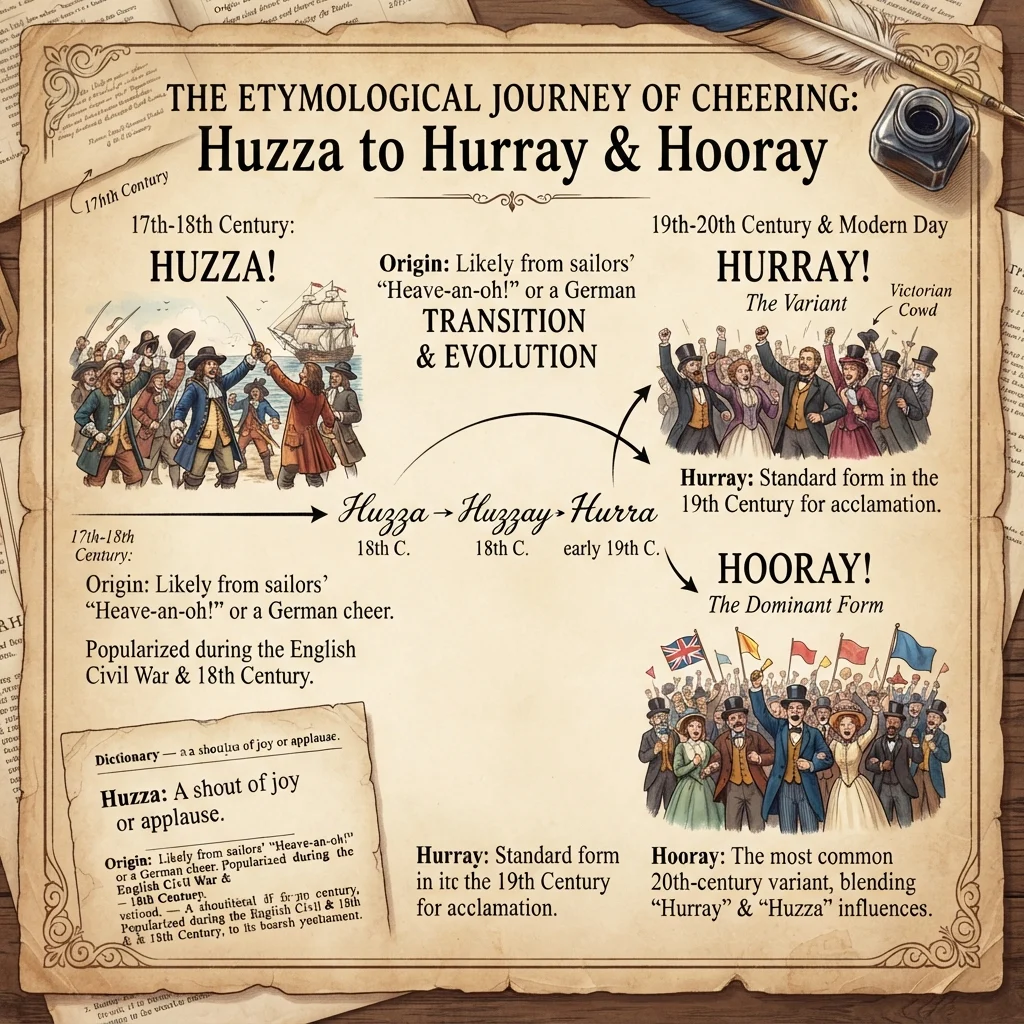
The history of hurray and hooray is interesting because these words began as spoken cheers rather than ordinary vocabulary.
The forms hurray, hooray, and hurrah are connected with older cheering words such as huzza or huzzah. These older forms were used to express excitement, encouragement, triumph, or applause.
Over time, people wrote these sounds in different ways. This helped create the spellings we use today.
The spelling differences exist partly because an exclamation is meant to represent a sound. People did not originally learn the word from a fixed spelling. They heard a cheer and then wrote it down in different forms.
This is why English has several related forms:
- Hooray
- Hurray
- Hurrah
- Hoorah
- Huzzah
These words have similar meanings, although some forms are much less common today.
The spelling hooray is especially familiar in modern English. Hurray is also a normal dictionary form.
The important point is that the different spellings do not mean that one person is happy while another is celebrating. They are simply different written forms of a cheerful exclamation.
British English vs American English Spelling
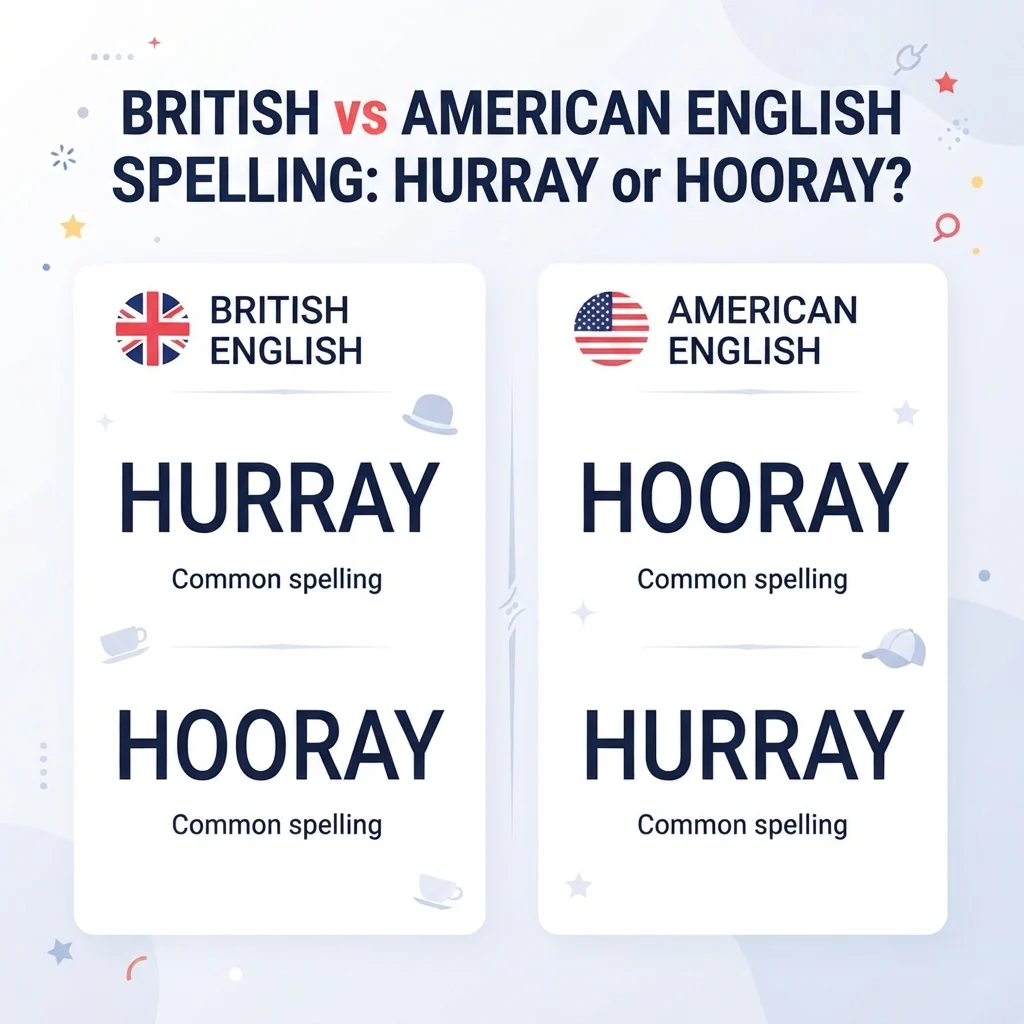
There is no major British-American spelling rule that makes hurray correct in one country and hooray wrong in another.
Both forms can be understood in British and American English.
You may see hooray frequently in modern writing, while hurray also appears in dictionaries and everyday use.
Comparison Table
| Feature | British English | American English |
|---|---|---|
| Hooray | Correct | Correct |
| Hurray | Correct | Correct |
| Hurrah | Correct | Correct |
| Meaning | Joy or approval | Joy or approval |
| Main difference | No fixed spelling rule | No fixed spelling rule |
British English Examples
Hooray! The summer holidays are here.
Hurray! We finally finished the project.
American English Examples
Hooray! We won the championship.
Hurray! The weekend has arrived.
The main lesson is simple: do not treat hurray and hooray like colour and color. They are not a standard British-versus-American spelling pair.
Which Spelling Should You Use?
The best choice depends mainly on your audience and writing style.
For a US Audience
Hooray is a natural choice for American readers.
Example:
Hooray! We finally made it.
You can also use hurray because it is a valid spelling.
For a UK Audience
You can use either hooray or hurray.
Example:
Hooray! The team has won.
Both forms are understandable and acceptable.
For Commonwealth English
Both spellings can work across many Commonwealth English contexts.
If you want a familiar modern form, hooray is a simple choice.
For a Global Audience
For international readers, hooray is a clear and familiar option.
However, there is no need to worry if you use hurray. The meaning remains clear.
Simple writing advice
If you need to choose just one spelling, use:
Hooray
If your existing article, brand, or style guide uses hurray, you do not need to change it simply because you think it is incorrect.
Common Mistakes with Hurray or Hooray
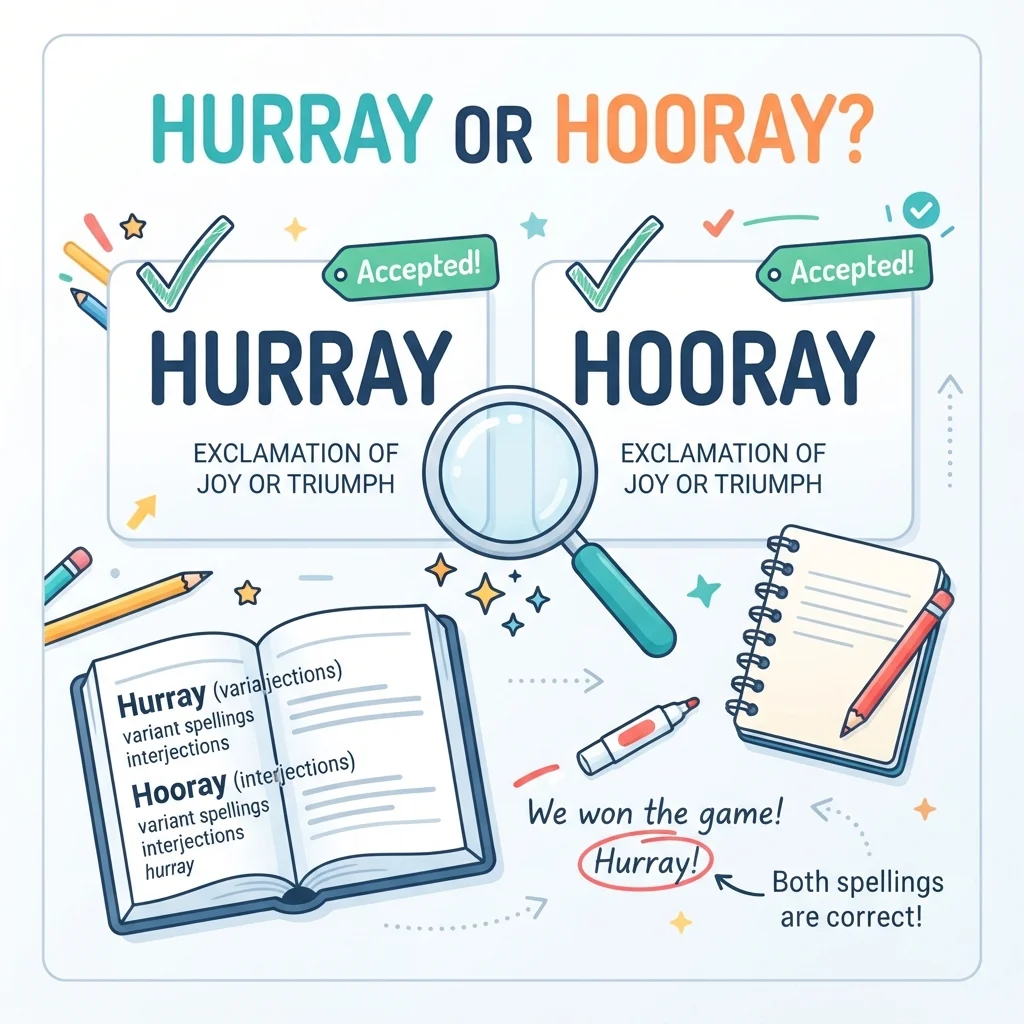
People often make mistakes because the word represents a spoken sound.
Mistake 1: Thinking “hurray” is wrong
Wrong idea:
Hurray is always incorrect.
Correct:
Hurray is an accepted spelling.
Mistake 2: Thinking “hooray” is only American
Wrong idea:
Hooray is only used in American English.
Correct:
Hooray is used in both British and American English.
Mistake 3: Confusing “hooray” with “hurray”
These words have the same basic meaning.
Hooray! We did it!
Hurray! We did it!
Both sentences work.
Mistake 4: Using too many exclamation marks
Because hooray expresses excitement, writers sometimes write:
HOORAY!!! We won!!!!
This may be fine in casual social media posts, but it can look excessive in normal writing.
A cleaner version is:
Hooray! We won!
Mistake 5: Using it in every formal sentence
Hooray is emotional and expressive. It is more common in casual or lively writing.
For a formal report, a sentence such as:
The project was completed successfully.
may be better than:
Hooray! The project was completed successfully.
Choose the tone that fits your audience.
Hurray or Hooray in Everyday Examples

The word is most common when people want to show happiness, excitement, or approval.
In Emails
Informal emails can use hooray naturally.
Hooray! The meeting has been moved to Friday.
Hurray! Your application was approved.
For a formal business email, a more neutral sentence may be better.
I am pleased to let you know that your application was approved.
In News Writing
News stories may use hooray when reporting a celebration, quotation, or public reaction.
The crowd shouted, “Hooray!” when the final result was announced.
This style makes the emotion clear without making the reporter’s own writing overly casual.
On Social Media
Hooray is very common in casual posts.
Hooray! Finally got my new phone! 🎉
Hurray! Vacation starts tomorrow!
Social media often uses the word with emojis, capital letters, or exclamation marks.
In Formal Writing
Hooray and hurray are usually less common in formal academic or professional writing.
Instead of:
Hooray! We achieved our goal.
A formal version might be:
We are pleased to announce that we achieved our goal.
Still, the word can appear in formal writing when quoting someone’s speech or describing a celebration.
In Conversations
Hooray! You are coming with us.
Hurray! Dinner is ready.
The word adds emotion without needing a long explanation.
Hurray or Hooray – Google Trends & Usage Data
Search interest for hurray and hooray can change based on country, language habits, season, and the time period selected in Google Trends.
Google Trends does not show the exact number of searches. Instead, it shows relative search interest on a 0–100 scale. A higher value means greater interest compared with the selected period and location.
For this keyword, searchers usually have a spelling and usage intent. They want to know:
- Is hurray correct?
- Is hooray correct?
- Hurray or hooray?
- How do you spell hooray?
- Is hurray a word?
- What does hooray mean?
- Is hooray British or American?
The two spellings can also appear in different contexts. Hooray is strongly associated with common phrases such as “Hip, hip, hooray!”, while hurray appears as an accepted variant.
Search patterns can differ between the US, UK, Canada, Australia, and other English-speaking regions. However, country differences should not be treated as a strict rule saying that one spelling is correct and the other is wrong.
For SEO and educational content, covering both spellings is useful because someone searching for hurray may still be looking for information about hooray, and vice versa.
Hurray or Hooray Variations Compared Side by Side
| Word | Basic meaning | Common use | Example |
|---|---|---|---|
| Hooray | Joy or celebration | Very common | Hooray! We won! |
| Hurray | Joy or celebration | Common variant | Hurray! We finished! |
| Hurrah | Joy or approval | Traditional variant | Hurrah! The plan worked! |
| Hoorah | Joy or celebration | Less common | Hoorah! We made it! |
| Huzzah | Joy or triumph | Old-fashioned/playful | Huzzah! The quest is complete! |
The most important forms for modern readers are hooray and hurray.
FAQs About Hurray or Hooray
1. Is it hurray or hooray?
Both hurray and hooray are correct spellings. They have the same basic meaning and are used to express happiness, excitement, approval, or celebration.
2. Is hooray the correct spelling?
Yes. Hooray is a standard English spelling and is widely used today.
3. Is hurray a real word?
Yes. Hurray is a valid English word and a variant spelling of hooray.
4. Is hooray British or American?
Hooray is used in both British and American English. It is not limited to one variety of English.
5. Is hurray American English?
Hurray can be used in American English, but it is not an American-only spelling. It is also understood and used elsewhere.
6. What does hooray mean?
Hooray is an exclamation used to express happiness, excitement, approval, celebration, or victory.
Example:
Hooray! We passed the test.
7. Which is more common: hurray or hooray?
Hooray is a very familiar modern form, while hurray is also correct. If you need one simple choice for general readers, hooray is a safe option.
Conclusion
So, hurray or hooray? The simple answer is that both spellings are correct. They are variants used to express happiness, excitement, approval, celebration, or victory.
Hooray is a familiar modern spelling and appears often in phrases such as “Hip, hip, hooray!” Hurray is also a valid spelling and has the same basic meaning. Neither should be treated as a spelling mistake simply because it looks different.
The two forms are not a strict British-versus-American spelling pair. Both can be found in British and American English. You may also see related forms such as hurrah and the less common hoorah.
For everyday writing, social media, messages, and cheerful informal content, hooray is an easy choice. If you prefer hurray, you can use it with confidence too.
The key is to match the word with your tone. Use these cheerful expressions when you want your writing to sound happy, excited, or celebratory.

Walter de la Mare writes creative English captions for funcaptionz.com, sharing short ideas, thoughtful wording, and expressive lines for modern readers.









