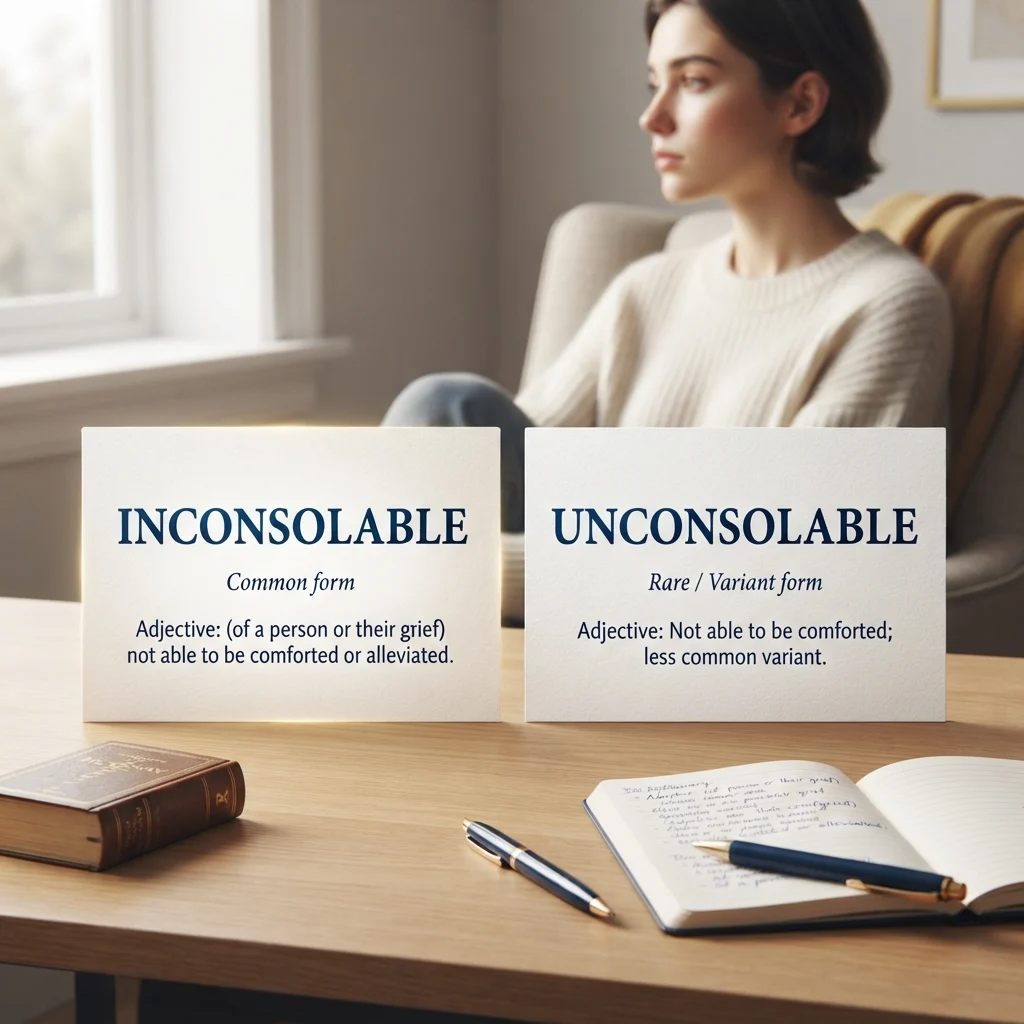
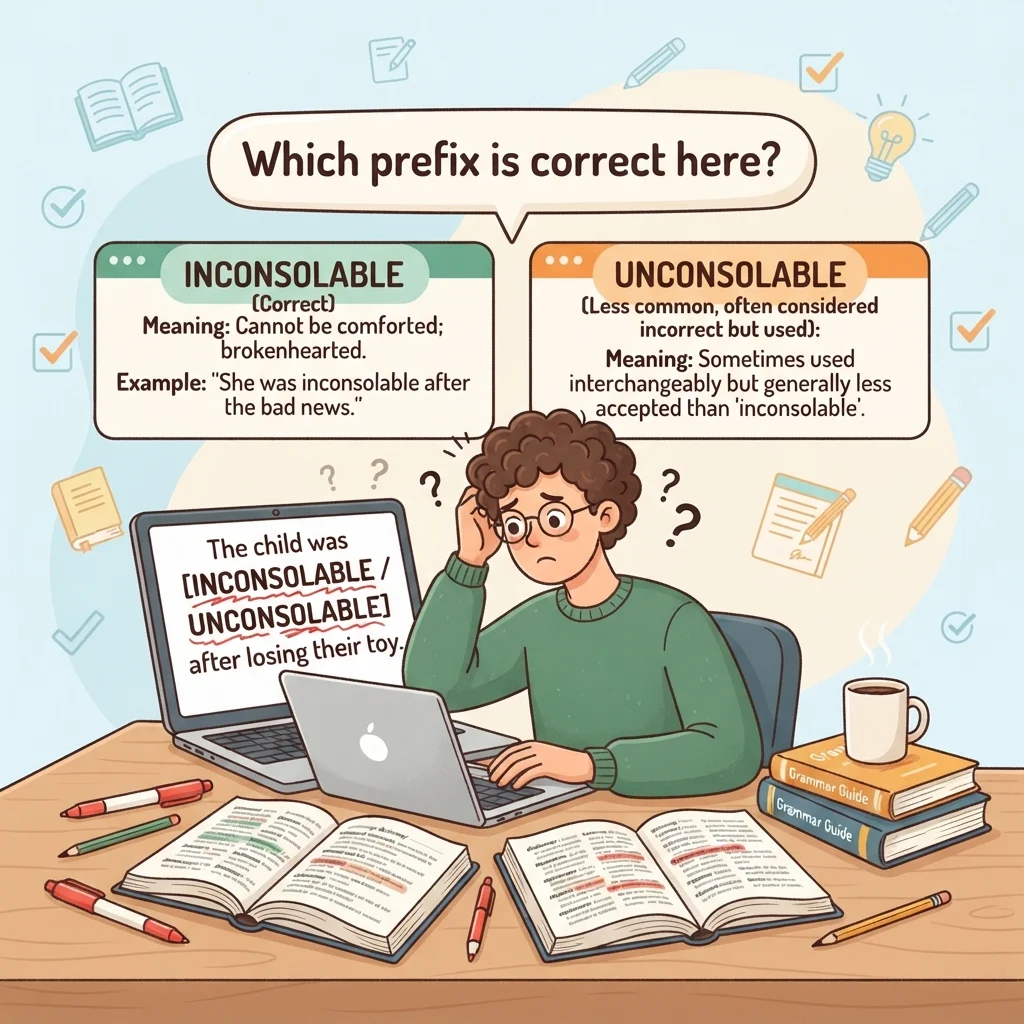
Inconsolable is the standard and preferred word for someone who cannot be comforted, while unconsolable is uncommon and generally not used in standard English.
Inconsolable or unconsolable? If you’ve ever hesitated between these two words, you’re not alone. At first glance, unconsolable may seem like the obvious choice because “un-” often means “not.” However, when you want to describe someone who is extremely upset, grieving, or impossible to comfort, inconsolable is the natural and established choice.
For example, you would say, “She was inconsolable after hearing the heartbreaking news.” The word describes a person whose sadness or distress is so intense that ordinary comfort cannot make them feel better. Unconsolable, although understandable in meaning, is uncommon and can sound unnatural in standard English.
This small word-choice difference matters because choosing the wrong form can make otherwise polished writing sound awkward. Whether you’re writing an essay, email, article, story, or everyday message, knowing which word fits can help you communicate clearly and confidently.
But why is inconsolable preferred when “unconsolable” seems to make sense? The answer becomes much clearer when you look at how the word is formed, how it is used in real sentences, and how standard English treats these two forms.
In this guide, you’ll learn the exact difference between inconsolable and unconsolable, their meanings, pronunciation, correct usage, example sentences, common mistakes, and a simple way to remember which word to use. By the end, you’ll know exactly which form belongs in your writing—and why.
Inconsolable or Unconsolable meanings
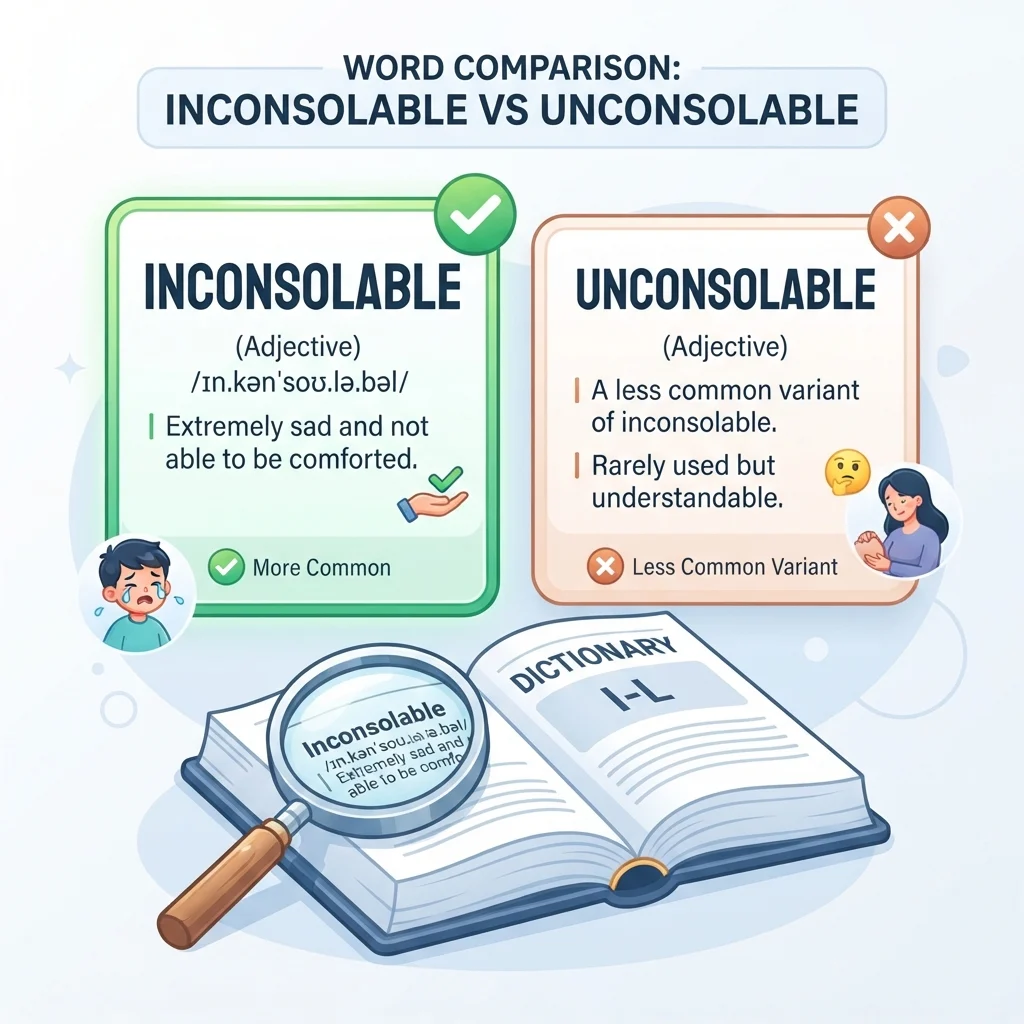
Inconsolable is the standard and more common form.
It means unable to be comforted because of deep sadness, grief, or distress.
Example:
She was inconsolable after hearing the sad news.
Unconsolable has the same basic meaning, but it is less common.
He seemed unconsolable after the loss.
So, if you need one form for everyday, school, professional, or formal writing, choose inconsolable.
Quick Comparison
| Word | Meaning | Usage |
|---|---|---|
| Inconsolable | Unable to be comforted | More common and preferred |
| Unconsolable | Unable to be comforted | Less common variant |
| Consolable | Able to be comforted | Opposite idea |
The key point is that inconsolable and unconsolable do not have a major difference in meaning. Their main difference is frequency and standard usage.
The Origin of Inconsolable or Unconsolable
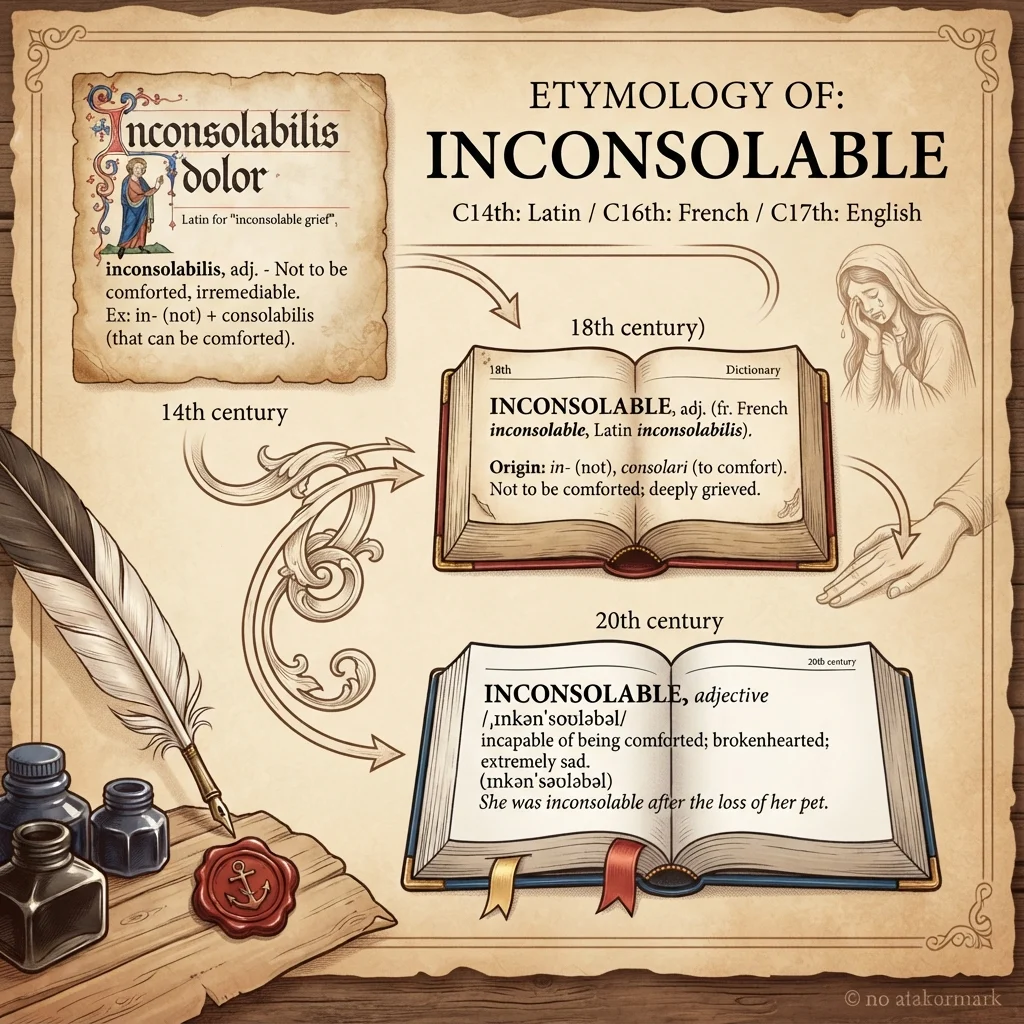
The word inconsolable has a long history. It comes from the Latin word inconsolabilis, meaning “unable to be comforted.”
It is built from two main parts:
- in- = not
- consolable = able to be comforted
The word is linked to the Latin verb consolari, meaning to comfort, encourage, or soothe.
Over time, the word moved through French and then into English. Inconsolable appeared in English around the late 16th century.
The form unconsolable developed through the English use of un- as a negative prefix. English has many words that use un- to express the opposite of something.
For example:
- happy → unhappy
- able → unable
- certain → uncertain
- comfortable → uncomfortable
Because un- often creates negative words, unconsolable may look very natural to English speakers.
However, English does not always use un- for every negative adjective. Some words developed with in-, and inconsolable became the more established form.
That is why both forms can be understood, but inconsolable is much more common.
British English vs American English Spelling
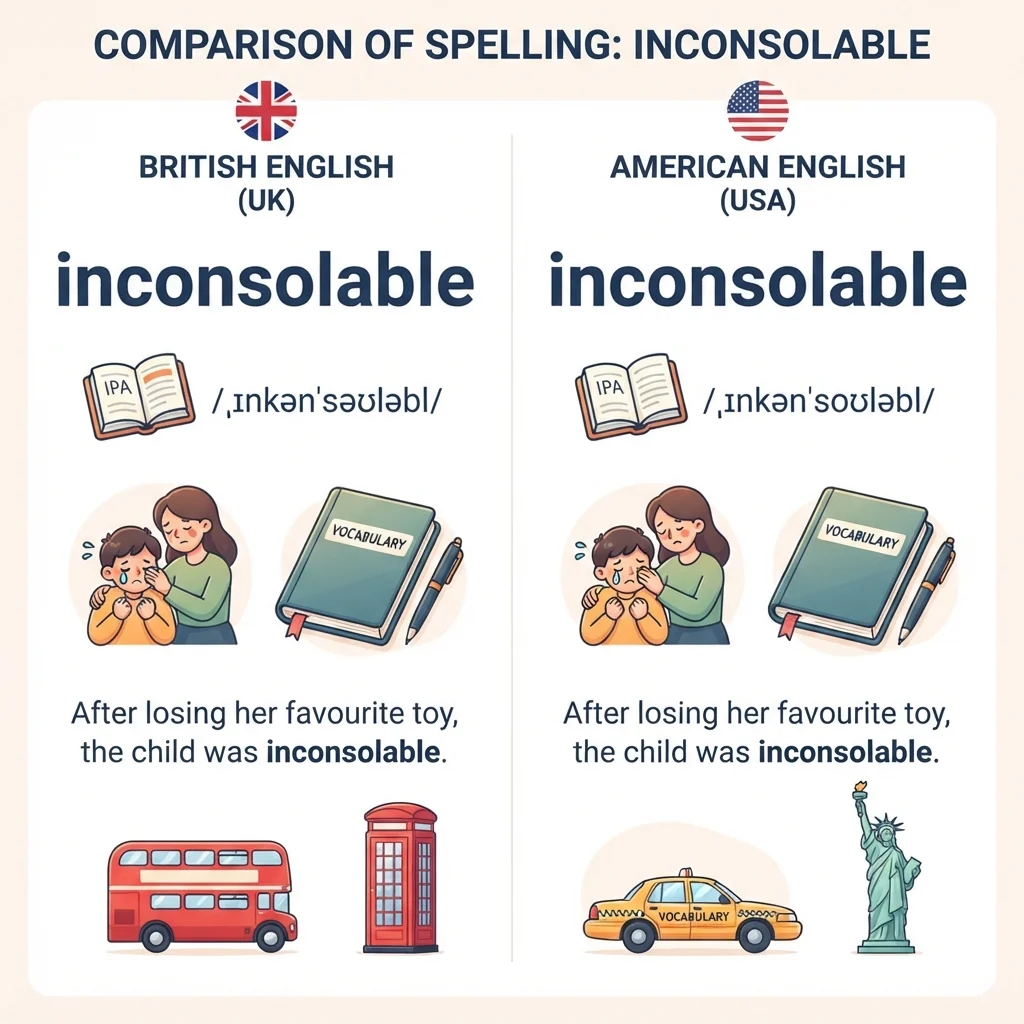
There is no major British-versus-American spelling change here.
Unlike words such as colour/color or organise/organize, inconsolable keeps the same spelling in both British and American English.
The main difference is frequency of use, not regional spelling.
In both varieties, inconsolable is the form you are most likely to see in normal writing.
Examples in British English
She was inconsolable after the accident.
The child became inconsolable when his mother left.
Examples in American English
He was inconsolable after hearing the news.
She cried for hours and was completely inconsolable.
Comparison Table
| Form | British English | American English | Frequency |
|---|---|---|---|
| inconsolable | Common | Common | High |
| unconsolable | Used occasionally | Used occasionally | Lower |
| inconsolably | Common | Common | High |
| unconsolably | Less common | Less common | Lower |
So, you do not need to change the spelling based on whether your readers are from the UK or the US.
Which Spelling Should You Use?
For most readers, inconsolable is the safest choice.
For US English
Use inconsolable in school assignments, business writing, articles, emails, and general communication.
For UK and Commonwealth English
Inconsolable is also the natural choice. The same spelling works well in British, Australian, and other Commonwealth English contexts.
For Global English
If your readers come from different countries, choose inconsolable.
It is easier for readers to recognize and is more common in modern English.
When Can You Use Unconsolable?
You can use unconsolable when:
- You are quoting someone.
- You are discussing word variations.
- You are writing creative text.
- You want to preserve the wording of an older or less common source.
- The word appears naturally in a particular text.
For normal professional writing, however, inconsolable is the better choice.
Common Mistakes with Inconsolable or Unconsolable
These words can cause several common mistakes.
Mistake 1: Thinking Unconsolable Is Wrong
Incorrect idea: “Unconsolable is not a real English word.”
Better understanding: It is a recognized but less frequent form.
Mistake 2: Treating Both Forms as Equally Common
Both words have the same basic meaning, but they are not equally common.
Inconsolable is the form you will usually want.
Mistake 3: Using Inconsolable for Simple Sadness
Inconsolable is a strong word.
She was a little sad about the rain.
This does not normally need inconsolable.
A better example is:
She was inconsolable after losing her beloved pet.
Mistake 4: Confusing Inconsolable With Unhappy
These words are not exact synonyms.
Unhappy can mean mildly or strongly sad.
Inconsolable suggests very deep sadness where comfort does not seem to help.
Mistake 5: Forgetting the Adverb Form
The adverb is:
inconsolably
Example:
He wept inconsolably after the loss.
Shall or Should: What’s the Difference and When to Use Each? ✍️
Inconsolable or Unconsolable in Everyday Examples

Knowing how the word works in real sentences makes the difference easier to remember.
In Emails
I was inconsolable after receiving the unexpected news.
For professional emails, use the word only when the emotional situation truly calls for it.
In News Writing
The family was described as inconsolable after the tragic event.
This style is common when describing strong grief.
On Social Media
I was inconsolable after watching that ending.
Social media often uses the word in a dramatic or humorous way.
In Formal Writing
The mother was inconsolable following the loss of her child.
This is a clear and formal use.
In Stories
The young boy sat quietly, inconsolable after losing his favorite toy.
Writers often use inconsolable to show powerful emotion.
With Common Nouns
You can often see the word before nouns such as:
- inconsolable grief
- inconsolable sadness
- inconsolable child
- inconsolable mother
- inconsolable father
- inconsolable family
- inconsolable tears
Inconsolable or Unconsolable – Google Trends & Usage Data
Search interest for inconsolable is much stronger than for unconsolable in normal English usage.
This difference makes sense because inconsolable is the established form used more often in dictionaries, edited writing, news language, books, and everyday communication.
Google searches for the two terms can vary by country and time. Search interest may also rise when major emotional events, books, films, or news stories use the word.
The important point is that search volume does not mean the two words have different meanings. Both describe someone who cannot easily be comforted.
For content aimed at a broad English-speaking audience, inconsolable gives you the clearer and more familiar choice.
Usage Snapshot
| Search or Usage Term | General Usage |
|---|---|
| inconsolable | Very common |
| inconsolably | Common |
| unconsolable | Less common |
| unconsolably | Less common |
| inconsolable meaning | Common learner search |
| inconsolable or unconsolable | Common comparison query |
Because search trends change over time, exact numbers can move from month to month. The spelling distinction remains the same: inconsolable is the more frequent form.
Inconsolable or Unconsolable: Side-by-Side Variations
| Variation | Meaning | Recommended Use |
|---|---|---|
| inconsolable | Unable to be comforted | Yes |
| unconsolable | Unable to be comforted | Less common |
| inconsolably | In a way that cannot be comforted | Yes |
| unconsolably | In a way that cannot be comforted | Less common |
| consolable | Able to be comforted | Yes |
| console | To comfort someone | Yes |
| consoled | Comforted someone | Yes |
| consoling | Giving comfort | Yes |
FAQs About Inconsolable or Unconsolable
1. Is inconsolable or unconsolable correct?
Both forms are recognized, but inconsolable is the more common and standard choice in modern English.
2. What does inconsolable mean?
Inconsolable means extremely sad or distressed and unable to be comforted.
3. Is unconsolable a real word?
Yes. Unconsolable is a recognized less-common variant of inconsolable.
4. Which word should I use in formal writing?
Use inconsolable. It is more familiar and more widely used.
5. Is inconsolable used in American English?
Yes. Inconsolable is commonly used in American English.
6. Is inconsolable used in British English?
Yes. British English also uses inconsolable. The spelling does not change.
7. What is the opposite of inconsolable?
The closest opposite is consolable, meaning able to be comforted.
8. What is the adverb of inconsolable?
The adverb is inconsolably.
Example:
She cried inconsolably after hearing the news.
Conclusion:
When choosing between inconsolable or unconsolable, the answer is simple. Both words can describe someone who is too sad or distressed to be comforted, but they are not used with the same frequency.
Inconsolable is the more common and familiar form. It works well in everyday English, school writing, professional communication, news writing, social media, and formal text. It is also the best choice when you want your writing to sound natural to a wide English-speaking audience.
Unconsolable is not meaningless or impossible to understand. It is a less common variant that you may still find in dictionaries and some written contexts.
The easiest rule to remember is this: when you are unsure, use inconsolable.
So, if you are writing a sentence about someone who cannot be comforted, write:
She was inconsolable after the loss.
That is the clear, natural choice for most modern English writing.

Storm Jameson writes engaging English captions for funcaptionz.com, sharing creative wording, short ideas, and expressive lines for modern readers online Today.









