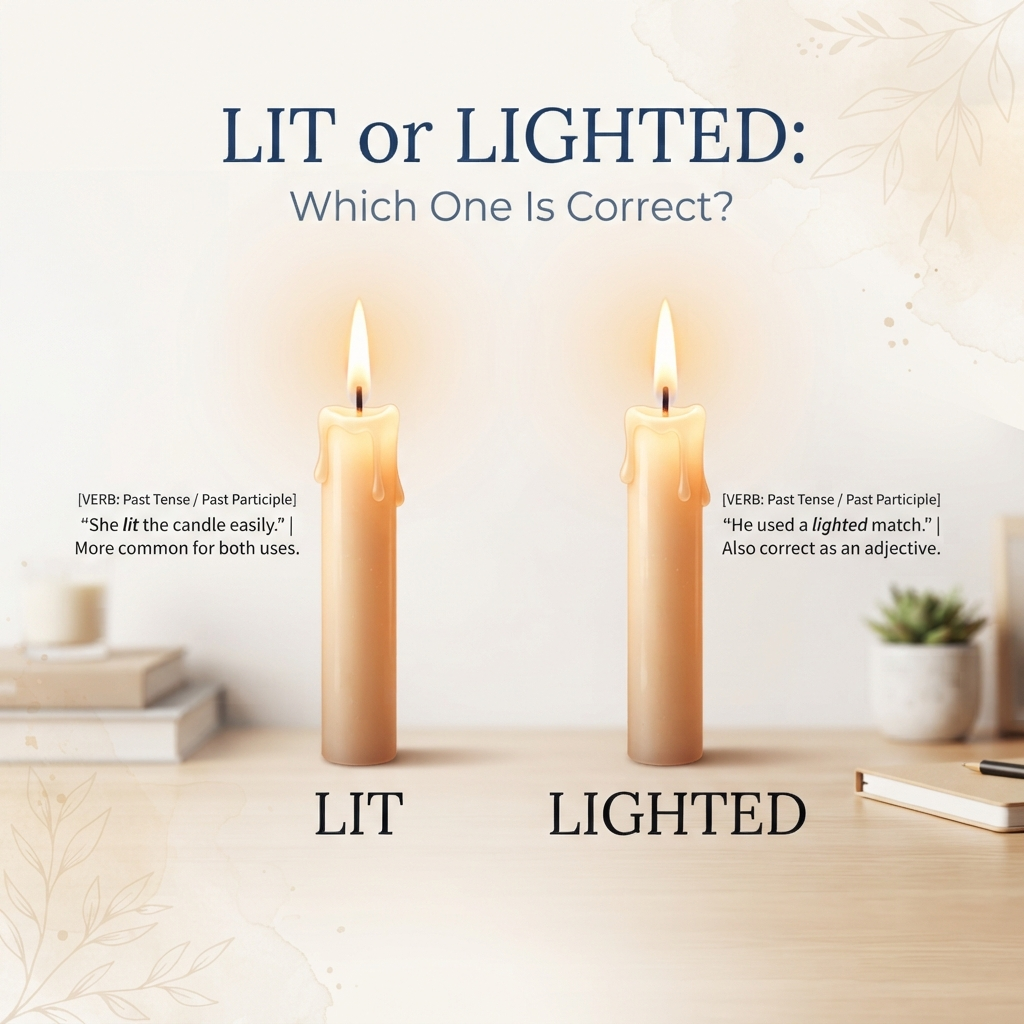
“Lit” and “lighted” are both correct forms of “light,” but “lit” is more common as the past tense, while “lighted” is often used as an adjective before a noun.
Lit or lighted—which one should you use? If you’ve ever paused while writing a sentence like “She ___ the candle,” you’re not alone. Both lit and lighted are legitimate forms of the verb light, but choosing the natural option depends on how the word is being used.
In everyday English, lit is generally the more common choice for the past tense and past participle. For example, “She lit the candle before dinner” sounds natural and straightforward. Lighted is also correct, but it frequently appears as an adjective before a noun, as in “a lighted sign” or “a lighted pathway.” It can also be used as a verb form in some varieties and contexts.
The difference becomes especially useful when you’re writing for school, work, blogs, formal communication, or everyday conversation. Knowing when to choose lit can help your sentences sound natural, while recognizing lighted can prevent you from assuming that the less common form is automatically incorrect.
So, is lit or lighted correct? Both can be correct—the context determines which one sounds most appropriate. Rather than memorizing a complicated rule, you can learn a few simple patterns that make the choice much easier.
In this guide, you’ll discover the exact difference between lit and lighted, clear grammar rules, natural example sentences, common mistakes, British and American usage, and practical tips for choosing the right form. By the end, you’ll be able to use lit and lighted confidently without second-guessing your sentence.
Lit or Lighted meanings
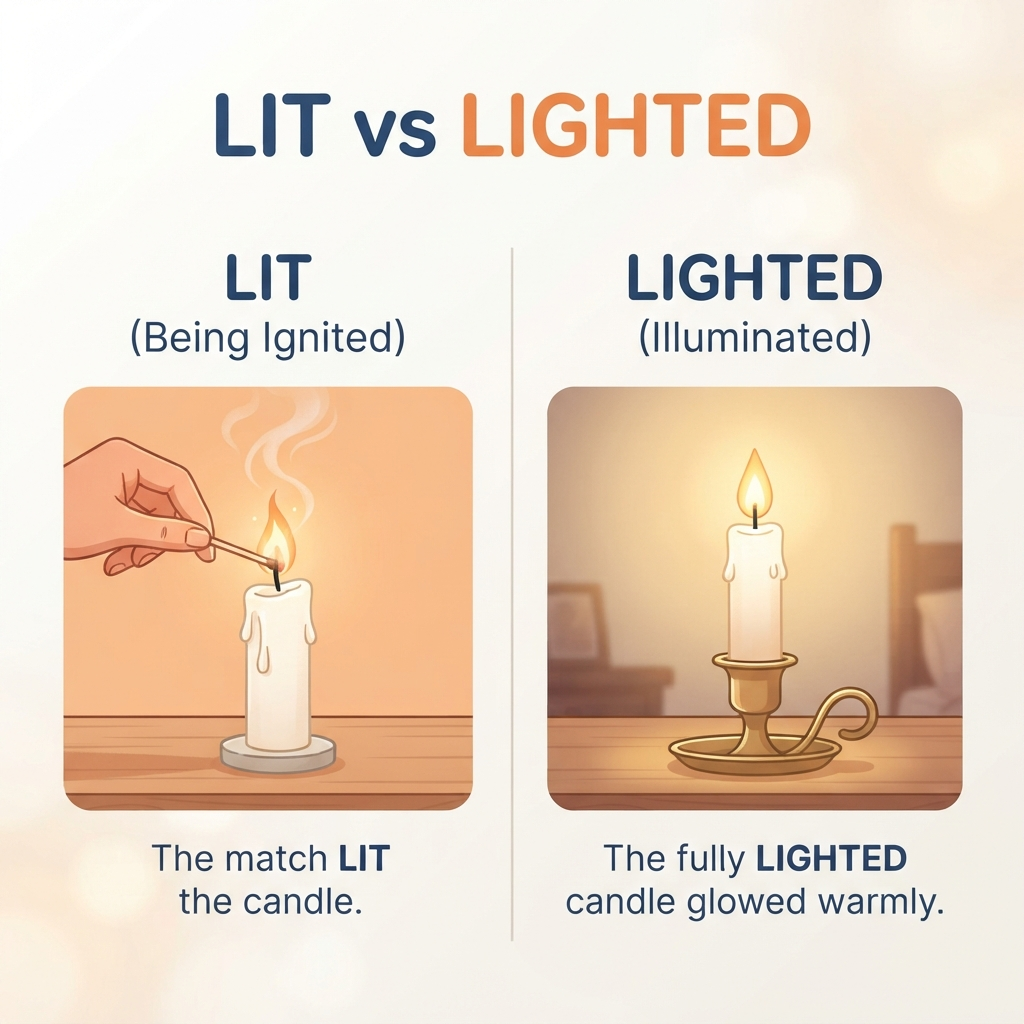
Lit and lighted are both correct past-tense and past-participle forms of light.
However, lit is usually the more natural choice in everyday English.
Examples with “lit”
- She lit a candle.
- He lit the fireplace.
- They lit the lantern.
- I lit a match.
- We lit the candles for dinner.
Examples with “lighted”
- She lighted the candle.
- He lighted the fireplace.
- The room was lighted by several lamps.
- A lighted candle stood on the table.
So, if you need a simple rule:
Use “lit” for most everyday actions. “Lighted” is also correct and can work well in descriptive phrases.
For example:
Action: She lit the candle.
Description: She held a lighted candle.
The Origin of Lit or Lighted

The word light has a very long history in English. It is connected with the idea of making something bright, starting a fire, or giving something light.
Over time, English developed more than one past form of the verb.
Lighted follows the regular English pattern:
light → lighted
This is similar to many regular verbs:
- walk → walked
- play → played
- clean → cleaned
- light → lighted
But English also kept the shorter irregular form:
light → lit
This makes light unusual because both forms have remained in standard use.
Older English writing used lighted frequently. Over time, lit became much more common, especially when describing a direct action such as lighting a candle or fire.
Today, both forms can still be found. However, modern readers will usually see and hear lit more often in ordinary sentences.
The important point is that lighted is not simply a spelling mistake. It is a real and accepted form of the verb.
British English vs American English Spelling
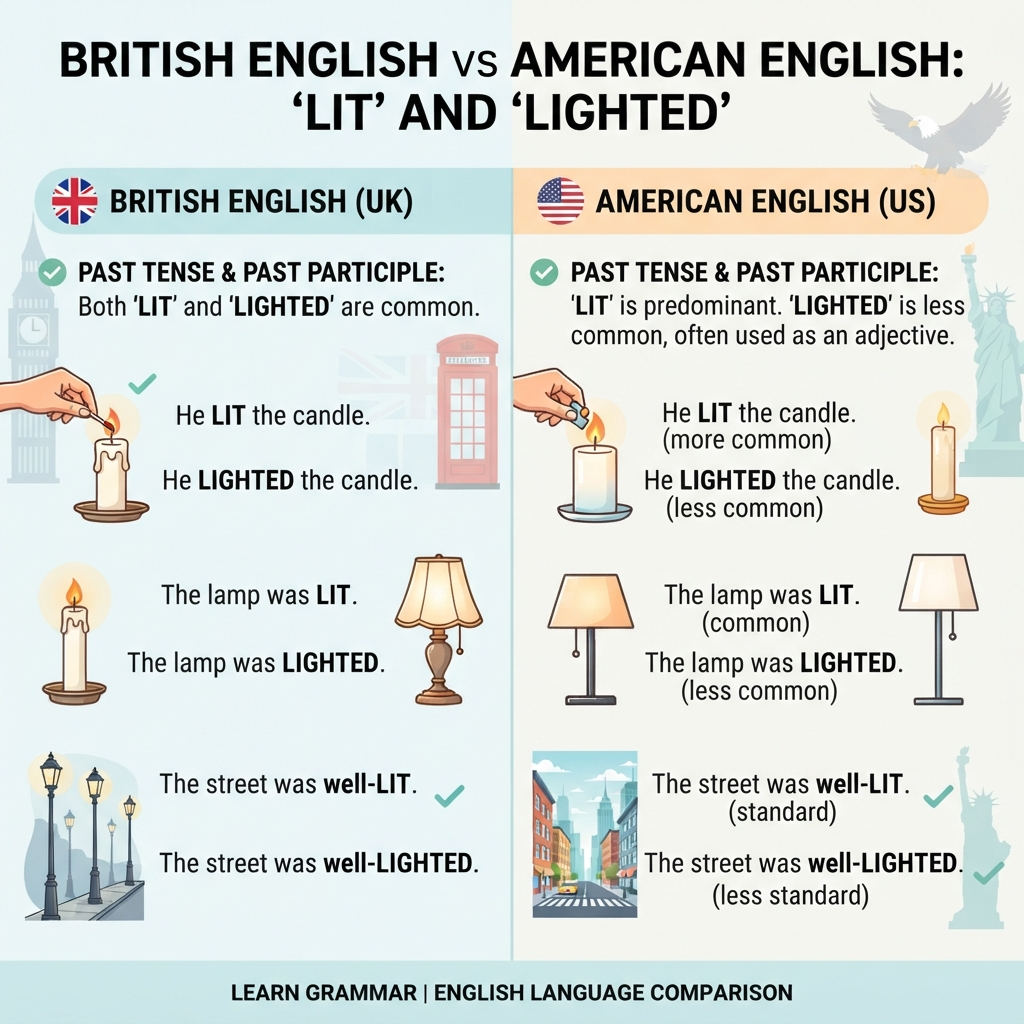
The difference between lit and lighted is not a simple British-versus-American spelling rule.
Both forms are used in British and American English. However, usage can vary by context.
In everyday writing, lit is widely used in both varieties.
Comparison Table
| Use | American English | British English |
|---|---|---|
| Past action | lit | lit |
| Alternative past form | lighted | lighted |
| Past participle | lit | lit |
| Descriptive adjective | lit / lighted | lit / lighted |
| Everyday choice | Usually lit | Usually lit |
| Formal or descriptive use | lighted can appear | lighted can appear |
For example:
American English:
She lit a candle.
British English:
She lit a candle.
Both sound completely natural.
You may also see:
The room was lighted by candles.
This is correct too.
A useful modern pattern
In many everyday sentences:
lit sounds shorter and more natural.
Examples:
- He lit the fire.
- She lit a cigarette.
- They lit the lamps.
- We lit the candles.
But lighted can still appear when describing something:
- a lighted candle
- a lighted sign
- a lighted path
- a lighted window
There is no need to treat the two forms as completely separate regional spellings.
Which Spelling Should You Use?
Your choice should depend mainly on your sentence, audience, and writing style.
For American English
Lit is a very natural choice for everyday writing.
She lit the candle before dinner.
Lighted is also correct, but it may sound more formal or less common in a simple sentence.
For British English
Lit is also widely used and is a safe choice for normal writing.
He lit the fire.
You can still use lighted where it fits naturally.
For Commonwealth English
Readers in countries such as Canada, Australia, and New Zealand will understand both forms.
If you want a simple choice for an international audience, lit is usually a good option.
For formal writing
Both can be correct. Focus on consistency and sentence meaning.
For example:
The candles were lit before the ceremony.
This is clear and natural.
For descriptive writing
Lighted can sometimes work well before a noun:
They walked along a lighted path.
But lit is also possible:
They walked along a lit path.
Modern English commonly uses both.
Common Mistakes with Lit or Lighted

Mistake 1: Thinking “lighted” is always wrong
This is incorrect.
Lighted is a valid English word.
Correct:
She lighted the candle.
But this may sound less natural than:
She lit the candle.
Mistake 2: Thinking only “lighted” is correct
This is also incorrect.
Lit is a standard past form of light.
Correct:
He lit a match.
Mistake 3: Using “light” for a past action
Incorrect:
Yesterday, she light the candle.
Correct:
Yesterday, she lit the candle.
Or:
Yesterday, she lighted the candle.
Mistake 4: Confusing “lit” with slang
The word lit can also have a modern informal meaning, often describing something exciting or fun.
For example:
The party was lit.
But in grammar questions about light, “lit” usually means the past form of the verb.
Mistake 5: Assuming “lighted” is only American
English usage is more complex than that.
Both lit and lighted can occur in different varieties of English. Context matters more than simply labeling one American and the other British.
Lit or Lighted in Everyday Examples
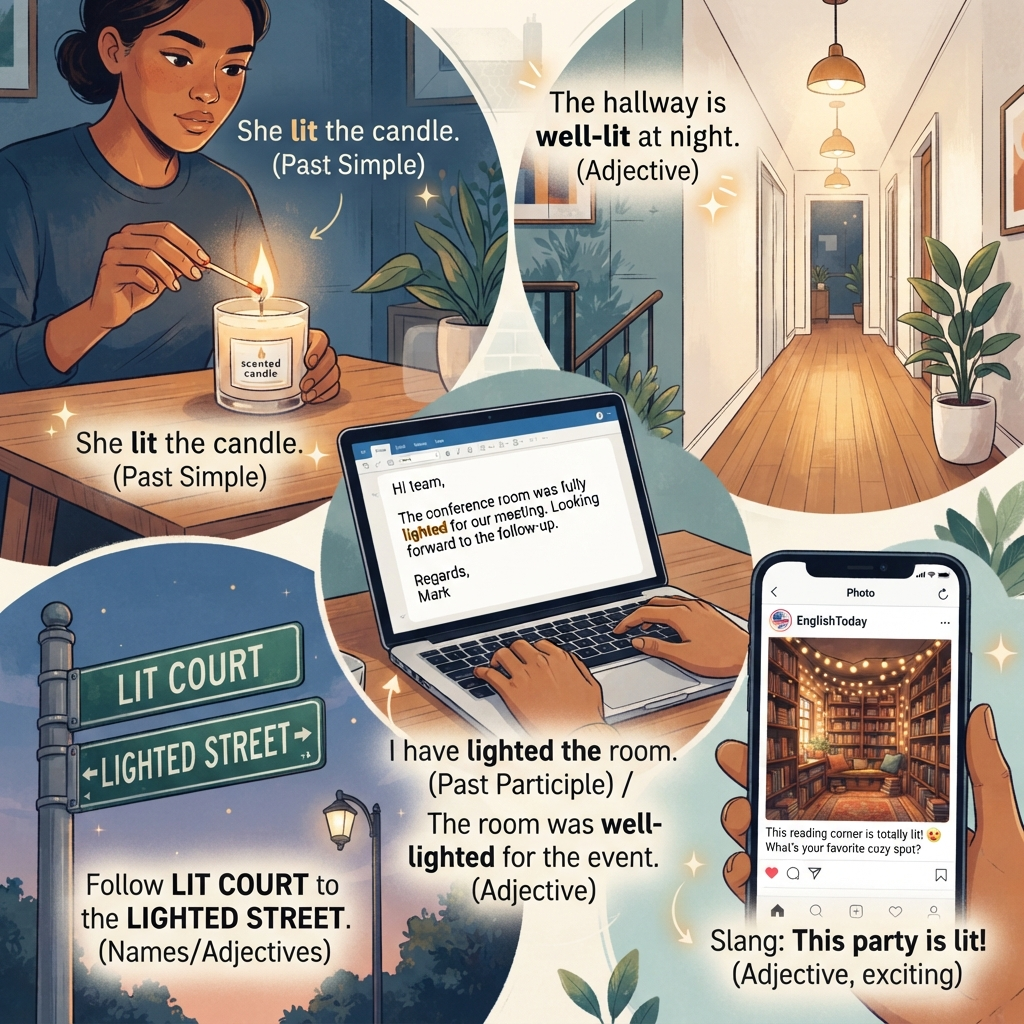
In Emails
Simple and natural:
I lit the candles before the guests arrived.
Another example:
The hallway was well lit when I arrived.
In professional emails, lit is usually easy and natural.
In News Writing
News writing often prefers short, direct wording.
Workers lit the city’s holiday lights on Friday.
Another example:
The candles were lit during the ceremony.
The shorter form works well because it keeps the sentence clear.
On Social Media
Social media often uses lit because it is short and familiar.
The whole place was lit last night!
Here, lit has an informal meaning: exciting or lively.
But it can also have its normal meaning:
We lit the candles and took some photos.
In Formal Writing
Both forms can work.
The candles were lit before the ceremony began.
Or:
The hall was lighted by several large lamps.
For most modern formal writing, lit is still a simple and natural choice.
In Descriptive Writing
You may see both forms:
A lighted window appeared in the distance.
Or:
A lit window appeared in the distance.
Both are understandable and grammatically acceptable.
Lit or Lighted – Google Trends & Usage Data
Search interest for “lit or lighted” comes from a common grammar question: people know that light is unusual because it has two accepted past forms.
Modern usage data and published-language databases show that lit has become very common over time. It is especially common when light is used as a verb to describe an action.
For example:
She lit the candle.
Lighted still appears in published English, especially in descriptive uses and phrases where it works as an adjective.
The exact popularity of each form can change depending on the country, type of writing, and sentence structure. Spoken English, books, newspapers, and formal writing may show different patterns.
For practical writing, the safest modern approach is simple:
Use “lit” as your default past form, but do not assume “lighted” is wrong.
Lit vs Lighted: Side-by-Side Comparison
| Feature | Lit | Lighted |
|---|---|---|
| Base verb | Light | Light |
| Past tense | Yes | Yes |
| Past participle | Yes | Yes |
| Correct English | Yes | Yes |
| Everyday use | Very common | Less common |
| Descriptive use | Common | Common |
| Formal writing | Yes | Yes |
| British English | Used | Used |
| American English | Used | Used |
| Best simple default | Yes | Sometimes |
Compare These Sentences
| Lit | Lighted |
|---|---|
| She lit a candle. | She lighted a candle. |
| He lit the fire. | He lighted the fire. |
| They lit the lamps. | They lighted the lamps. |
| The room was lit by candles. | The room was lighted by candles. |
| A lit candle stood nearby. | A lighted candle stood nearby. |
The main difference is not correctness. It is frequency, style, and naturalness in context.
FAQs About Lit or Lighted
1. Is “lit” or “lighted” correct?
Both are correct. Lit is usually more common in everyday modern English, while lighted remains a valid form.
2. Is “lit” the past tense of light?
Yes.
Present: I light the candle.
Past: I lit the candle.
Lighted can also be used as the past form.
3. Is “lighted” grammatically correct?
Yes. Lighted is a standard form of the verb light.
4. Should I use “lit” in American English?
Yes, lit is a very natural choice in American English, especially for everyday actions.
5. Should I use “lit” in British English?
Yes. Lit is widely used in British English too.
6. Is “a lighted candle” correct?
Yes.
She carried a lighted candle.
You can also say:
She carried a lit candle.
7. Is “well-lit” correct?
Yes. Well-lit is a very common expression.
The office is well-lit.
It means that the office has enough light.
Conclusion
The choice between lit and lighted is easier than it first appears. Both words are correct forms of the verb light, and both can be used as past tense and past participle forms.
For most everyday sentences, lit is the simple and natural choice. You can say, “She lit the candle,” “He lit the fire,” or “They lit the lamps.” These sentences are clear and common.
Lighted is not wrong. It can also describe a completed action and may appear naturally in descriptive phrases such as “a lighted candle” or “a lighted path.” Regional English can also affect which form a writer prefers, but there is no strict rule saying that one belongs only to American English or only to British English.
If you are unsure, remember this easy rule: use “lit” as your default past form of “light.” Keep lighted when it sounds natural for your sentence or when you prefer its descriptive style.

Elizabeth Bowen is a creative writer at funcaptionz.com, sharing thoughtful English captions, short content, and inspiring ideas for modern readers.









