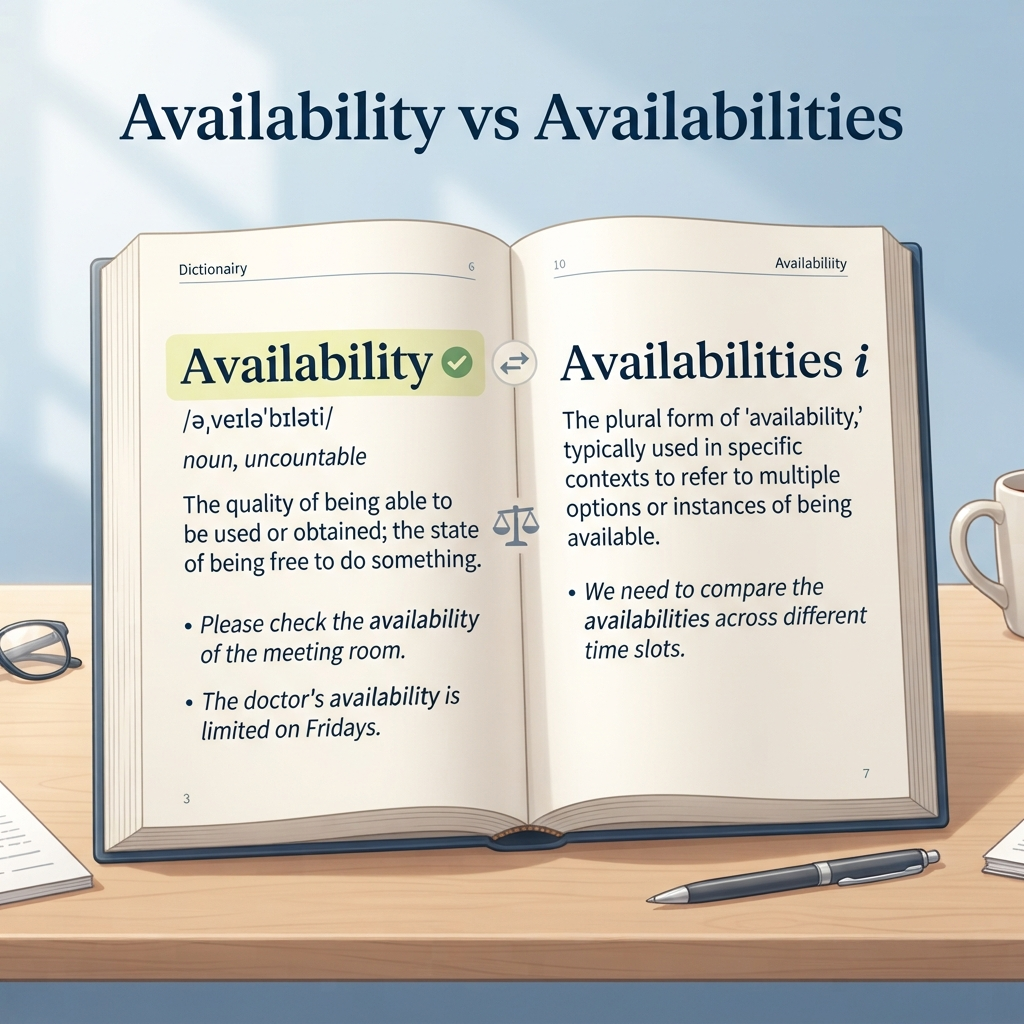
“Availability” is the correct and commonly used word in most situations, while “availabilities” is uncommon and is mainly used when referring to separate types or instances of availability.
Availability or availabilities—which one should you use? This small spelling and grammar choice can make a big difference when you’re writing an email, report, article, business message, or professional document. Although both forms can be grammatically possible, they are not used in the same way, and choosing the wrong one can make your sentence sound unnatural.
In most everyday and professional situations, availability is the natural choice. It describes the state or condition of being available, whether you’re talking about someone’s free time, a product in stock, a service, or an opportunity. For example, “Please confirm your availability for the meeting” sounds natural because it refers to someone’s general availability.
But what about availabilities? The plural form is much less common and is generally used only when discussing multiple distinct types, categories, or instances of availability. For example, a technical or business context might refer to different availabilities across several services or systems. In ordinary writing, however, using the plural can sound unnecessarily awkward.
So, if you’re wondering “availability or availabilities—which is correct?”, the safest answer is availability in most contexts. Knowing this simple distinction can help you write clearer, more natural English and avoid a common word-choice mistake.
In this guide, you’ll discover the exact difference between availability and availabilities, when to use each form, practical sentence examples, common mistakes, and simple rules that make the choice easy. By the end, you’ll know exactly which word fits your sentence—and when the plural availabilities actually makes sense.
Availability or Availabilities meanings
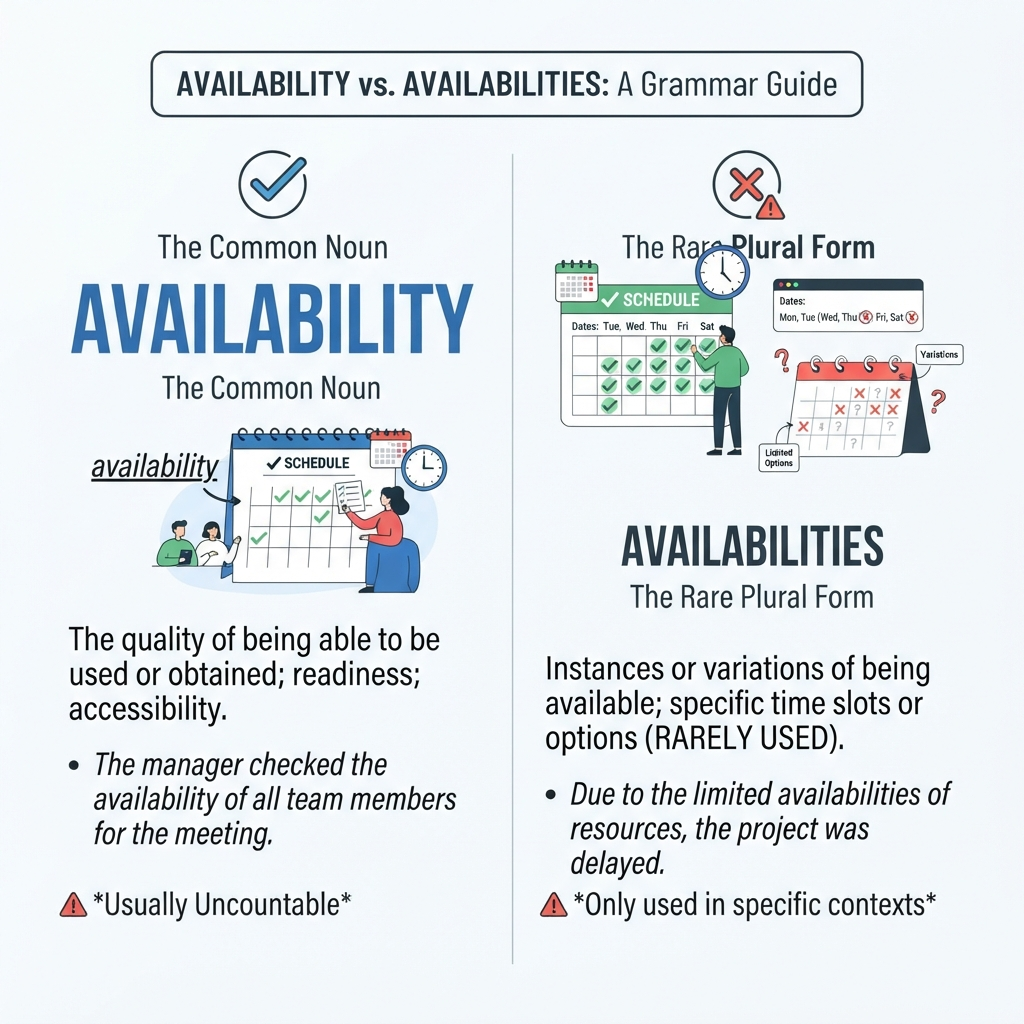
Availability is the standard and most common form.
It means the state of being available, free, or ready to use.
Examples:
- Please let me know your availability.
- The product’s availability is limited.
- I need to check my availability first.
- The hotel has good room availability.
Availabilities is grammatically possible, but it is much less common. It is used when talking about different types, conditions, or instances of availability.
Example:
- The system shows different availabilities for each service.
Quick rule
Use availability for general availability.
Use availabilities only when you clearly mean separate or different forms of availability.
So, in most everyday sentences:
Availability ✅
Availabilities ⚠️ Rare and context-specific
The Origin of Availability or Availabilities
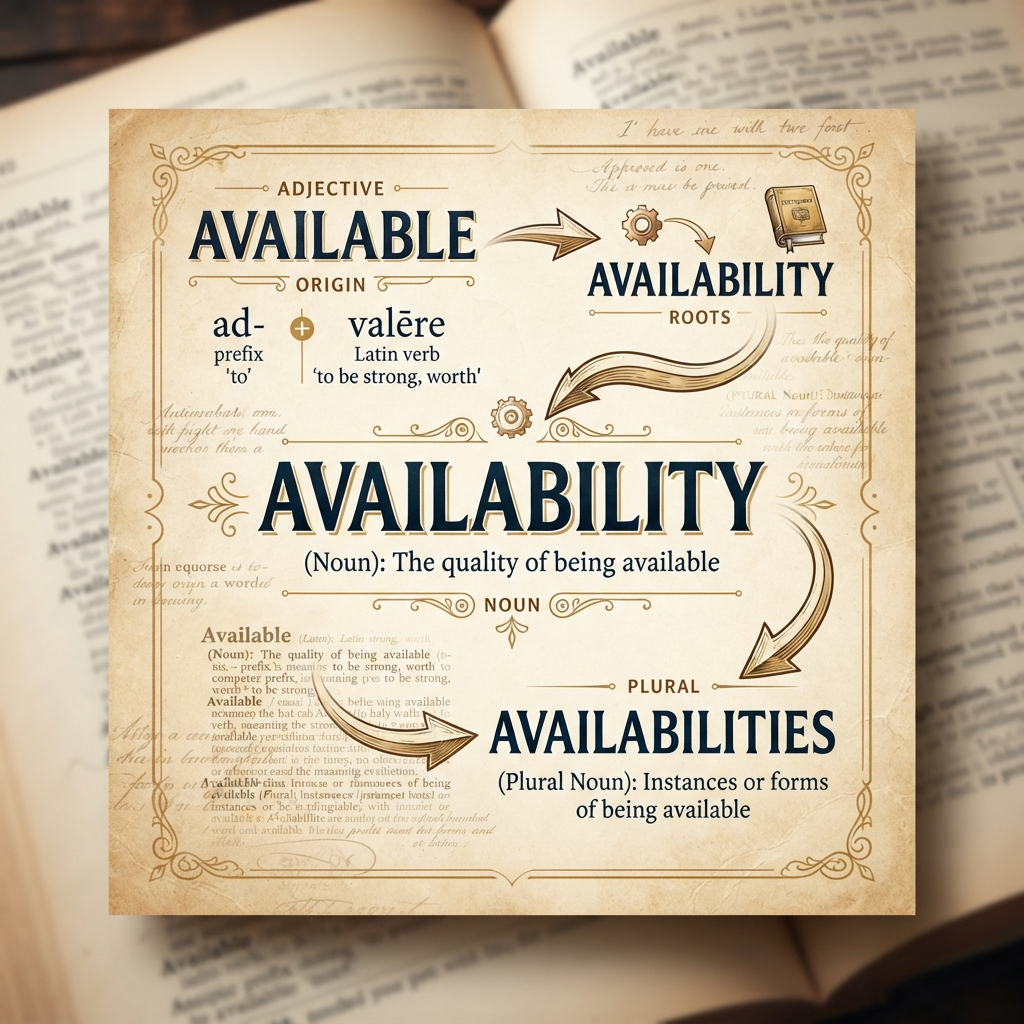
The word availability comes from available, which means ready, free, or accessible.
Available comes from the Latin word avail, which is connected with the idea of being useful or having value. Over time, English developed available to describe something that can be used, obtained, or accessed.
The ending -ity turns an adjective into a noun.
For example:
- available → availability
- possible → possibility
- responsible → responsibility
The plural form is made by adding -ies:
- availability → availabilities
This spelling happens because words ending in -y often change y to i before adding -es.
For example:
- ability → abilities
- possibility → possibilities
- availability → availabilities
There is no major British-versus-American spelling difference here. The main difference is singular versus plural use.
British English vs American English Spelling
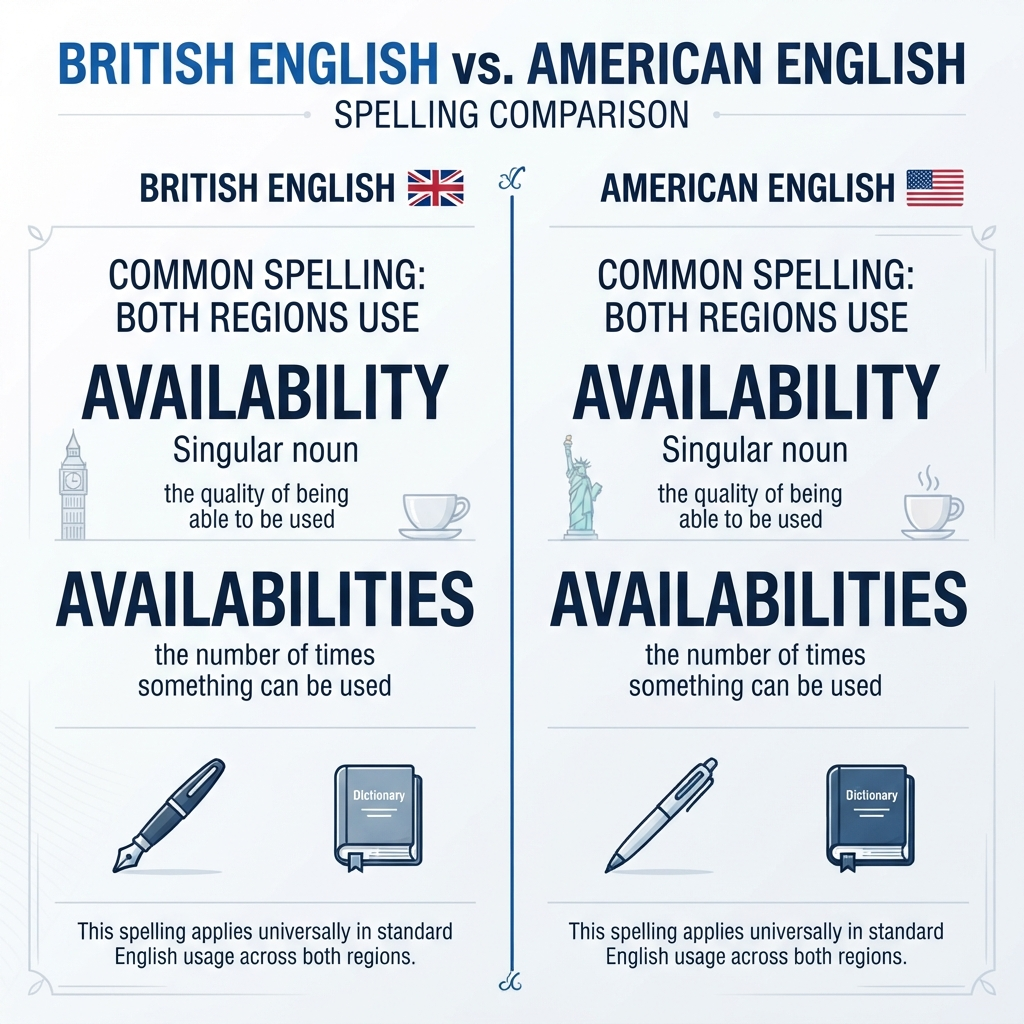
Both British English and American English normally spell the word as:
availability
The plural form is:
availabilities
So, unlike words such as colour/color or organise/organize, there is no standard UK/US spelling change for this word.
| Form | British English | American English |
|---|---|---|
| Singular | availability | availability |
| Plural | availabilities | availabilities |
| Common form | availability | availability |
| Rare plural use | availabilities | availabilities |
Examples in British English
- Please confirm your availability.
- The availability of tickets is limited.
- We need to discuss staff availability.
Examples in American English
- Please send me your availability.
- Check the availability of the product.
- The doctor’s availability has changed.
The spelling remains the same in both varieties.
Which Spelling Should You Use?
For most readers, availability is the best choice when you mean general availability.
For US English
Use availability in emails, business writing, websites, and everyday communication.
Example:
Please send me your availability for next week.
For UK and Commonwealth English
The same rule applies.
Example:
Could you confirm your availability for the meeting?
For a global audience
Availability is also the safest choice. It is widely understood and is much more common than availabilities.
Use availabilities only when your sentence talks about several separate availability conditions or categories.
Simple advice
If you are unsure, choose:
availability
In normal writing, this will almost always be the natural option.
Common Mistakes with Availability or Availabilities
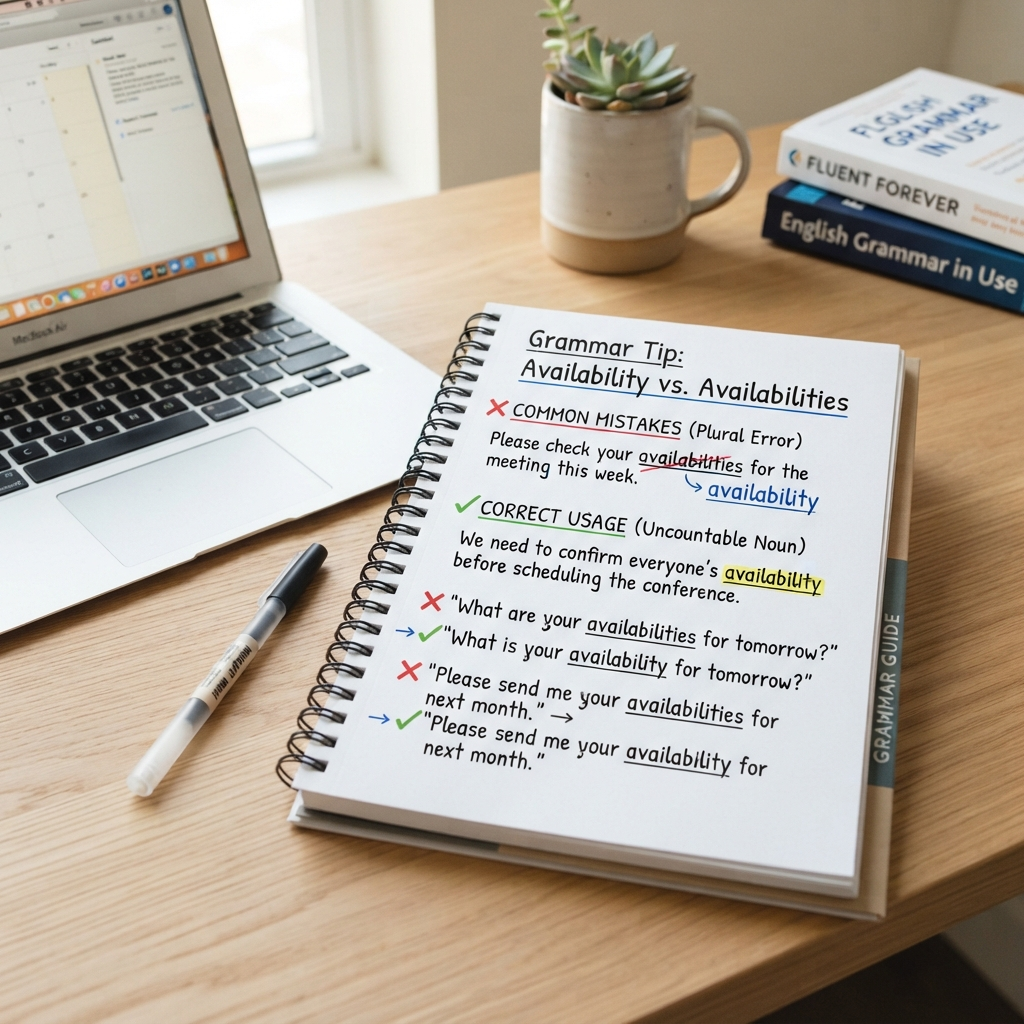
Mistake 1: Using “availabilities” for a person’s schedule
❌ Please send me your availabilities.
✅ Please send me your availability.
When talking about when a person is free, availability is normally used as an uncountable noun.
Mistake 2: Adding “an” before availability
❌ I have an availability tomorrow.
✅ I am available tomorrow.
✅ I have availability tomorrow.
The first sentence sounds unnatural in standard everyday English.
Mistake 3: Using “availabilities” for several time slots
❌ Please send your availabilities for the meeting.
✅ Please send your available times for the meeting.
You can also say:
✅ Please send me your availability for the meeting.
Mistake 4: Thinking British English uses another spelling
❌ British: availablity
❌ American: availability
There is no such UK/US spelling difference.
✅ British: availability
✅ American: availability
Mistake 5: Confusing “available” and “availability”
Available is an adjective.
Availability is a noun.
Examples:
- Is John available today?
- What is John’s availability today?
Availability or Availabilities in Everyday Examples
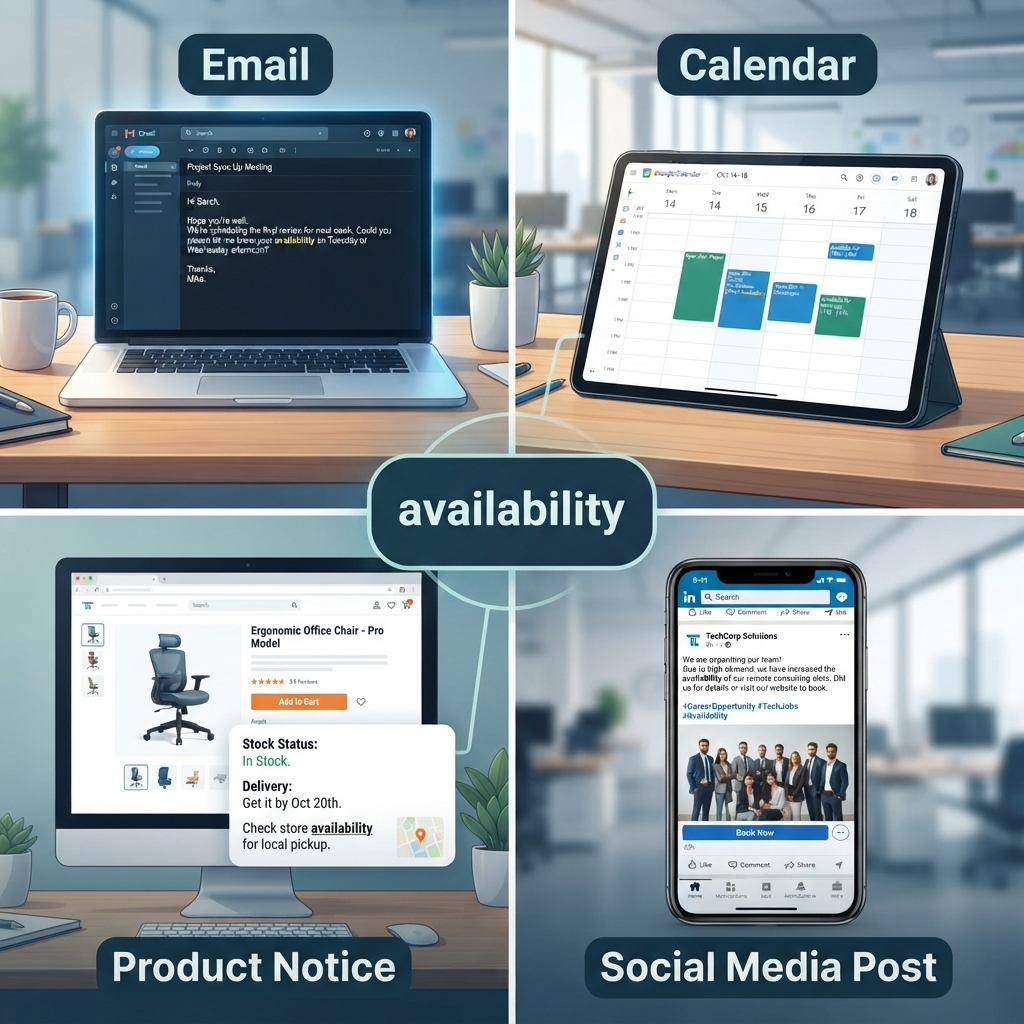
In Emails
Natural:
Please let me know your availability for next week.
Also natural:
Could you share your available times?
Avoid using availabilities unless you have a special reason to discuss separate availability types.
In News Writing
Natural:
Ticket availability remains limited for the event.
Natural:
The company announced that product availability would increase.
These sentences discuss availability as a general condition.
On Social Media
You might write:
Checking my availability before making weekend plans.
Or:
Limited availability — book early!
These uses are short and natural.
In Formal Writing
Example:
The study examined the availability of public transport in rural areas.
Example:
Product availability may vary by location.
Formal writing usually favors availability because it describes a general condition.
In Business Writing
Example:
Please confirm your availability before Friday.
Example:
We are reviewing staff availability for the upcoming project.
Availability or Availabilities – Google Trends & Usage Data
Search interest for availability is much broader because the word appears in many common situations.
People may search for it when they want information about:
- Job availability
- Product availability
- Hotel availability
- Appointment availability
- Ticket availability
- Meeting availability
- Service availability
- Room availability
Availabilities has a much narrower use. It may appear in technical, business, academic, or specialized writing where separate availability states are being discussed.
Usage can also vary by context. A person arranging a meeting is very likely to use availability, while a technical document may use the plural when discussing several distinct availability conditions.
For normal communication, availability is therefore the form most readers will expect.
Availability vs Availabilities: Side-by-Side Comparison
| Word | Number | Meaning | Common Use | Example |
|---|---|---|---|---|
| availability | Singular/uncountable | State of being available | Very common | Check my availability. |
| availabilities | Plural | Separate types or instances of availability | Rare | The system records different availabilities. |
| available | Adjective | Ready or free | Very common | I am available today. |
The easiest way to remember
Think of it this way:
Available = adjective
Availability = general state
Availabilities = separate availability types or cases
FAQs About Availability or Availabilities
1. Is “availability” correct?
Yes. Availability is the standard and most common noun form.
2. Is “availabilities” a real word?
Yes. Availabilities is a valid plural form, but it is uncommon in everyday English.
3. Should I say “my availability” or “my availabilities”?
Say my availability when discussing when you are free.
Example:
Please check my availability.
4. Is “availability” countable or uncountable?
Availability is usually used as an uncountable noun when it means the general state of being available.
5. Can I use “availabilities” in formal writing?
Yes, if you are talking about separate or different forms of availability. However, do not use it simply because you are talking about several available times.
6. Is there a British spelling of availability?
No. Availability is used in both British and American English.
7. Which is more common: availability or availabilities?
Availability is much more common in everyday and professional English.
Conclusion
The choice between availability or availabilities is usually simple once you understand how the words work. Availability is the normal choice when you mean the general state of being free, ready, accessible, or obtainable. It is widely used in emails, business writing, websites, news, and everyday conversations.
Availabilities is the plural form, but it has a much narrower use. It can describe separate types, cases, or conditions of availability. It is not normally used just because you are talking about several free times or options.
There is also no important British-versus-American spelling difference. Both varieties use availability and availabilities.
If you are writing a sentence and feel unsure, availability will usually be the right choice. For schedules, meetings, products, tickets, services, and general access, use availability. Use availabilities only when the context clearly requires a plural meaning.

Robert Walser creates meaningful English captions for funcaptionz.com, delivering creative wording, short ideas, and expressive lines for everyday inspiration..









