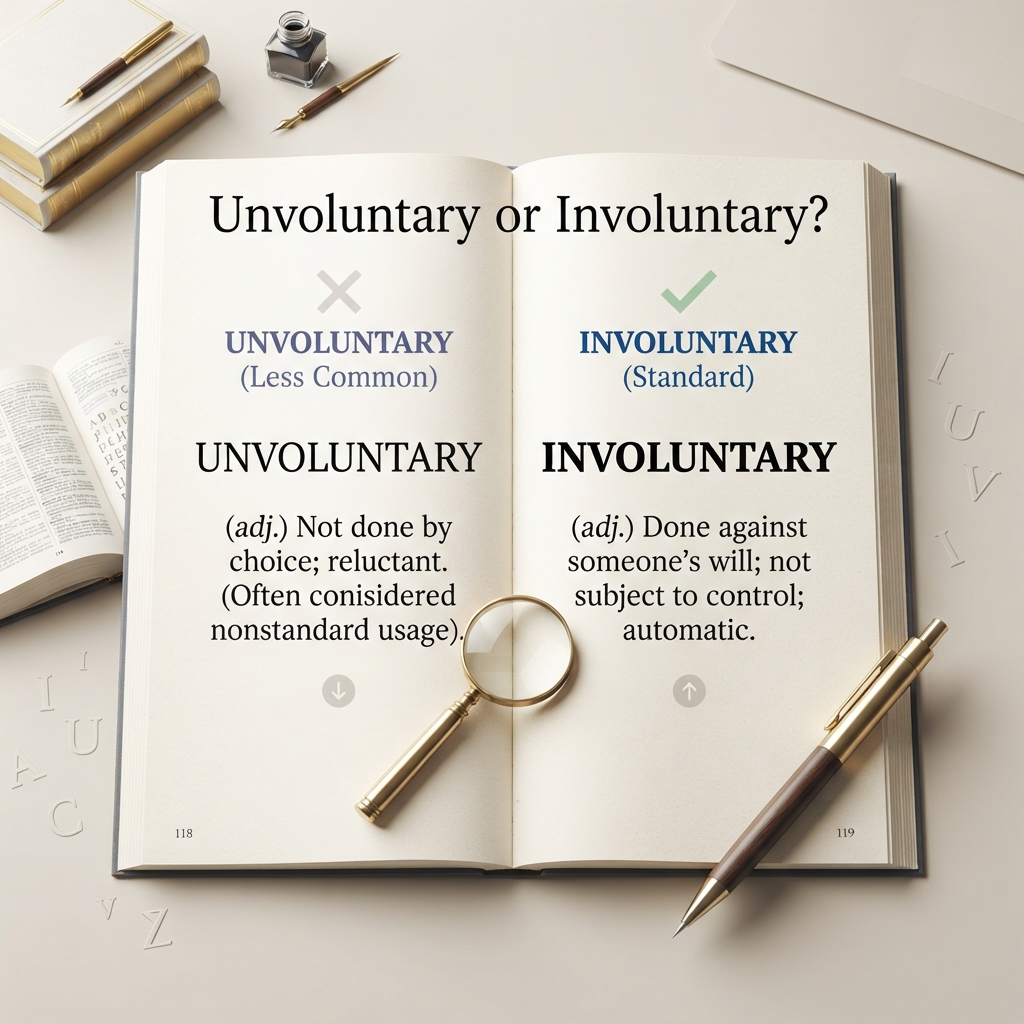
“Involuntary” is the correct English word. It means something that happens without conscious control or intention, while “unvoluntary” is not the standard word in modern English.
Unvoluntary or involuntary—which one is correct? If you’ve come across both forms and aren’t sure which one to use, the answer is simple: involuntary is the correct and standard English word. This small spelling mistake can easily slip into writing because “unvoluntary” may seem like a logical opposite of “voluntary,” but it isn’t the form normally used in standard English.
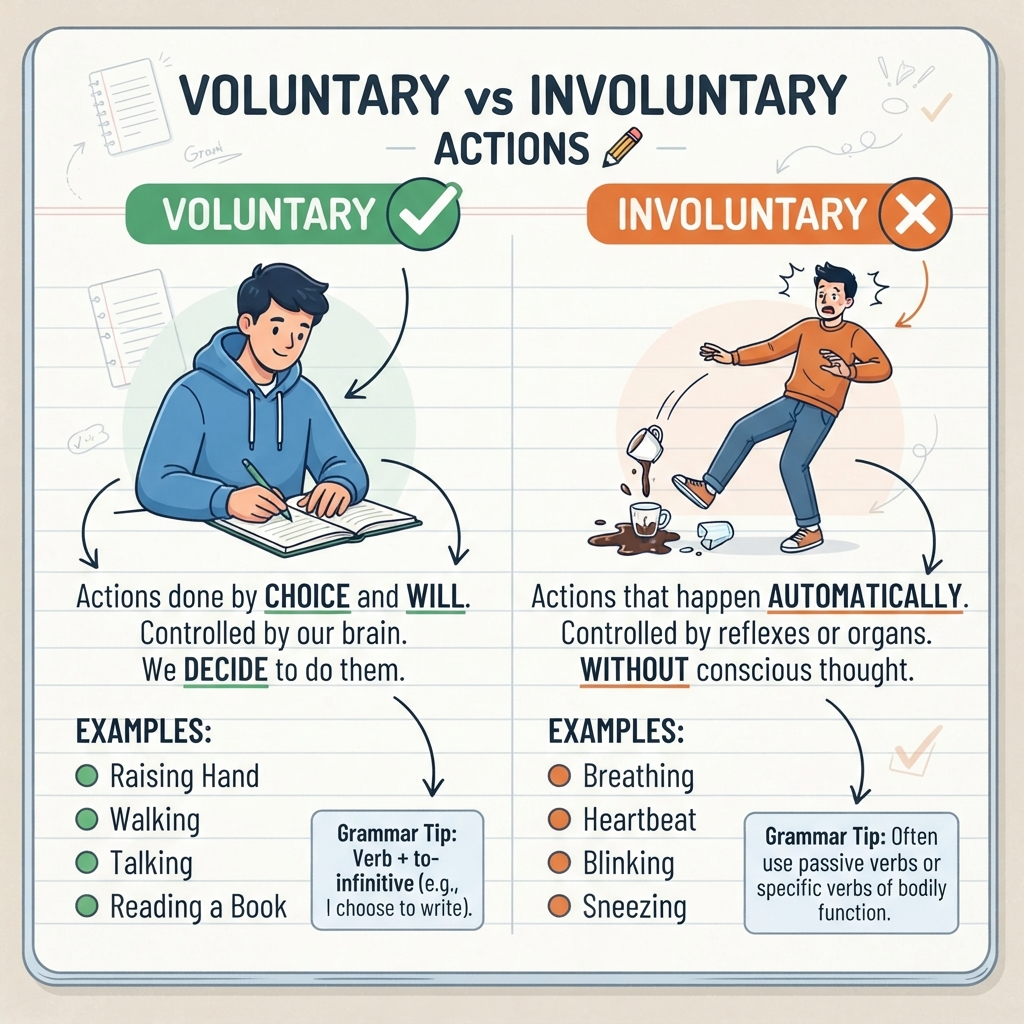
Involuntary describes something that happens without deliberate choice, conscious control, or intention. For example, blinking, sneezing, or a sudden reflex can be described as involuntary. You can also use it in phrases such as “involuntary movement,” “involuntary reaction,” and “involuntary response.”
On the other hand, unvoluntary is not the standard choice for everyday English, formal writing, academic work, or professional content. Choosing the established word involuntary will make your sentence clearer and more natural to English readers.
If you’ve been confused by these two words, don’t worry—the difference is easier to remember once you understand how each form is used. In this guide, you’ll discover the meaning of involuntary, why unvoluntary is generally avoided, correct sentence examples, common mistakes, and a simple way to remember which word to choose whenever this confusing pair comes up.
Unvoluntary or Involuntary meanings
Involuntary is the correct and standard word.
It describes something that happens without conscious choice, intention, or control.
Correct
- She gave an involuntary smile.
- His hand made an involuntary movement.
- Breathing is partly involuntary.
- The reaction was involuntary.
Usually Incorrect or Nonstandard
- She gave an unvoluntary smile.
- He made an unvoluntary movement.
The main difference is simple:
| Word | Standard English? | Meaning |
|---|---|---|
| Involuntary | Yes | Done without conscious choice or control |
| Unvoluntary | No / Rare | Nonstandard alternative to involuntary |
So, when you mean “not voluntary”, choose involuntary.
The Origin of Involuntary
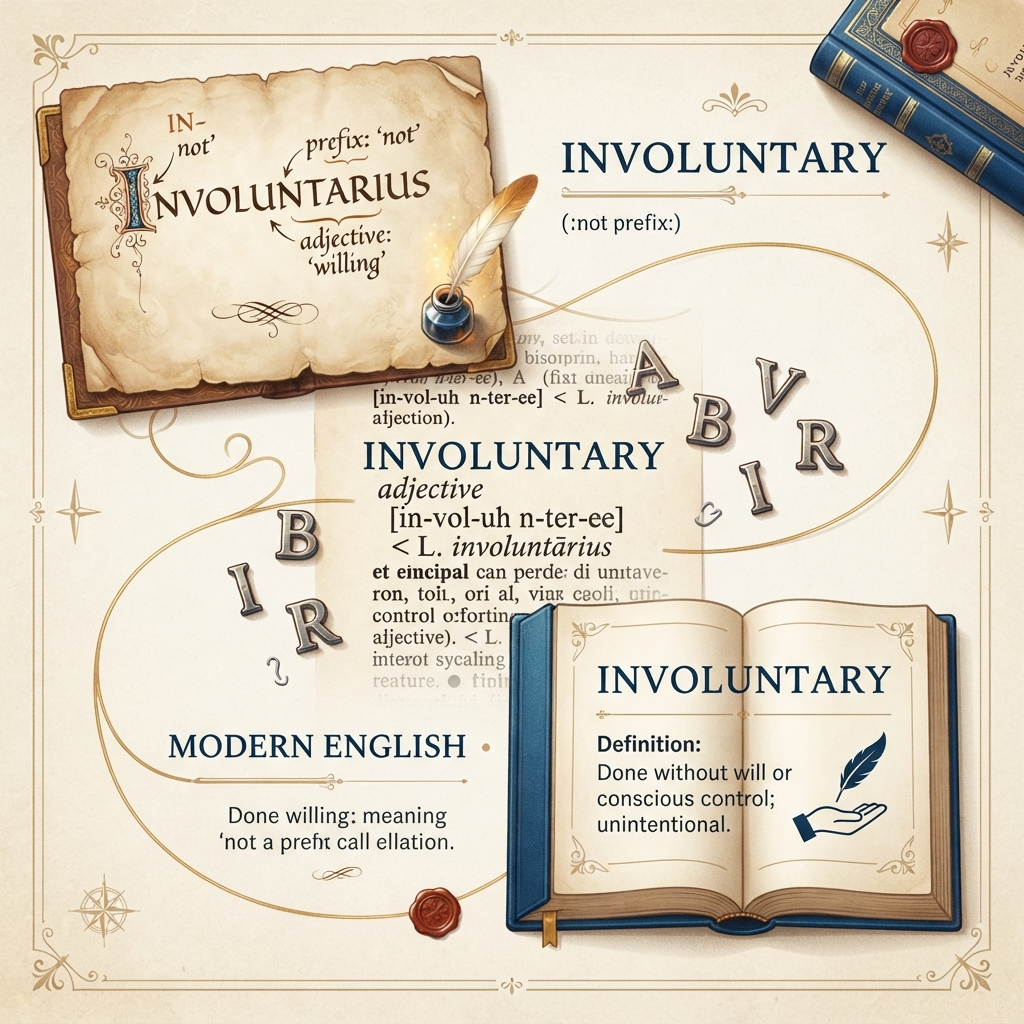
The word involuntary comes from Latin roots.
It is built from in-, meaning “not,” and voluntary, which relates to choice or free will. The word developed through Latin and later French before becoming part of English.
The word voluntary is linked to the Latin word voluntarius, meaning something done by choice or free will.
Adding in- changes the meaning:
voluntary → involuntary
The basic idea becomes:
chosen → not chosen
This explains why English uses involuntary rather than normally using “unvoluntary.”
English has many words that use prefixes such as in-, im-, il-, and ir- to create an opposite meaning.
Examples include:
- visible → invisible
- possible → impossible
- legal → illegal
- regular → irregular
- voluntary → involuntary
This pattern is one reason involuntary became the established English form.
British English vs American English Spelling
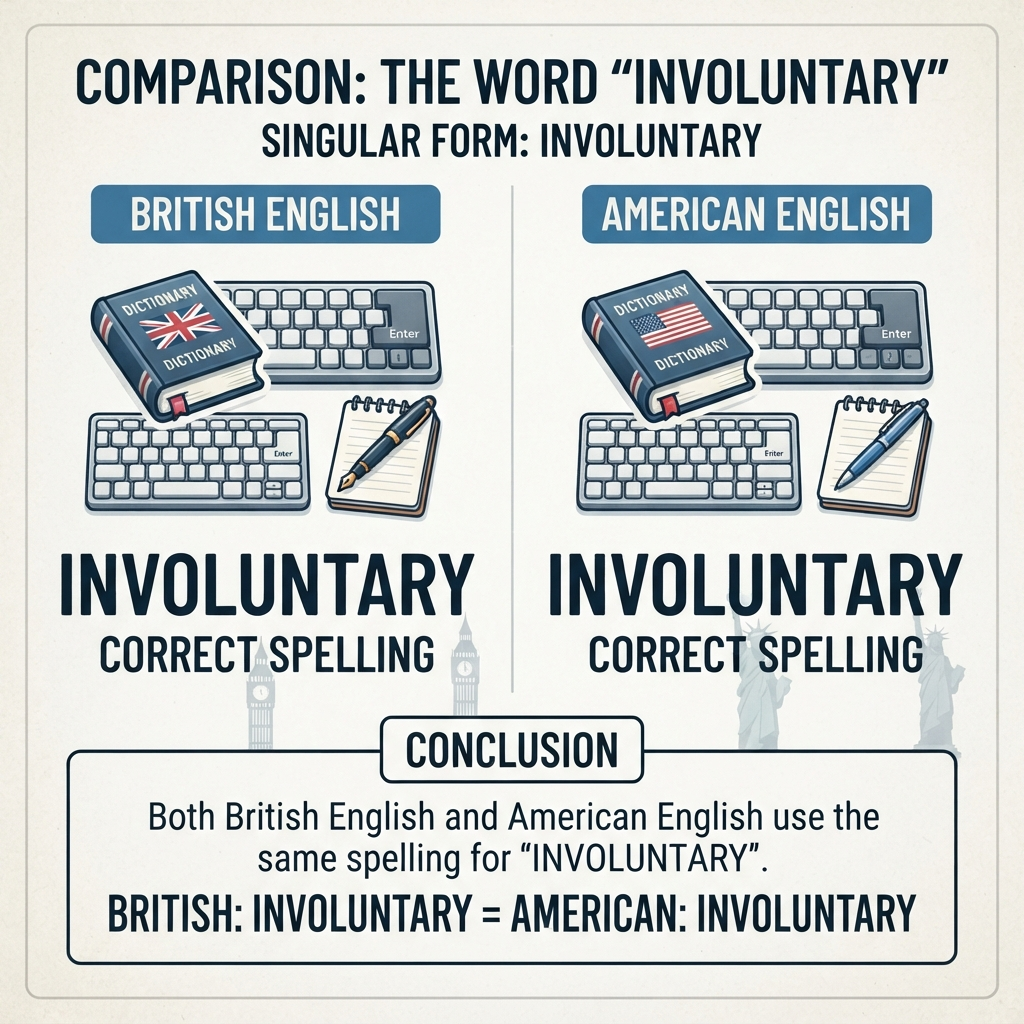
There is no major British-American spelling difference for this word.
Both American English and British English use:
involuntary
The spelling stays the same in both varieties.
| Meaning | American English | British English |
|---|---|---|
| Not done by choice | involuntary | involuntary |
| Done by choice | voluntary | voluntary |
| Incorrect/nonstandard alternative | unvoluntary | unvoluntary |
Examples in American English
He made an involuntary movement.
She gave an involuntary laugh.
Examples in British English
He made an involuntary movement.
She gave an involuntary laugh.
So, unlike words such as color/colour or center/centre, there is no standard US-versus-UK spelling issue here.
Which Spelling Should You Use?
Use involuntary in almost every situation.
For US English
If your audience is in the United States, use involuntary.
Example:
The patient experienced an involuntary muscle movement.
For UK and Commonwealth English
Use involuntary in British English and other varieties that follow British spelling.
Example:
She gave an involuntary gasp.
For Global English
Involuntary is also the safest choice for international readers.
It is widely understood and works well in:
- Business writing
- Academic writing
- Websites
- Emails
- News articles
- Social media
- Formal documents
If you are unsure, remember one simple rule:
Write “involuntary.”
Common Mistakes with Unvoluntary or Involuntary
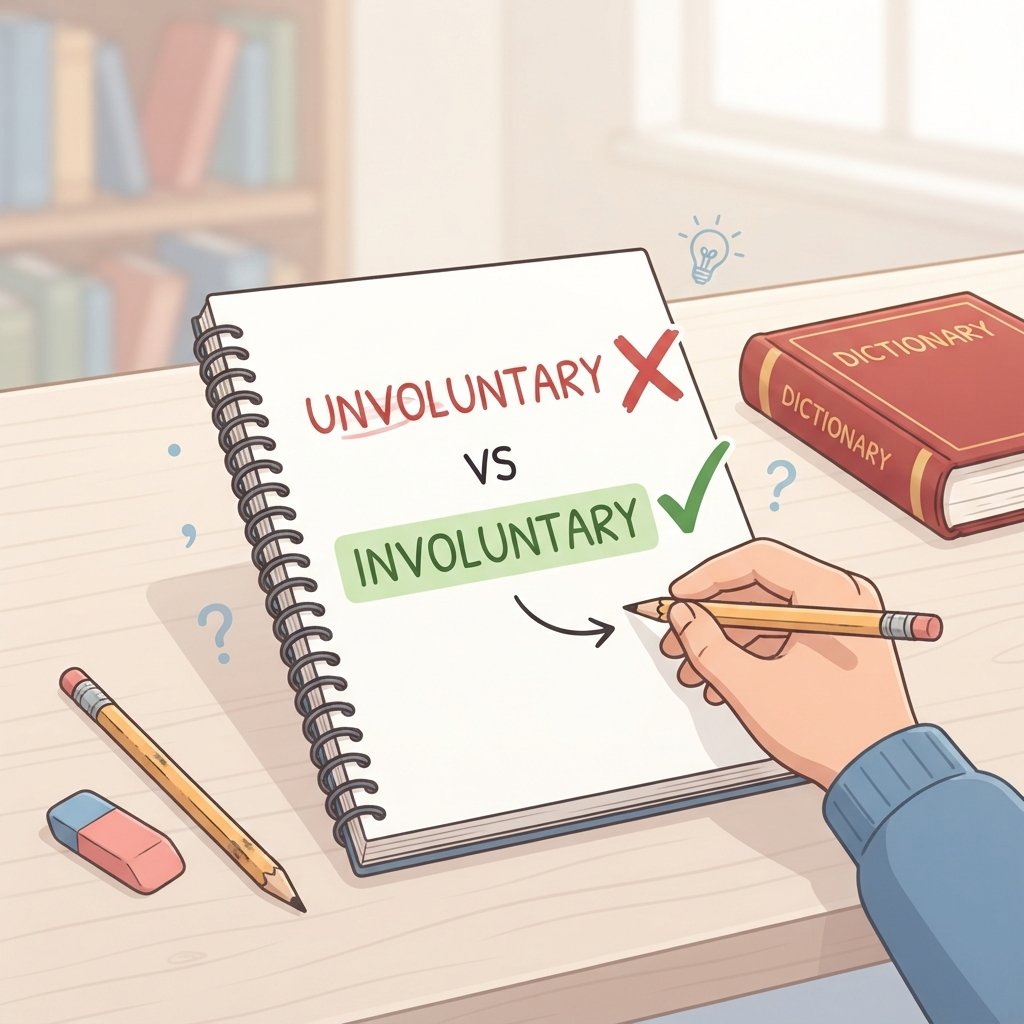
People often make a few simple mistakes with this word.
1. Writing “unvoluntary”
Wrong:
He made an unvoluntary movement.
Correct:
He made an involuntary movement.
2. Confusing involuntary with voluntary
Voluntary means something is done by choice.
Involuntary means something happens without conscious choice or control.
Example:
She made a voluntary decision to leave.
Her sudden smile was involuntary.
3. Adding “un-” to voluntary
English does not always form opposites by simply adding un-.
Although unvoluntary may look logical, involuntary is the established standard word.
4. Using the wrong spelling in formal writing
“Unvoluntary” can look unusual or incorrect to readers.
For professional writing, choose the standard form:
involuntary
Involuntary in Everyday Examples

The word involuntary appears in many areas of everyday English.
In Emails
The delay was caused by an involuntary change in the schedule.
In News Writing
The athlete made an involuntary movement during the event.
On Social Media
That was an involuntary laugh! 😂
In Formal Writing
The study examined involuntary responses to external sounds.
In Everyday Conversation
I gave an involuntary smile when I saw the surprise.
In Education
Blinking is an involuntary action that helps protect the eyes.
In Workplace Writing
The employee’s absence was due to an involuntary change in circumstances.
The word works well when you want to explain that an action was not planned, chosen, or consciously controlled.
Unvoluntary or Involuntary – Google Trends & Usage Data
Searches for “unvoluntary or involuntary” usually come from people checking spelling or trying to decide which word is correct.
The search intent is mainly about word choice, not about a difference in meaning between two equally accepted words.
In general English usage, involuntary is the established form. It appears in dictionaries, formal writing, news language, academic writing, and everyday communication.
Unvoluntary has much lower visibility and may appear in unusual, historical, or nonstandard contexts.
Search interest can also vary by country. English learners and writers in different regions may search the phrase when they encounter the less common form.
For practical writing, popularity should not be the only concern. The important point is whether the word is accepted as standard modern English.
For that reason, involuntary is the form to use in normal writing.
Unvoluntary vs Involuntary: Side-by-Side Comparison
| Feature | Unvoluntary | Involuntary |
|---|---|---|
| Standard modern English | No / Rare | Yes |
| Common in dictionaries | Not normally used as the standard form | Yes |
| Meaning intended | Not voluntary | Not voluntary |
| Recommended for formal writing | No | Yes |
| Recommended for emails | No | Yes |
| Recommended for social media | Better avoided | Yes |
| US English | Avoid | Use |
| British English | Avoid | Use |
| Global English | Avoid | Use |
| Best choice | ❌ | ✅ |
FAQs About Unvoluntary or Involuntary
1. Is “unvoluntary” a correct word?
Involuntary is the standard modern English word. “Unvoluntary” is rare and nonstandard, so it is best avoided in normal writing.
2. Is it involuntary or unvoluntary?
The correct choice is involuntary.
Example:
He made an involuntary movement.
3. What does involuntary mean?
Involuntary means something happens without conscious choice, intention, or control.
4. Is involuntary the opposite of voluntary?
Yes. Voluntary describes something done by choice, while involuntary describes something not consciously chosen or controlled.
5. Can I use “unvoluntary” in formal writing?
It is better not to. Use involuntary in formal, academic, professional, and public writing.
6. Do Americans and British people spell involuntary differently?
No. Involuntary has the same standard spelling in American and British English.
7. Why does “unvoluntary” look correct?
It looks logical because English often uses un- to create opposites. However, English has established the word involuntary as the standard form.
Conclusion
When choosing between unvoluntary or involuntary, the answer is clear: involuntary is the standard English word.
Use involuntary when you want to describe an action, reaction, movement, or event that happens without conscious choice or control. For example, an involuntary smile happens naturally rather than because someone deliberately decides to smile.
The word is used in both American and British English, so you do not need a different spelling for either variety. It is also the safest choice for global English, professional writing, emails, academic work, news content, and everyday communication.
Although unvoluntary may occasionally appear, it is not the normal modern form. Its appearance can make writing look unusual or incorrect.
The easiest rule to remember is:
Voluntary = chosen.
Involuntary = not consciously chosen.
So, whenever you are unsure, choose involuntary.

Storm Jameson writes engaging English captions for funcaptionz.com, sharing creative wording, short ideas, and expressive lines for modern readers online Today.









