
Immerse is the correct English spelling when you mean to become deeply involved in something or to put something completely into a liquid. “Emerse” is not the standard spelling for these meanings.
Emerse or immerse—which one is correct? If you’ve ever hesitated before typing this word, you’re not alone. These two spellings look almost identical, but choosing the wrong one can make your writing appear careless or confusing. The good news is simple: immerse is the standard English word you need in ordinary writing.
Immerse means to involve yourself deeply in an activity, subject, culture, or experience, or to place something completely under a liquid. For example, you might say, “She wants to immerse herself in French culture,” or “Immerse the cloth in warm water.” In contrast, emerse is not the standard spelling for these common meanings, so it is usually a spelling mistake when used in place of immerse.
The easiest way to remember emerse vs. immerse is to connect immerse with the idea of going deeply into something—whether it is an experience, subject, or liquid. This simple connection can help you avoid the mistake in essays, emails, articles, assignments, and everyday writing.
In this guide, you’ll discover the exact difference between emerse and immerse, their meanings, correct pronunciation, example sentences, common mistakes, and practical tips for remembering the correct spelling. By the end, you’ll know exactly when to use immerse and why emerse is usually the wrong choice.
Emerse or Immerse meanings
The correct spelling is immerse.
Immerse is a verb that means to become deeply involved in something or to put something completely into a liquid.
Correct:
- I want to immerse myself in English.
- She immersed herself in the new culture.
- The instructions say to immerse the cloth in water.
Incorrect:
- I want to emerse myself in English.
- She emerse herself in the new culture.
Emerse is not the standard spelling when you mean “to immerse.”
The easiest way to remember it is:
Immerse = correct
Think of immerse as having “imm” at the beginning.
The Origin of Emerse or Immerse

The word immerse comes from Latin. It is linked to the Latin word immergere, which means “to plunge into” or “to dip into.”
The word later entered English through French and Latin-based forms. Its original idea was closely connected with putting something deep into water or another liquid.
Over time, immerse developed a wider meaning.
Today, it can describe both a physical action and a mental or emotional experience.
For example:
- Physical: Immerse the paper in water.
- Mental: Immerse yourself in a book.
- Cultural: Immerse yourself in a new culture.
- Educational: Immerse yourself in English practice.
The spelling emerse can appear because people often spell words based on how they sound. However, standard English uses immerse for this meaning.
There is also a separate word, emerge, which means to come out or become visible. This may add to the confusion because emerge and immerse sound somewhat similar.
British English vs American English Spelling
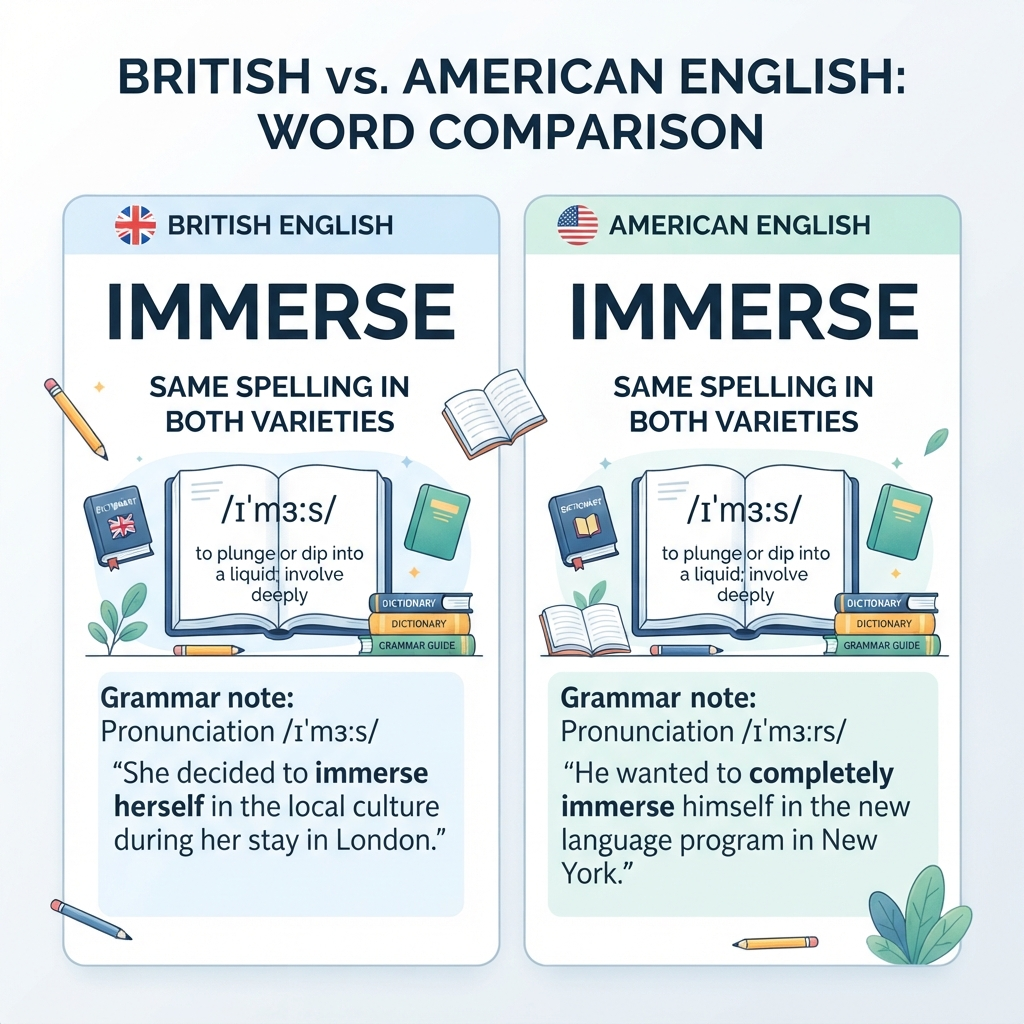
There is no major British-American spelling difference between immerse and immerse.
Both British English and American English use:
immerse
The spelling remains the same in both forms of English.
| Meaning | British English | American English |
|---|---|---|
| Put into liquid | immerse | immerse |
| Become deeply involved | immerse | immerse |
| Past tense | immersed | immersed |
| -ing form | immersing | immersing |
| Noun | immersion | immersion |
| Incorrect form | emerse | emerse |
So, if you write for readers in the UK, USA, Canada, Australia, or other English-speaking regions, immerse is the safe standard form.
Examples in Both Varieties
British English:
She decided to immerse herself in the local culture.
American English:
She decided to immerse herself in the local culture.
The sentence stays the same.
This makes immerse easier to remember than many English words that have different US and UK spellings.
Which Spelling Should You Use?
Use immerse.
For US English
Use immerse in:
- School assignments
- Emails
- Articles
- Business writing
- Social media
- Websites
- Academic work
Example:
Students can immerse themselves in English by reading every day.
For UK English
Use immerse as well.
Example:
Visitors can immerse themselves in the local culture.
For Commonwealth English
Countries such as Canada, Australia, and New Zealand also use immerse.
Example:
The program helps students immerse themselves in another language.
For Global English
If your writing is meant for an international audience, immerse is the correct choice.
There is no need to change the spelling based on your audience.
Quick Rule
If you mean “to become deeply involved” or “to put completely into liquid,” write immerse.
Common Mistakes with Emerse or Immerse

The most common mistake is leaving out the first m.
Mistake 1: Emerse
❌ I want to emerse myself in the language.
✅ I want to immerse myself in the language.
The correct spelling contains imm at the beginning.
Mistake 2: Emerced
❌ He emersed himself in the book.
✅ He immersed himself in the book.
The past form is immersed.
Mistake 3: Emersing
❌ She is emersing herself in her studies.
✅ She is immersing herself in her studies.
The -ing form is immersing.
Mistake 4: Mixing It With Emerge
Emerge and immerse have different meanings.
Emerge means to come out or become visible.
The sun began to emerge from the clouds.
Immerse means to become deeply involved or to put something into liquid.
She wanted to immerse herself in the new language.
Mistake 5: Using Immerse Without “Yourself”
You can use immerse with an object:
Immerse the cloth in water.
You can also use it with a reflexive pronoun:
Immerse yourself in the experience.
Both forms are correct.
Immerse in Everyday Examples
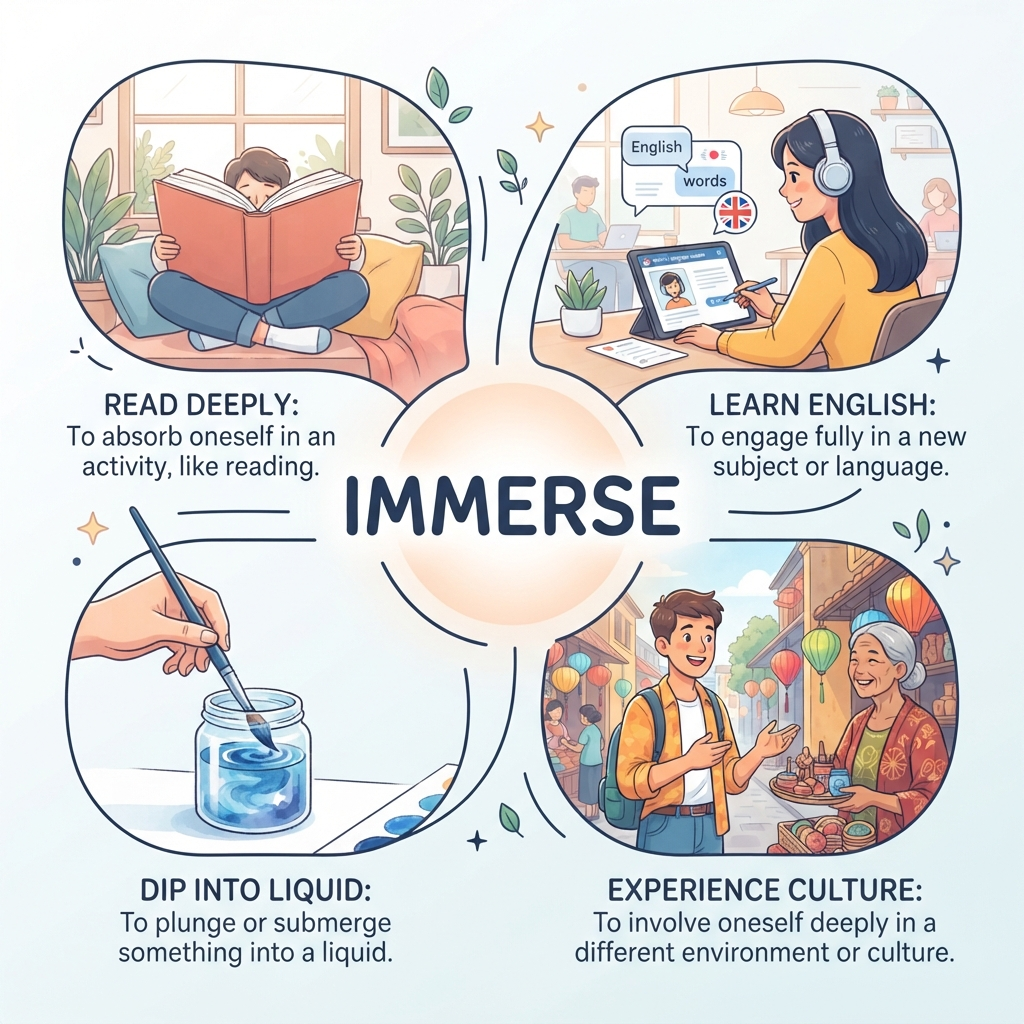
The word immerse appears in many types of everyday writing. It is common in education, travel, entertainment, business, and personal writing.
In Emails
You may use immerse when talking about learning or training.
We encourage new employees to immerse themselves in the company culture.
Another example:
Try to immerse yourself in the language before your trip.
In News Writing
News articles may use immerse when discussing culture, education, travel, or experiences.
The program allows students to immerse themselves in local traditions.
In Social Media
The word can make captions sound natural and expressive.
Time to immerse myself in a good book.
Or:
New city, new culture, new memories. I am ready to immerse myself in it all.
In Formal Writing
Immerse is also suitable for formal and academic writing.
Students should immerse themselves in a wide range of reading materials.
In Education
Language teachers often use this word.
Immersing yourself in English can help you become more comfortable with the language.
In Travel Writing
Travel content often uses immerse to describe experiencing another culture.
Travelers can immerse themselves in the local food, history, and traditions.
Emerse or Immerse – Google Trends & Usage Data
Search behavior shows why emerse or immerse can be a useful spelling question. People often search both versions when they are unsure which spelling is correct.
The two forms do not have equal status in standard English.
Immerse is the established English spelling and is widely used in dictionaries, books, websites, education, and professional writing.
Emerse may appear in searches because people are checking a spelling they have seen, heard, or guessed.
Search interest can also vary by country and context. English learners may be more likely to search spelling questions, while native speakers may encounter the word through education, travel, books, or online content.
A key point is that search frequency does not decide whether a spelling is correct. A word can receive searches simply because people are unsure about it.
For normal English writing, the standard choice remains:
Immerse
Emerse vs Immerse: Comparison Table
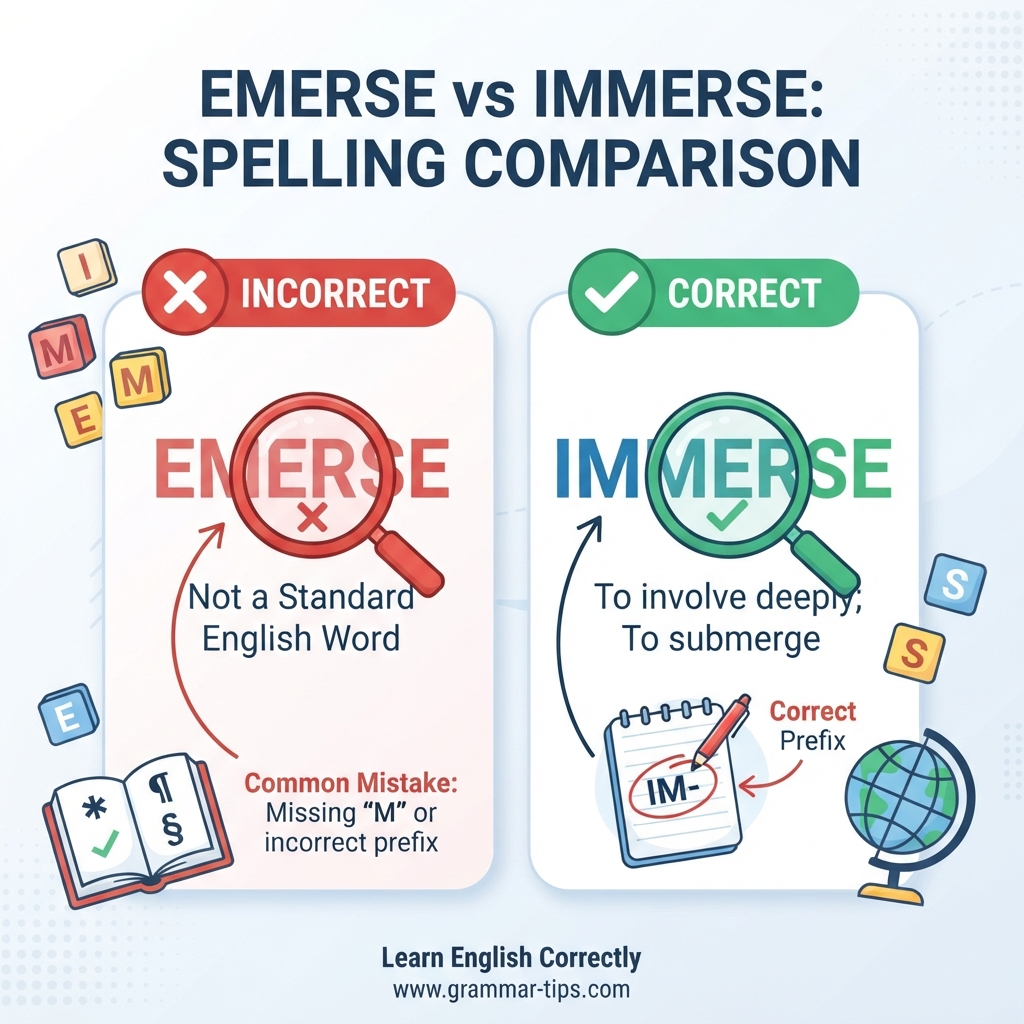
| Variation | Correct? | Meaning | Example |
|---|---|---|---|
| immerse | ✅ Yes | Become deeply involved | Immerse yourself in the language. |
| immersed | ✅ Yes | Past form | She was immersed in her work. |
| immersing | ✅ Yes | -ing form | He is immersing himself in study. |
| immersion | ✅ Yes | Deep involvement | Language immersion can be helpful. |
| emerse | ❌ No for this meaning | Common spelling mistake | Avoid this spelling. |
| emersed | ❌ No for this meaning | Common spelling mistake | Use immersed instead. |
| emersing | ❌ No for this meaning | Common spelling mistake | Use immersing instead. |
How to Remember Immerse
A simple memory trick can help.
Remember:
IM + MERSE = IMMERSE
The word starts with IMM.
You can also connect it with the idea of going into something.
Immerse = go deeply into something
For example:
- Immerse yourself in a book.
- Immerse yourself in a language.
- Immerse yourself in a culture.
- Immerse the object in water.
If you remember “deep into”, you are more likely to remember immerse.
FAQs About Emerse or Immerse
1. Is “emerse” a correct word?
For the meaning normally intended in “emerse or immerse,” no. The standard English spelling is immerse.
2. Is it “immerse” or “emerse”?
It is immerse. Use it when you mean becoming deeply involved in something or putting something completely into liquid.
3. What does immerse mean?
Immerse means to involve yourself deeply in something or to put something completely into a liquid.
Example:
She immersed herself in her studies.
4. What is the past tense of immerse?
The past tense is immersed.
Example:
He immersed himself in the project.
5. Is “immersing” correct?
Yes. Immersing is the correct -ing form of immerse.
Example:
She is immersing herself in a new language.
6. Do British people spell it “emerse”?
No. British English uses immerse, just like American English.
7. Why do people spell immerse as emerse?
The mistake often happens because immerse can sound like it starts with an “e” sound when spoken quickly. People may then leave out one m when writing it.
Conclusion
When choosing between emerse or immerse, the correct standard spelling is immerse. This spelling is used in both British English and American English, so you do not need to change it based on your audience.
Immerse can mean putting something completely into liquid, but it is also commonly used in a broader sense. You can immerse yourself in a book, language, culture, subject, activity, or experience.
The spelling emerse is a common error that often comes from the way immerse sounds. Remember that the correct word begins with imm.
Use immerse, immersed, immersing, and immersion in your writing. Whether you are writing an email, school assignment, social media post, news article, or formal document, immerse is the spelling to choose.
A quick memory rule is simple: immerse means to go deeply into something. Once you remember that idea, the spelling becomes much easier.

Stella Gibbons writes creative English captions for funcaptionz.com, blending wit, clarity, and short ideas to inspire readers across social platforms daily use









