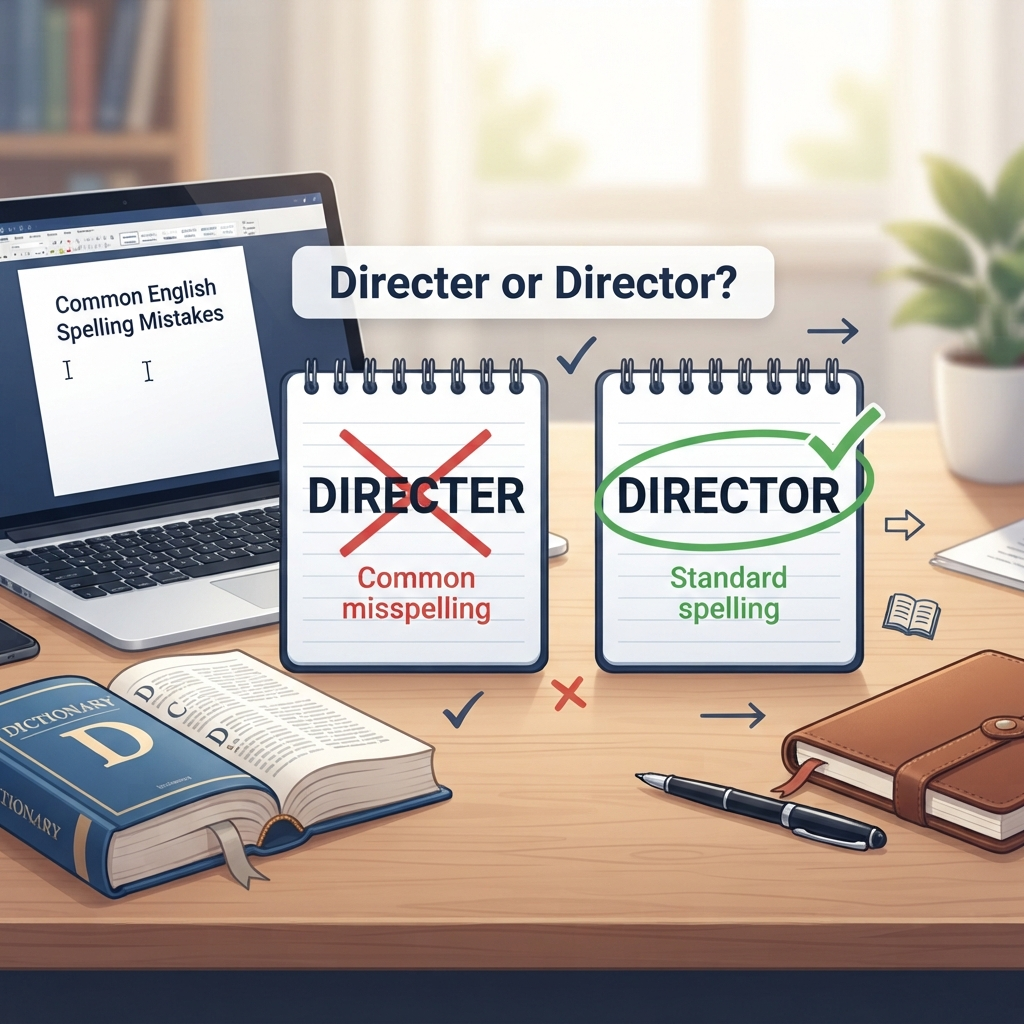
“Director” is the correct English spelling, while “directer” is generally considered incorrect. Use “director” when referring to a person who directs a film, organization, project, or activity.
Directer or director—which spelling is correct? If you’ve ever hesitated before typing this word, you’re not alone. The two spellings look surprisingly similar, but only one is the standard form used in modern English: director. Knowing the difference is important because a small spelling mistake can make otherwise polished writing look careless.
The word director describes someone who directs or manages something. You might use it for a person who leads a company department, directs a movie, supervises a project, or guides an organization. For example, “The director approved the final plan” is correct. Directer, on the other hand, is not the standard spelling you should choose in normal English writing.
So why does this confusion happen? The word direct may make “directer” seem like the natural form, but English word formation does not always work exactly as pronunciation suggests. The established noun is director, and this is the spelling you’ll find in dictionaries and standard professional writing.
Whether you’re writing an assignment, résumé, email, article, report, or business document, choosing the right form matters. In this guide, you’ll learn directer vs. director in detail, including their meanings, pronunciation, word origins, correct usage, example sentences, common mistakes, and practical tips for remembering the correct spelling.
By the end, you’ll have a simple rule to remember: when you mean a person who directs, write director—not “directer.”
Directer or Director meanings
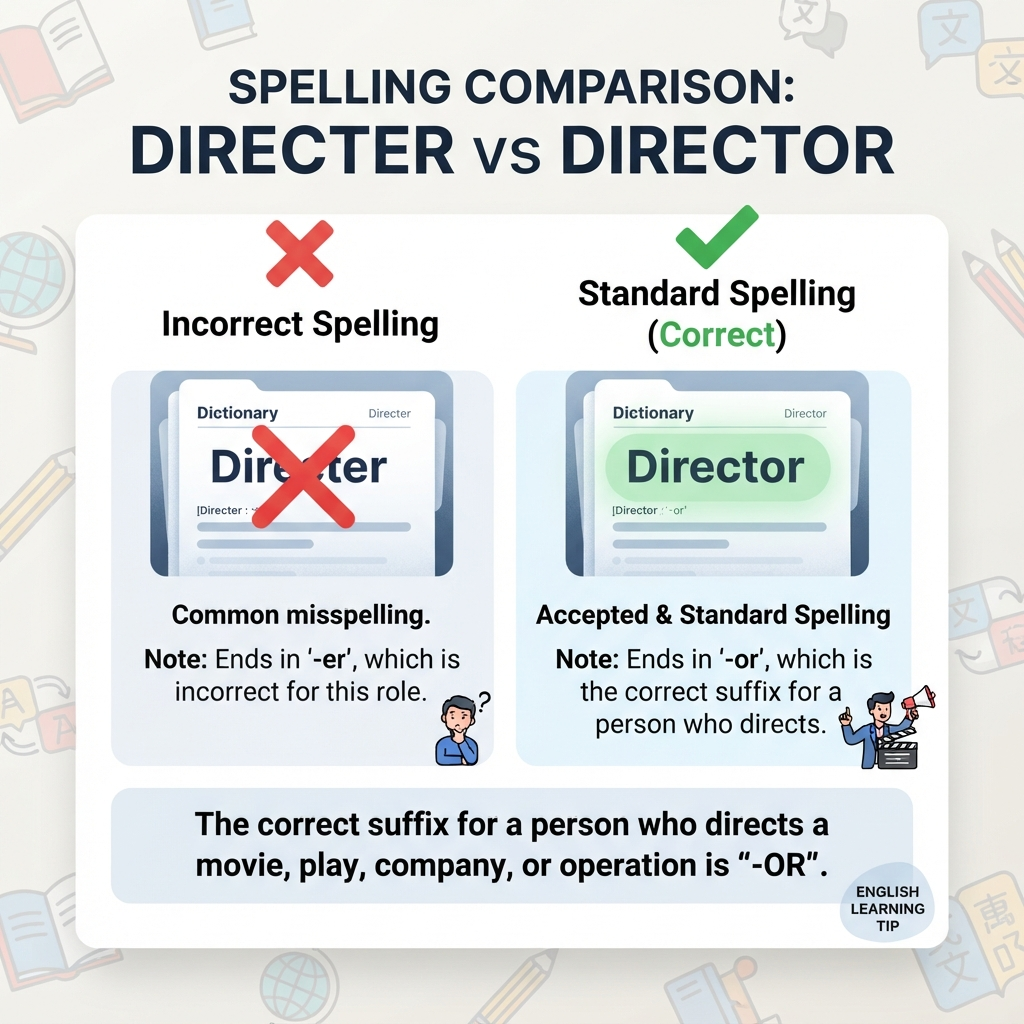
Director is the correct and standard spelling.
Directer is generally considered a misspelling when you mean a person who directs something.
Correct:
- The director of the company gave a speech.
- She is a famous movie director.
- The school director welcomed the guests.
- He works as a director at a large company.
Incorrect:
- She is a movie directer.
- The company directer called a meeting.
The confusion is understandable because the verb is direct. However, English does not always form a person noun by simply adding -er.
For example:
- direct → director
- inspect → inspector
- act → actor
- translate → translator
So, when you mean a person who directs, use director.
Quick answer: Director ✅ | Directer ❌
The Origin of Director
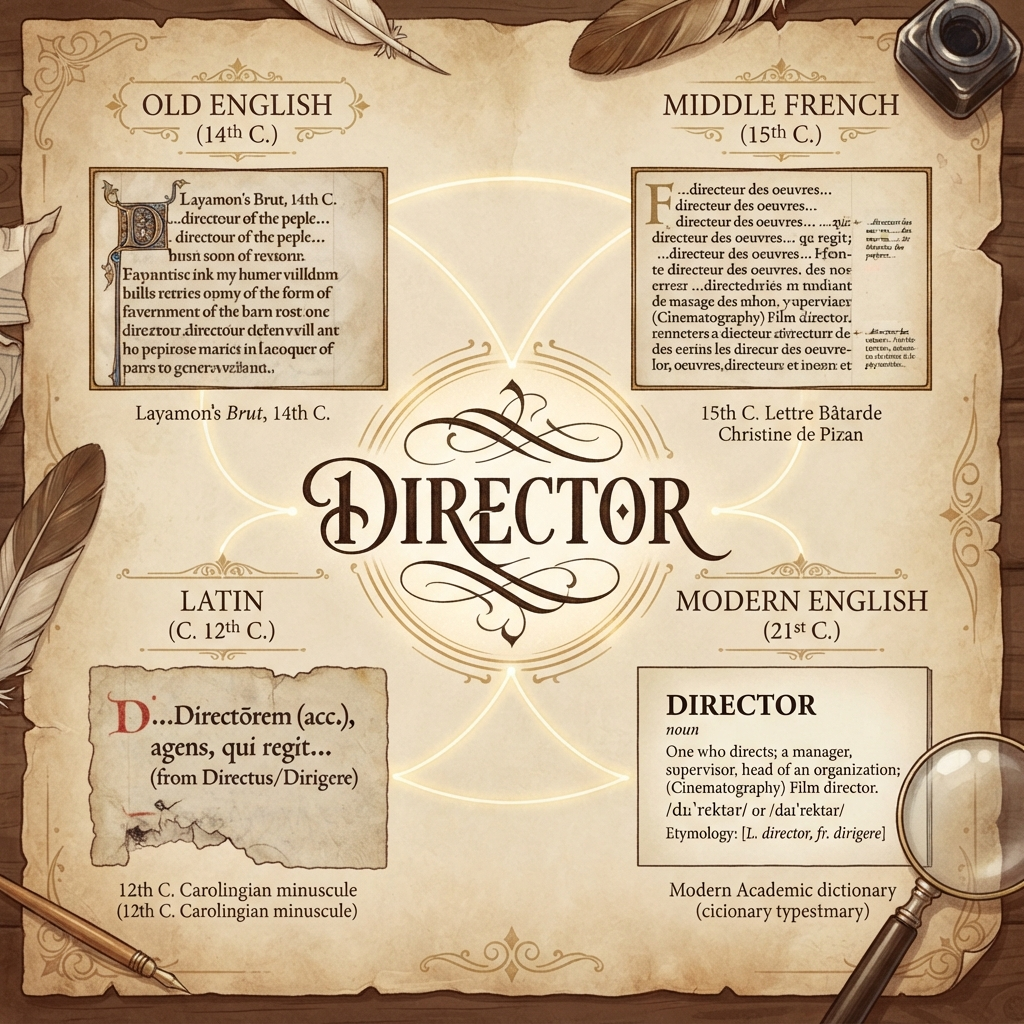
The word director comes from Latin. It is related to the Latin word dirigere, which means “to guide,” “to direct,” or “to set straight.”
The word entered English through French and developed into director.
The ending -or is common in English words that describe a person who performs an action or has a particular role.
For example:
- act → actor
- create → creator
- govern → governor
- supervise → supervisor
- direct → director
This helps explain why directer is not the usual form.
The English verb direct has been used for centuries. Over time, director became the established noun for a person who directs.
Today, the word can describe many different roles. A director may lead a business, manage an organization, guide a film production, oversee a school, or lead a department.
The spelling has remained director in both British and American English.
British English vs American English Spelling
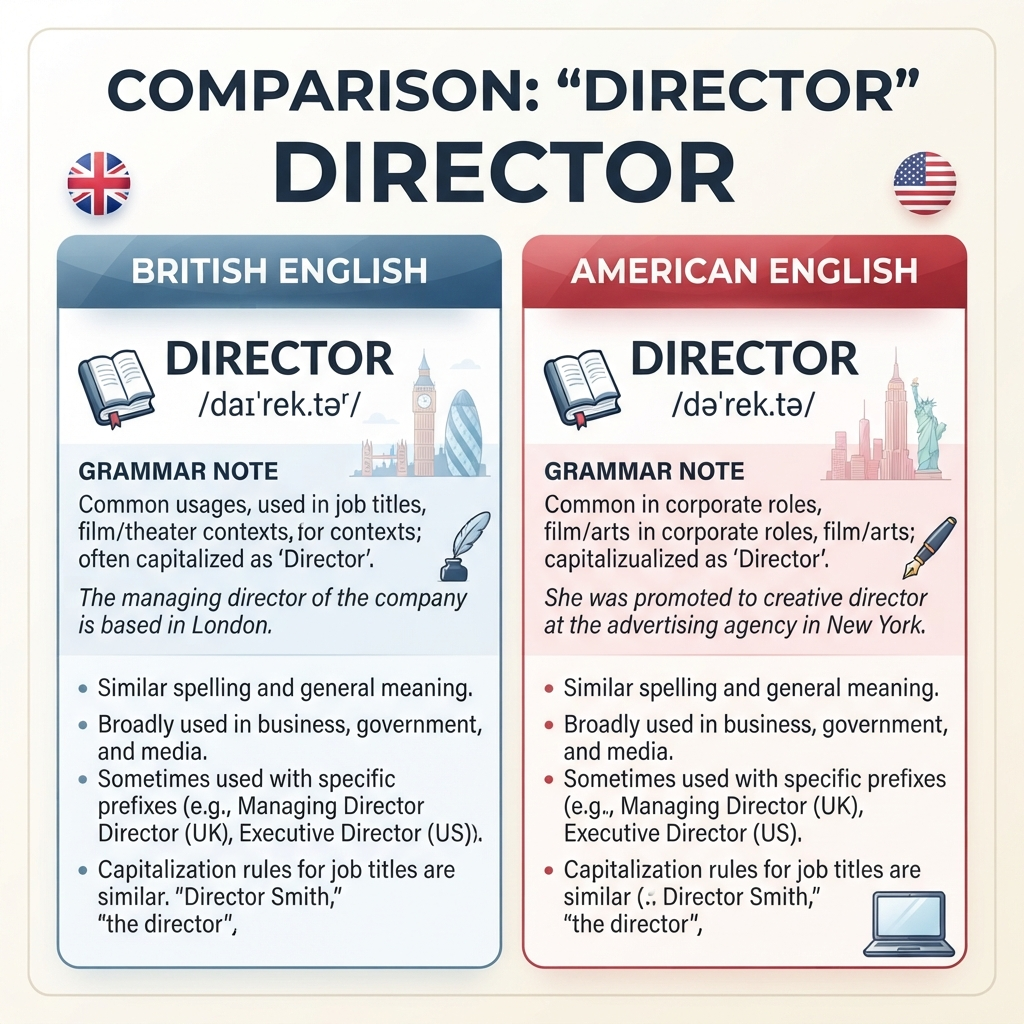
There is no spelling difference between British and American English for director.
Both use:
director
The form directer is not the normal standard spelling in either variety.
| English Variety | Standard Spelling | Example |
|---|---|---|
| British English | director | The director joined the meeting. |
| American English | director | The director joined the meeting. |
| Canadian English | director | She became a company director. |
| Australian English | director | The film director spoke today. |
| New Zealand English | director | The director approved the plan. |
| Global English | director | He is the project director. |
So, unlike words such as colour/color or centre/center, this is not a British-versus-American spelling issue.
If you write director, your spelling is correct for both major forms of English.
Which Spelling Should You Use?
The simple answer is: use director.
For US English
Use director in:
- Business writing
- School assignments
- Emails
- Resumes
- News writing
- Film reviews
- Professional documents
Example:
She was appointed director of marketing.
For UK English
Use director in the same situations.
Example:
He is the director of the company.
For Commonwealth English
Countries such as Canada, Australia, and New Zealand also commonly use director.
For Global English
If you write for an international audience, director is the safest and standard choice.
There is no need to change it to directer based on your audience.
Common Mistakes with Directer or Director
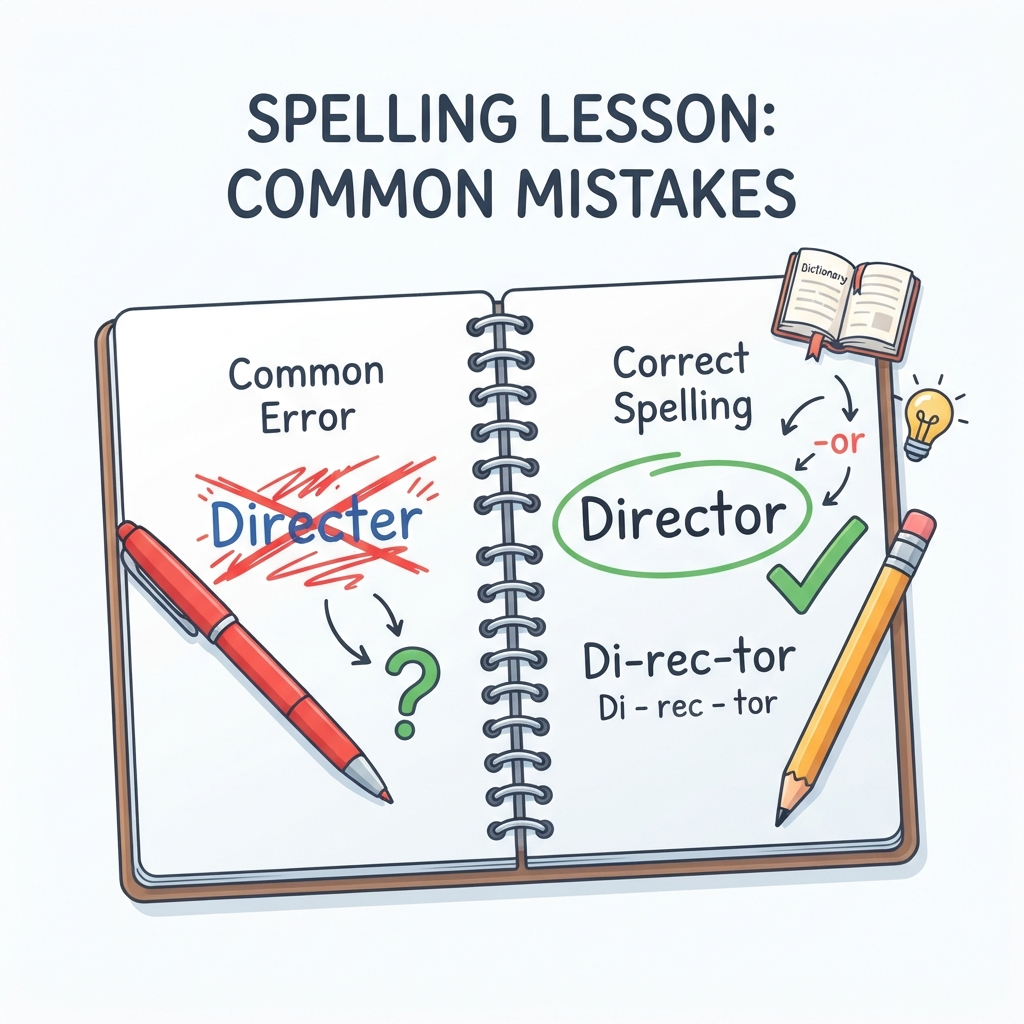
Here are some common mistakes people make.
Mistake 1: Adding -er to direct
Some writers think:
direct + er = directer
This looks logical, but director is the established English noun.
Correct:
He is the director.
Incorrect:
He is the directer.
Mistake 2: Using Directer in a Job Title
Job titles should use the standard spelling.
Correct:
- Marketing Director
- Sales Director
- Film Director
- Creative Director
- Project Director
Incorrect:
- Marketing Directer
- Film Directer
- Project Directer
Mistake 3: Confusing Director With Direct
Direct is usually a verb or adjective.
Example:
She will direct the film.
Director is a noun.
Example:
She is the film director.
Mistake 4: Using Directer in Formal Writing
Even if readers understand what you mean, directer can look like a spelling error.
For professional writing, always choose director.
Mistake 5: Assuming Every Action Word Uses -er
English has many irregular word forms.
For example:
- teach → teacher
- drive → driver
- write → writer
- direct → director
So you cannot always create a correct noun by simply adding -er.
Director in Everyday Examples

The word director appears in many areas of everyday English.
In Emails
Dear Director,
I am writing to request a meeting about the new project.
Or:
The director has approved the proposal.
In News Writing
The company director announced a new plan.
The film director discussed the project in an interview.
In Social Media
Such an amazing film! The director did a great job.
Congratulations to our new director!
In Formal Writing
The director is responsible for overseeing the department.
The board appointed a new director last month.
In School Writing
The school director welcomed the students.
In Business Writing
The marketing director presented the new strategy.
In Film Writing
The director created a powerful scene.
These examples show that director works across casual, professional, and formal contexts.
Directer or Director – Comparison Table
| Word | Correct? | Meaning | Example |
|---|---|---|---|
| Director | ✅ Yes | A person who directs | She is the director. |
| Directer | ❌ Usually no | Not the standard noun for this meaning | Avoid this spelling. |
| Direct | ✅ Yes | To guide or control | He will direct the team. |
| Directed | ✅ Yes | Past form of direct | She directed the film. |
| Directing | ✅ Yes | Present participle of direct | He is directing a movie. |
| Direction | ✅ Yes | Guidance or control | Follow the director’s direction. |
The key difference is simple:
Direct = action
Director = person
Direction = guidance or control
Directer or Director – Google Trends & Usage Data
Search interest for “directer or director” usually comes from spelling confusion. People may type both forms into search engines to check which one is correct.
The spelling director is the established form used in standard English across major English-speaking countries.
Searches for directer can still appear because people often build a word from the verb direct and assume that adding -er creates the person noun.
Usage also changes with context.
For example, director is common in:
- Business
- Movies and television
- Education
- Government organizations
- Marketing
- Technology
- Nonprofit organizations
- Professional job titles
Because director is used in many fields, it has much broader everyday use than the nonstandard spelling directer.
If you see directer while reading, it may be a typo or an unusual historical or specialized usage. For normal modern English writing, director is the form to choose.
Why Do People Write Directer?
The main reason is simple: directer looks like a natural English word.
English often creates nouns by adding -er to verbs:
- teach → teacher
- work → worker
- drive → driver
- paint → painter
Because direct is a verb, it is easy to assume:
direct + er = directer
But English contains many words that follow different patterns.
The standard noun is director, not directer.
This is why spelling checks are useful when you are unsure about a word that looks logical but does not follow the usual pattern.
Is Director a Noun or Verb?
Director is a noun.
It refers to a person who directs, manages, leads, or oversees something.
Examples:
The director approved the plan.
The director is meeting the staff.
She became the company’s new director.
The word direct can be a verb:
She will direct the film.
So remember:
Direct = verb
Director = noun
This simple difference can help you avoid the directer/director mistake.
FAQs About Directer or Director
1. Is it directer or director?
Director is the standard spelling when referring to a person who directs something.
2. Is directer a real word?
You may encounter directer, but it is not the normal standard English noun for a person who directs. In everyday and professional writing, use director.
3. Why is it director and not directer?
The noun comes from a historical word formation connected to Latin and French rather than simply adding -er to the English verb direct.
4. Is director correct in British English?
Yes. Director is the standard spelling in British English.
5. Is director correct in American English?
Yes. Director is also the standard spelling in American English.
6. Can I use directer in formal writing?
It is best to avoid it when you mean a person who directs. Use director in formal, academic, business, and professional writing.
7. What is the difference between direct and director?
Direct is generally a verb meaning to guide or control something. Director is a noun for a person who directs or manages something.
Conclusion
When choosing between directer or director, the answer is clear: director is the standard spelling.
The word director is used for a person who directs, leads, manages, or oversees something. It can describe a film director, company director, school director, project director, or creative director.
The confusion often happens because English commonly forms person nouns with -er. This can make directer look correct. However, English word formation does not always follow one simple rule. Director is the established form that has been used in English for a long time.
There is also no major British-versus-American spelling difference here. Both British and American English use director.
So, whether you are writing an email, school assignment, news article, resume, social media post, or formal document, choose director.
Correct: Director ✅
Avoid: Directer ❌

Walter de la Mare writes creative English captions for funcaptionz.com, sharing short ideas, thoughtful wording, and expressive lines for modern readers.









