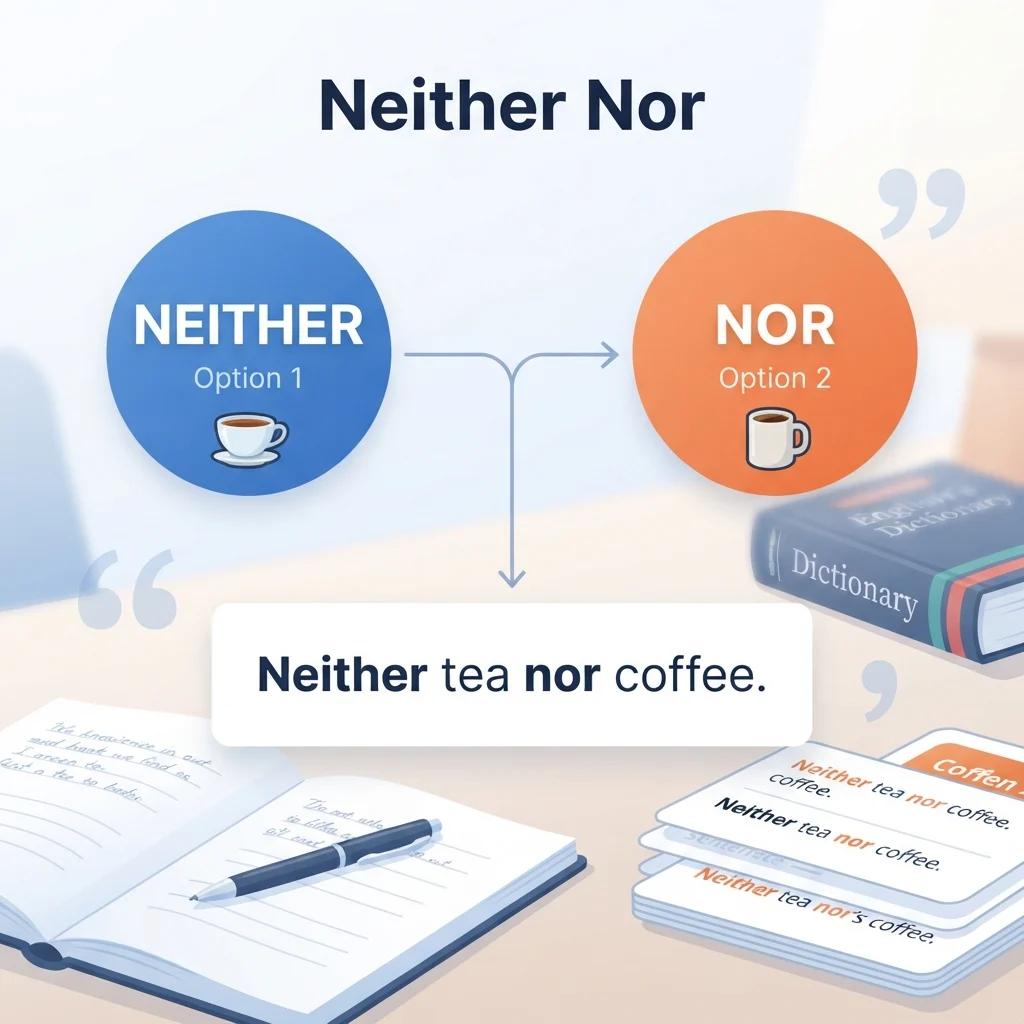
Neither and nor work together to connect two negative choices: “Neither John nor Mary came.” Neither introduces the first option, while nor introduces the second.
Neither or nor—which one should you use, and when? This small grammar choice can cause surprisingly common mistakes, but the rule becomes much easier once you understand what each word does. The simplest way to remember it is this: neither introduces the first negative choice, while nor connects the second negative choice.
For example, “Neither John nor Mary came to the meeting.” Here, neither introduces John and nor introduces Mary. The sentence means that John did not come and Mary did not come either. This neither … nor structure is one of the clearest ways to say that two people, things, or actions are both not involved.
But there is more to neither or nor than simply putting the two words together. Their use can become confusing when you are dealing with verbs, singular and plural subjects, longer sentences, or multiple choices. Another common problem is using nor incorrectly when a sentence actually needs or, or using neither without understanding what it is referring to.
Whether you are writing an essay, school assignment, professional email, blog post, or everyday message, mastering this difference can make your English more precise and natural. One simple grammar rule can save you from awkward or incorrect sentences.
In this complete guide, you’ll learn the difference between neither and nor, how to use neither … nor correctly, when to use each word, subject-verb agreement rules, clear examples, common mistakes, and easy ways to remember the difference. By the end, choosing between neither or nor will no longer feel confusing—you’ll know exactly how and when to use them with confidence.
Neither or Nor meanings
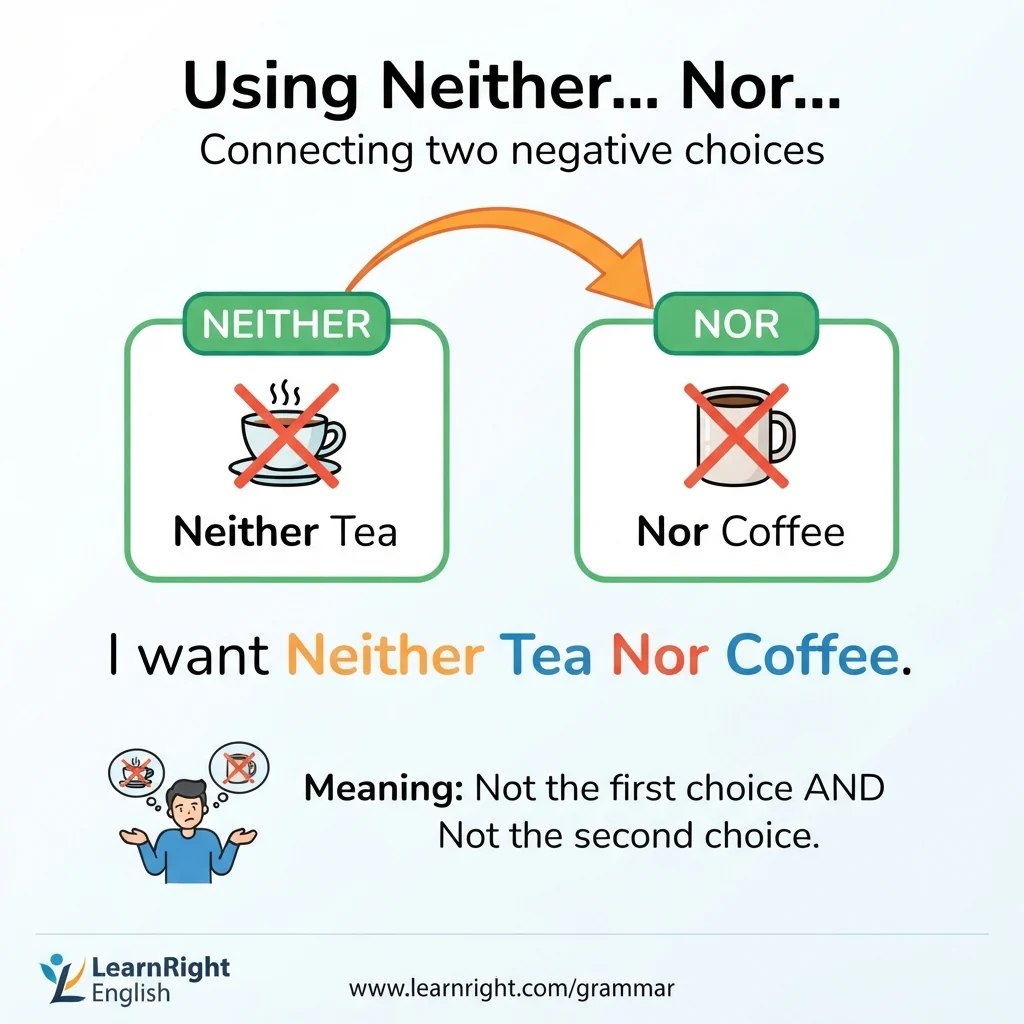
Neither means “not one and not the other.”
Nor is often used with neither to connect two negative choices.
The most common structure is:
Neither + choice 1 + nor + choice 2
Examples
- Neither John nor Mark was ready.
- Neither tea nor coffee is available.
- Neither answer is correct.
- She likes neither cats nor dogs.
Think of it this way:
Neither = not this one
Nor = and not that one
Can “Neither” Be Used Alone?
Yes.
For example:
- Neither answer is correct.
- Neither option works for me.
- Neither student passed the test.
Here, neither works as a determiner or pronoun.
Can “Nor” Be Used Alone?
Yes, but its use is more limited.
For example:
- He did not call, nor did he send a message.
- She cannot swim, nor can she drive.
Notice the special word order after nor:
nor + helping verb + subject
The Origin of Neither or Nor
Neither and nor are old English words. They developed from older forms of English and have been used for centuries to express negative ideas.
The word neither is connected with the idea of “not either.” In simple terms, it rejects both choices.
The word nor has also been used for a long time as a negative joining word. It is closely linked with the word “or,” but it is used in negative structures.
Over time, English speakers developed the familiar pattern:
neither…nor
For example:
Neither rain nor snow stopped them.
The spelling of these words is not mainly a British-versus-American issue. Neither and nor are standard spellings in both British and American English.
The bigger difference is often pronunciation, especially with neither.
You may hear:
- NEE-ther
- NYE-ther
Both pronunciations are widely used.
So, if you are asking whether British English spells the word differently from American English, the answer is no. The spelling remains the same.
British English vs American English Spelling
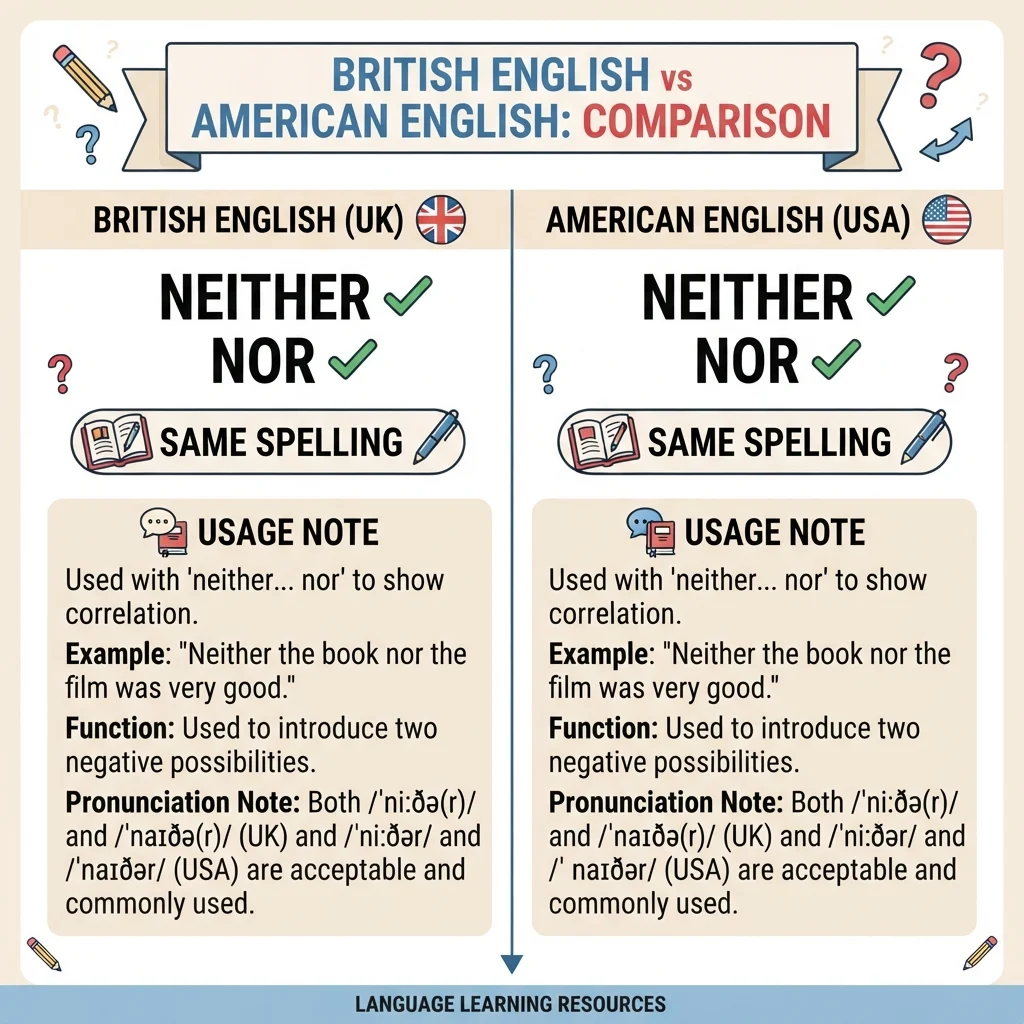
There is no major spelling difference between British and American English for neither or nor.
| Word | British English | American English |
|---|---|---|
| Neither | neither | neither |
| Nor | nor | nor |
| Neither…nor | neither…nor | neither…nor |
Examples in Both Varieties
British English:
Neither Tom nor James is coming.
American English:
Neither Tom nor James is coming.
The spelling stays the same.
What About Pronunciation?
The main variation is pronunciation.
Some speakers say:
NEE-ther
Others say:
NYE-ther
Both are accepted in standard English.
So, unlike words such as colour/color or favour/favor, you do not need to change the spelling of neither or nor based on your audience.
Which Spelling Should You Use?
Use neither and nor in both British and American English.
For US English
Use:
- neither
- nor
- neither…nor
Example:
Neither option is available.
For UK and Commonwealth English
Use the same spellings:
- neither
- nor
- neither…nor
Example:
Neither answer is correct.
For Global English
If you write for an international audience, neither and nor are safe choices.
The important thing is not spelling. It is using the words correctly.
Quick Advice
If you mean “not one and not the other,” use neither.
If you are connecting two negative choices, use nor after neither.
Example:
Neither Monday nor Tuesday works for me.
Common Mistakes with Neither or Nor
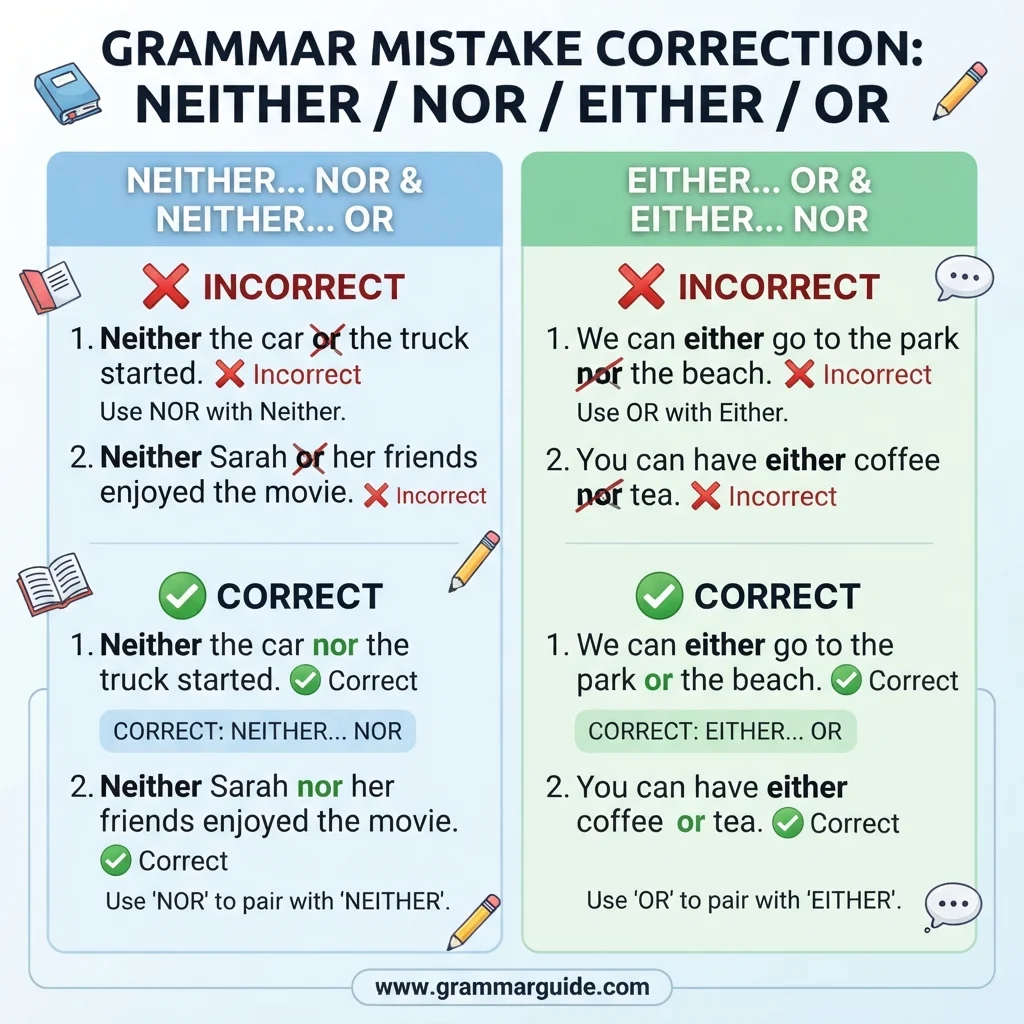
Even though the basic rule is easy, several mistakes are common.
Mistake 1: Using “or” After “neither”
❌ Neither John or Mark came.
✅ Neither John nor Mark came.
The standard pair is:
neither…nor
Mistake 2: Using “nor” After “either”
❌ Either John nor Mark will come.
✅ Either John or Mark will come.
The positive pair is:
either…or
The negative pair is:
neither…nor
Mistake 3: Double Negatives
❌ I don’t like neither option.
This creates a double negative in standard English.
Better:
✅ I don’t like either option.
Or:
✅ I like neither option.
Mistake 4: Forgetting Parallel Structure
Try to keep the two parts similar.
❌ Neither reading books nor to watch movies is fun.
✅ Neither reading books nor watching movies is fun.
Both sides should follow the same grammatical pattern.
Mistake 5: Incorrect Word Order After “Nor”
❌ He did not study, nor he completed the homework.
✅ He did not study, nor did he complete the homework.
After nor in this structure, the helping verb comes before the subject.
Neither or Nor in Everyday Examples

Knowing the rule is useful, but seeing the words in real situations makes it easier to remember.
In Emails
Neither the manager nor the assistant is available today.
We received neither the payment nor the confirmation email.
These forms sound clear and professional.
In News Writing
Neither team nor its supporters expected the result.
The report found that neither company nor its partners had responded.
News writing often uses neither…nor to describe two negative conditions.
In Social Media
Social media writing is usually more relaxed.
Neither coffee nor sleep can fix this Monday.
Neither ready nor worried. Just going with it.
These examples show how neither…nor can work in casual captions.
In Formal Writing
The structure is also common in formal English.
Neither option provides a complete solution.
Neither the proposal nor the report contains enough information.
It can help make formal writing concise and direct.
Neither or Nor – Google Trends & Usage Data
Search interest for “neither or nor” usually comes from people trying to understand grammar, sentence structure, and English usage.
The search intent is often educational. Students, English learners, writers, and people checking a sentence may search for the difference between these words.
Common Search Contexts
People may search for:
- neither or nor difference
- neither nor meaning
- how to use neither and nor
- neither or nor grammar
- neither…nor examples
- can neither be used alone
- how to use nor in a sentence
The phrase is also relevant across countries where English is taught as a first or additional language.
Because neither and nor have the same standard spelling in British and American English, searches are more likely to focus on grammar and usage than spelling differences.
Usage Pattern
The most important pattern to remember is:
Neither + A + nor + B
Example:
Neither Anna nor Emma attended the meeting.
This structure is widely understood in standard English.
Neither or Nor: Comparison Table
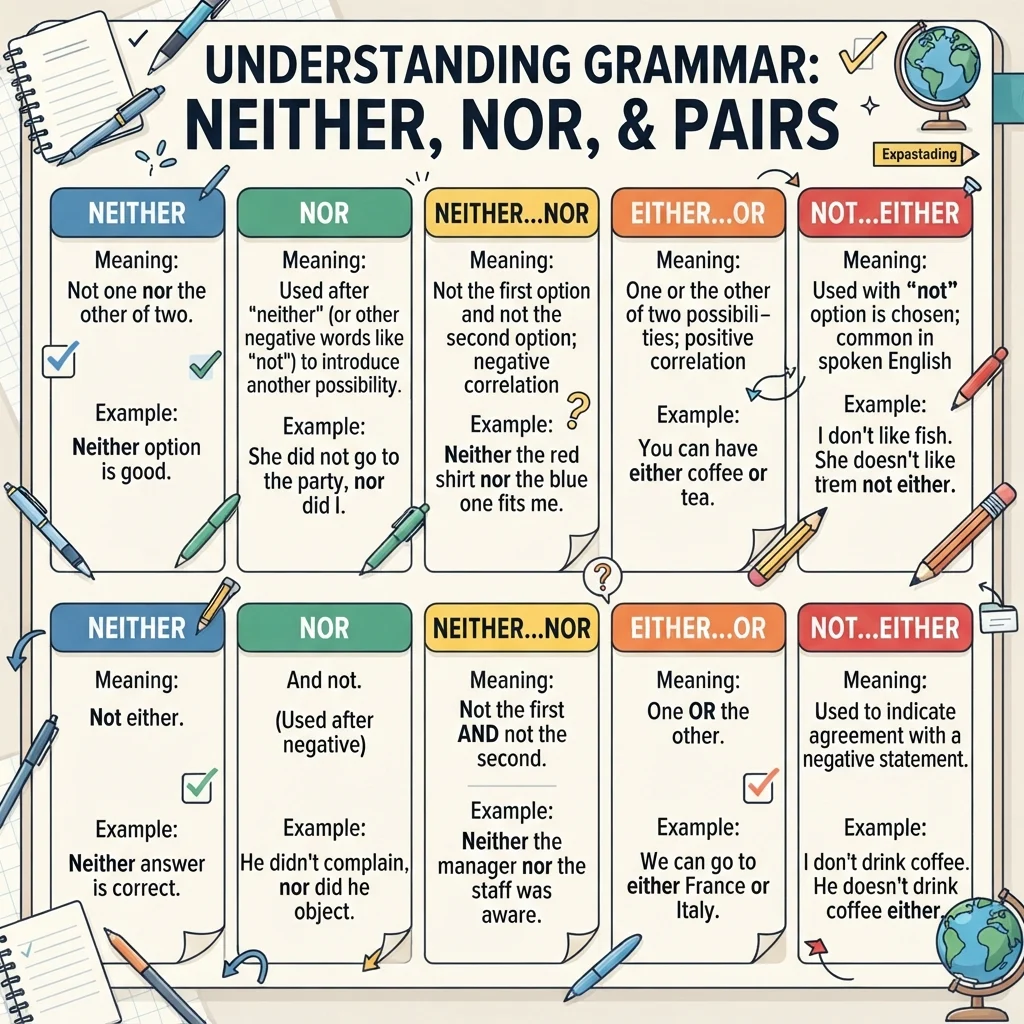
| Word/Structure | Meaning | Main Use | Example |
|---|---|---|---|
| Neither | Not one or the other | Rejects two choices | Neither answer is right. |
| Nor | Negative connector | Connects negative ideas | He didn’t call, nor did he text. |
| Neither…nor | Not A and not B | Connects two negative choices | Neither Tom nor Sam came. |
| Either…or | One choice or the other | Connects positive alternatives | Either Tom or Sam will come. |
| Not…either | Negative form | Shows that neither choice applies | I don’t want either one. |
Easy Memory Trick
Remember these two pairs:
Either → or
Neither → nor
That simple pattern prevents many mistakes.
FAQs About Neither or Nor
1. Is it “neither or nor”?
The standard negative pair is “neither…nor,” not “neither…or.”
Example:
Neither John nor Sarah came.
2. Can “neither” be used without “nor”?
Yes.
Example:
Neither answer is correct.
Here, neither means that both answers are not correct.
3. Can “nor” be used without “neither”?
Yes. Nor can follow another negative statement.
Example:
She did not call, nor did she send a message.
4. What is the difference between “either…or” and “neither…nor”?
Either…or presents alternatives.
Either tea or coffee is fine.
Neither…nor rejects both alternatives.
Neither tea nor coffee is available.
5. Is “neither” singular or plural?
When neither is the subject, formal standard English often treats it as singular.
Example:
Neither answer is correct.
When neither…nor connects subjects, verb agreement can depend on the structure and style. In careful writing, make the sentence clear and avoid awkward constructions.
6. Which is correct: “neither of them are” or “neither of them is”?
Neither of them is is the traditional formal choice.
Example:
Neither of them is available.
In informal speech, plural agreement can also be heard, but “neither of them is” is a safe choice for formal writing.
7. How do you use “nor” correctly?
Use nor to add another negative idea.
Example:
He did not apologize, nor did he explain his actions.
Notice that did comes before he after nor.
Conclusion
Understanding neither or nor is much easier once you remember their basic roles. Neither means that not one of two choices applies. Nor commonly connects the second negative choice. Together, they form the familiar structure neither…nor.
For example, “Neither Ali nor Sara came” means that Ali did not come and Sara did not come.
There is also no British-versus-American spelling difference for these words. Both varieties use neither and nor. The main variation you may notice is how some speakers pronounce neither.
For clear writing, remember three simple rules: use neither…nor for two negative choices, use either…or for alternatives, and avoid unnecessary double negatives. Also, keep both parts of the sentence grammatically parallel.
Once these patterns become familiar, you can use neither and nor confidently in emails, social posts, schoolwork, news-style writing, and formal documents.

Elizabeth Bowen is a creative writer at funcaptionz.com, sharing thoughtful English captions, short content, and inspiring ideas for modern readers.









