
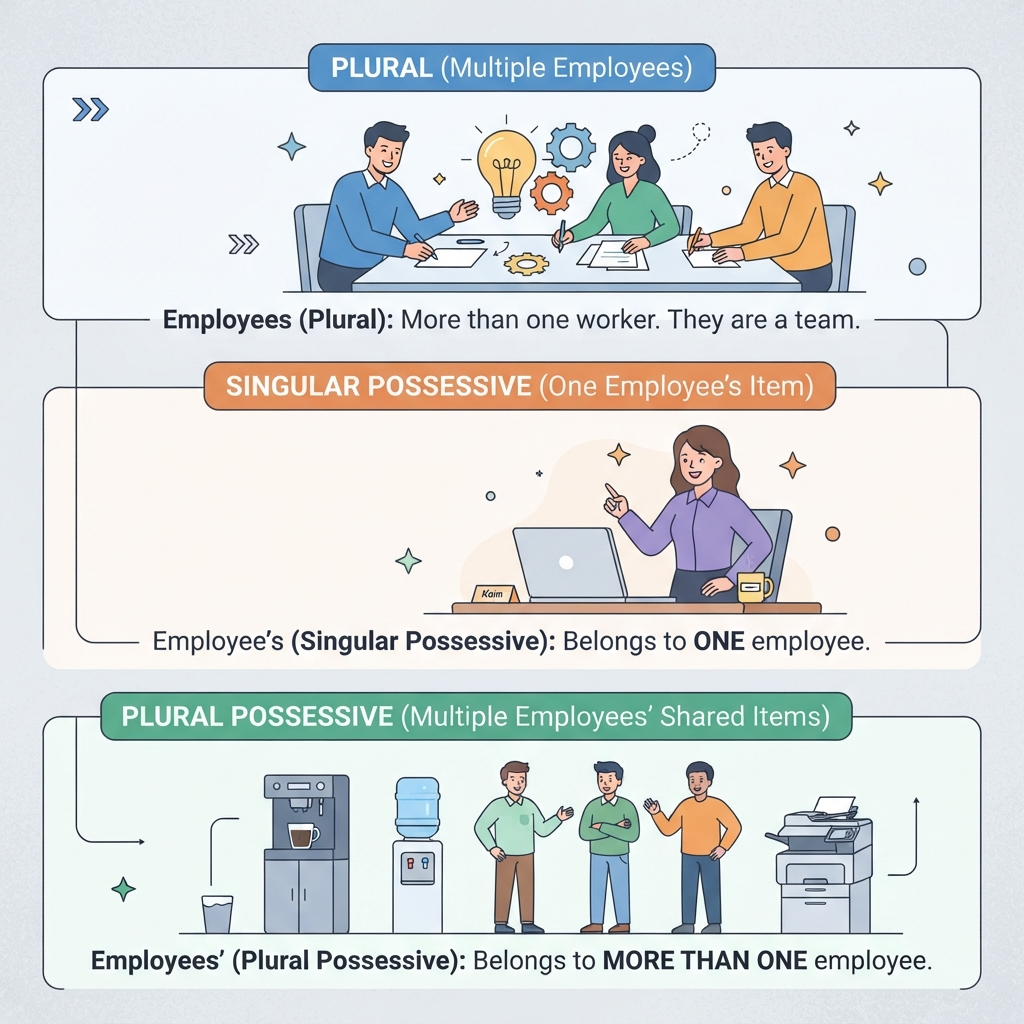
“Employees” is the plural of “employee,” while “employee’s” shows that something belongs to one employee. For multiple employees’ possession, use “employees’.”
Employees or employee’s—which spelling is correct? A tiny apostrophe can completely change the meaning of your sentence, and this is where many writers get confused. Although employees, employee’s, and employees’ look almost identical, each form has a different grammatical purpose. Knowing the difference can help you write clearer emails, reports, workplace documents, essays, and everyday sentences without second-guessing your spelling.
Use employees when you are talking about two or more workers: “The company hired ten new employees.” Use employee’s when something belongs to one employee: “The employee’s desk is near the window.” But when something belongs to more than one employee, the correct form is employees’: “The employees’ meeting starts at nine.”
That final apostrophe is easy to overlook, but it matters. Writing employee’s when you mean several workers can change the meaning of your sentence and make your writing grammatically incorrect. The good news is that once you understand the simple relationship between the singular, plural, and possessive forms, choosing the right one becomes much easier.
In this guide, you’ll discover the clear difference between employees or employee’s, learn when to use employees’, see simple real-world examples, understand the most common mistakes, and get an easy rule for remembering each form. By the end, you’ll be able to choose the correct spelling confidently—whether you’re talking about one employee, several employees, or something that belongs to them.
Employees or Employee’s meanings
The quick answer is:
- Employee = one worker
- Employees = two or more workers
- Employee’s = something belongs to one employee
- Employees’ = something belongs to several employees
Simple examples
Employees
The employees arrived early.
Here, employees means more than one worker.
Employee’s
The employee’s computer is broken.
Here, the computer belongs to one employee.
Employees’
The employees’ computers are broken.
Here, the computers belong to several employees.
Quick comparison
| Form | Meaning | Example |
|---|---|---|
| Employee | One worker | The employee called me. |
| Employees | More than one worker | The employees called me. |
| Employee’s | Belongs to one worker | The employee’s phone rang. |
| Employees’ | Belongs to several workers | The employees’ phones rang. |
Easy rule: If you mean workers, use employees. If you mean something belonging to one worker, use employee’s.
The Origin of Employees or Employee’s
The word employee comes from the French word employé, meaning a person who is employed.
It is connected to the verb employ, which comes from older French and Latin roots related to using or engaging someone for work.
English later developed employee as the noun for a person who works for an employer.
The plural form is created by adding -s:
employee → employees
The possessive form uses an apostrophe:
employee → employee’s
This is why the two forms look different.
The spelling difference is not simply a style choice. The apostrophe has a grammatical purpose. It normally shows possession or ownership.
For example:
The employee’s badge is missing.
The badge belongs to one employee.
But:
The employees are waiting.
There is no possession here. Employees is simply the plural form.
British English vs American English Spelling
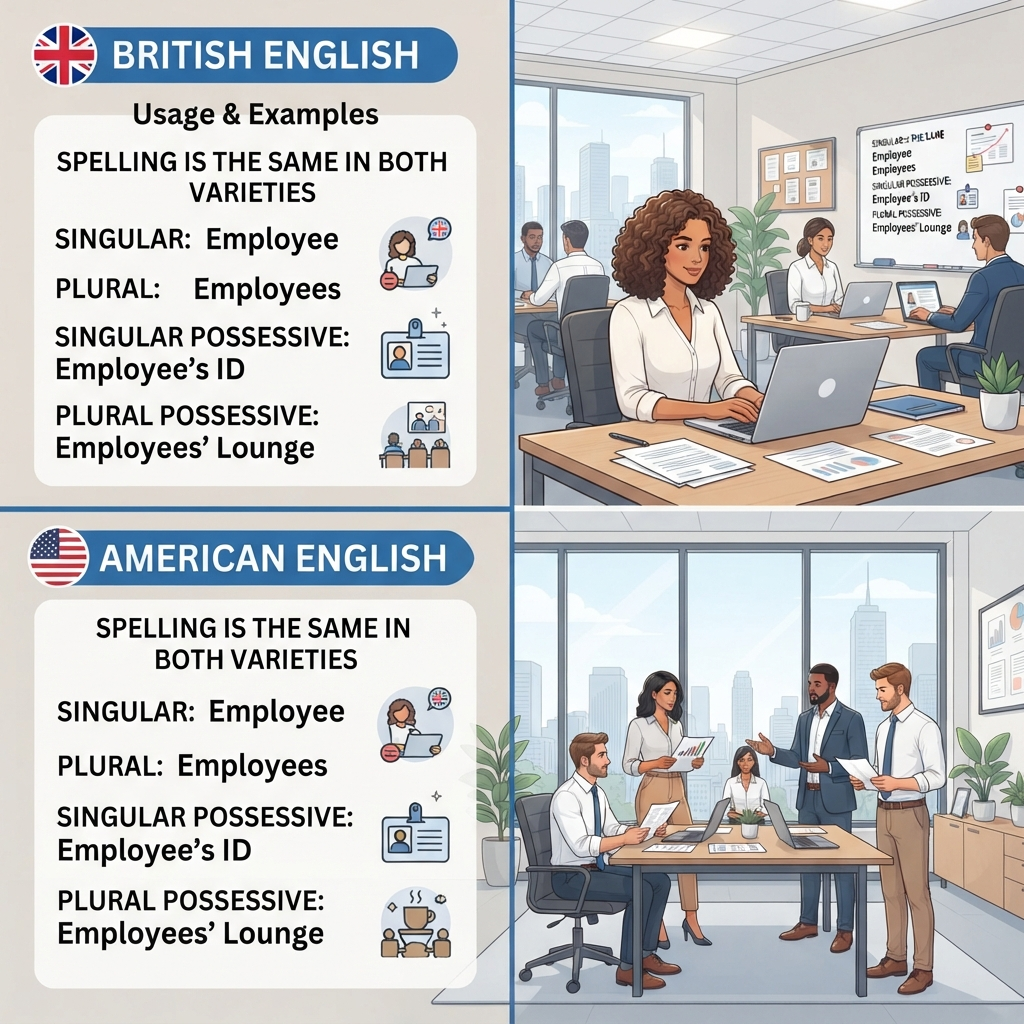
The spelling of employee and employees is the same in both British and American English.
The main rule also stays the same:
employee → employees
For possession:
employee’s → one employee’s possession
employees’ → several employees’ possession
Comparison table
| Meaning | British English | American English |
|---|---|---|
| One worker | employee | employee |
| Several workers | employees | employees |
| Belonging to one worker | employee’s | employee’s |
| Belonging to several workers | employees’ | employees’ |
There is no major British-versus-American spelling difference here.
This is useful because you do not need to change employees to another spelling when writing for American readers or British readers.
Examples
British English:
The employees’ meeting starts at nine.
American English:
The employees’ meeting starts at nine.
Both are correct.
The important thing is to understand number and possession, not the country.
Which Spelling Should You Use?
Your choice depends on what you want to say.
Use “employees” for multiple workers
Use employees when you are talking about two or more people who work for a company or organization.
The employees received new ID cards.
Many employees work from home.
Use “employee’s” for one person’s possession
Use employee’s when one employee owns, uses, or is connected to something.
The employee’s contract was renewed.
I found the employee’s file.
Use “employees’” for several people’s possession
Use employees’ when something belongs to multiple employees.
The employees’ office is on the second floor.
The employees’ concerns were discussed.
For global audiences
The spelling rules remain the same. Focus on the meaning of the sentence.
If you are unsure, ask yourself:
Am I talking about workers, one worker’s thing, or several workers’ things?
That question usually gives you the answer.
Common Mistakes with Employees or Employee’s
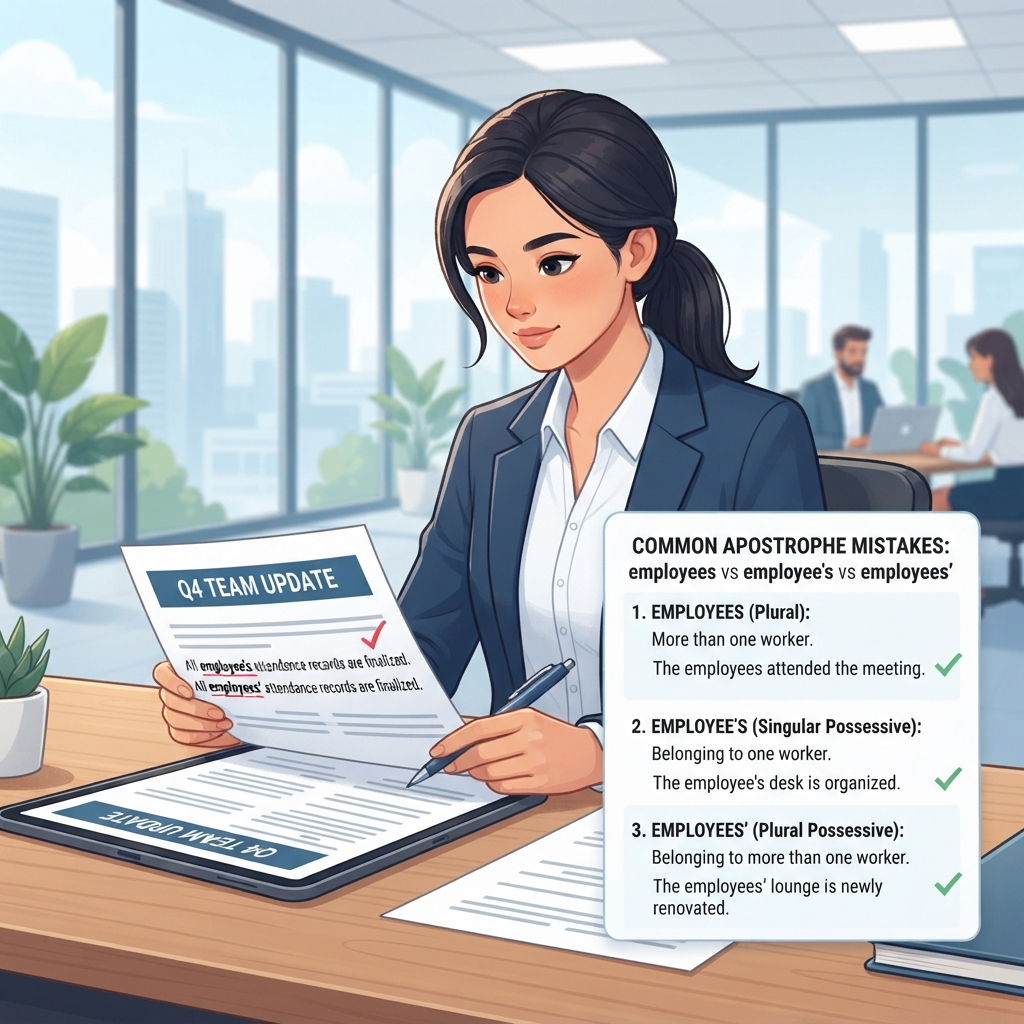
Apostrophes are one of the most common causes of confusion.
Mistake 1: Using “employee’s” for the plural
❌ The company’s employee’s attended the meeting.
✅ The company’s employees attended the meeting.
You need employees because you mean several workers.
Mistake 2: Forgetting the apostrophe for possession
❌ The employees report was missing.
If one employee owns the report:
✅ The employee’s report was missing.
If several employees own or share the report:
✅ The employees’ report was missing.
Mistake 3: Confusing “employees’” and “employee’s”
❌ The employee’s uniforms were ready.
If the uniforms belong to several employees, this is incorrect.
✅ The employees’ uniforms were ready.
Mistake 4: Adding an apostrophe to every plural
❌ Employees’ are important to the company.
✅ Employees are important to the company.
A plural word does not need an apostrophe unless possession is involved.
Employees or Employee’s in Everyday Examples

These forms appear often in workplace writing.
In emails
Please remind the employees about tomorrow’s meeting.
Here, employees means several workers.
Please send the employee’s documents to HR.
Here, employee’s shows possession by one employee.
In news writing
Employees across the company received new benefits.
This refers to many workers.
The employee’s complaint led to an investigation.
This refers to one worker.
On social media
Our employees make this company special.
The word simply means workers.
We celebrated our employees’ achievements today.
The achievements belong to several employees.
In formal writing
The employees’ feedback helped improve the policy.
The feedback came from several employees.
The employee’s performance was reviewed.
The performance of one employee was reviewed.
Employees or Employee’s – Google Trends & Usage Data
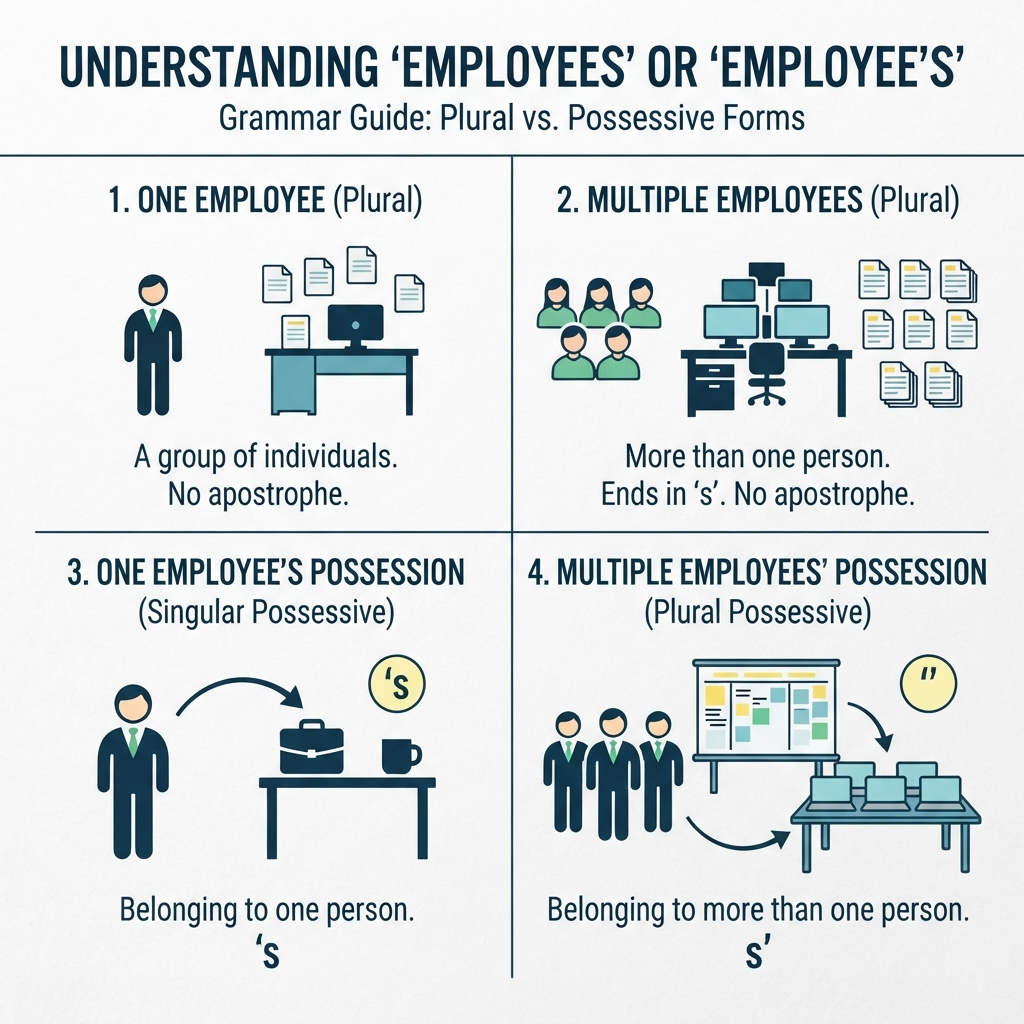
Searches for “employees or employee’s” usually come from people who are unsure about plural and possessive grammar.
The search intent is often practical. People may be writing:
- Business emails
- HR documents
- Job-related content
- Company policies
- Reports
- Website content
- School assignments
- Professional messages
The word employees is naturally much more common in everyday English because businesses often talk about groups of workers.
Employee’s appears less often because it is a possessive form. Its use depends on whether a sentence describes something connected to one particular employee.
Search interest can also vary by country and context. Workplace vocabulary is especially common in countries where English is widely used for business and education.
The key point is that popularity does not decide which spelling is correct. Grammar and meaning decide it.
Side-by-side comparison
| Form | Grammar role | Example |
|---|---|---|
| Employee | Singular noun | One employee called. |
| Employees | Plural noun | Five employees called. |
| Employee’s | Singular possessive | The employee’s desk. |
| Employees’ | Plural possessive | The employees’ desks. |
FAQs About Employees or Employee’s
1. Is “employees” or “employee’s” correct?
Both can be correct, but they have different meanings. Employees means more than one worker. Employee’s shows that something belongs to one worker.
2. Is “employees” plural?
Yes. Employees is the plural form of employee.
Example:
The employees are working.
3. When should I use “employee’s”?
Use employee’s when something belongs to or relates to one employee.
Example:
The employee’s laptop is new.
4. What is the plural possessive of employee?
The plural possessive is employees’.
Example:
The employees’ benefits were updated.
5. Is “employees’” correct?
Yes. Employees’ is correct when something belongs to multiple employees.
Example:
The employees’ opinions were considered.
6. Is “employee’s” the same as “employees”?
No. Employee’s has an apostrophe and normally shows possession by one employee. Employees is simply the plural form.
7. Do British and American English spell employees differently?
No. Employees is spelled the same in British and American English. The same applies to employee’s and employees’.
Conclusion
Understanding employees or employee’s becomes easy once you focus on meaning. Employee means one worker, while employees means two or more workers. The apostrophe changes the job of the word.
Use employee’s when something belongs to one employee. Use employees’ when something belongs to several employees. For a simple plural, use employees without an apostrophe.
For example, “The employees are ready” talks about several workers. “The employee’s desk is ready” describes one worker’s desk. “The employees’ desks are ready” describes desks belonging to several workers.
The same rules apply in British and American English. So, when choosing between these forms, do not focus on the country. Focus on whether you mean one worker, several workers, one worker’s possession, or several workers’ possession.
Once you learn this simple pattern, you can use these forms confidently in emails, reports, websites, and professional writing.

Robert Walser creates meaningful English captions for funcaptionz.com, delivering creative wording, short ideas, and expressive lines for everyday inspiration..









