
“Congratulations” is the full, standard form, while “congrats” is its shorter, informal version. Both are correct, but “congratulations” is better for formal situations and “congrats” suits casual messages.
Congrats or congratulations—which one should you use when you want to celebrate someone’s success? The difference may look small, but the word you choose can change the tone of your message. “Congratulations” is the complete form and is commonly used in formal, professional, and meaningful situations. “Congrats” is the shortened, casual form and is especially common in texts, social media comments, and friendly conversations.
For example, you might write, “Congratulations on your promotion!” in a professional message, while “Congrats on your new job!” sounds perfectly natural when talking to a friend. Both expressions show happiness, praise, or good wishes for someone’s achievement—the main difference is the level of formality.
So, is “congrats” correct English? Yes. It is a widely used informal shortening of “congratulations.” It is not simply a spelling mistake or incorrect version. However, choosing between congrats or congratulations depends on who you’re speaking to, what happened, and where you’re writing the message.
This guide explains the difference clearly, including their meanings, correct usage, formality, common situations, sentence examples, and helpful tips. Whether you’re writing a professional email, graduation message, wedding card, social media comment, or quick text to a friend, you’ll learn exactly when to use “congrats” and when “congratulations” is the better choice.
Congrats or Congratulations meanings
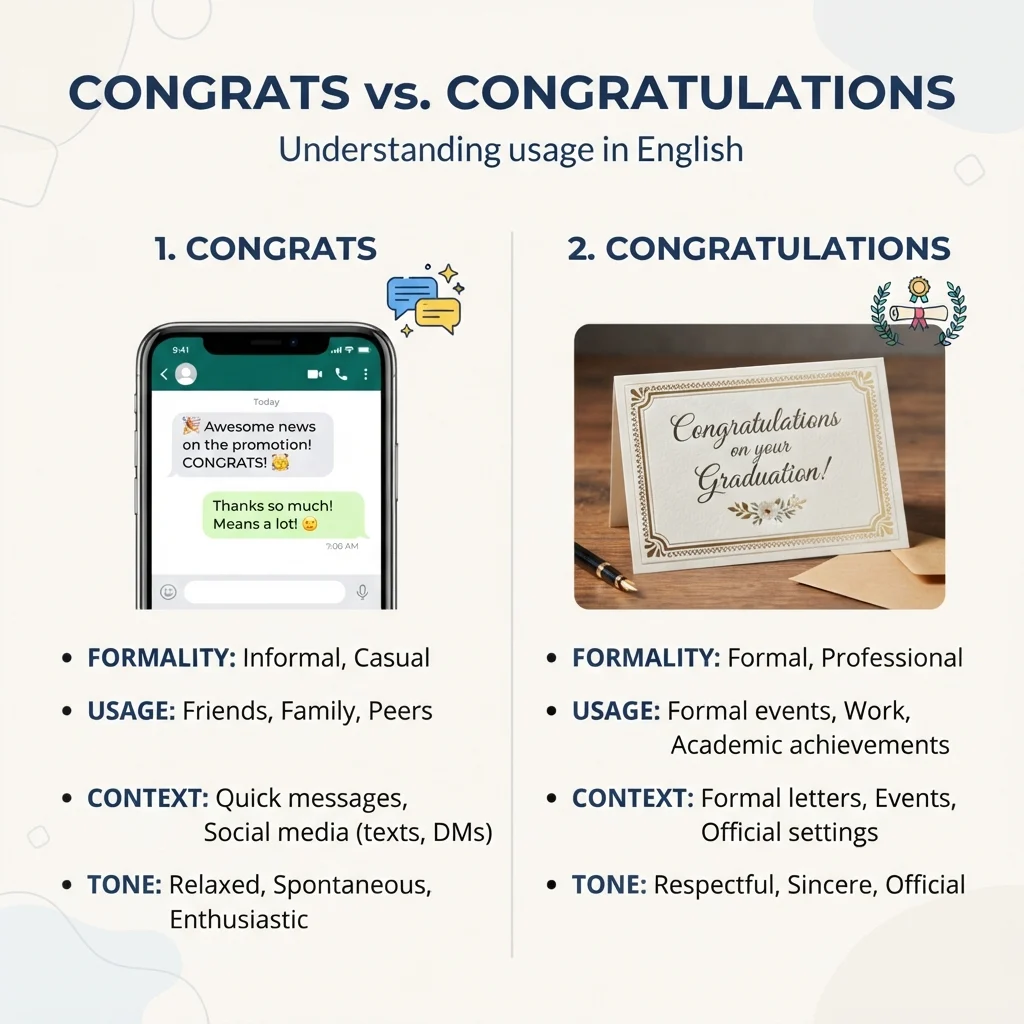
“Congratulations” is the complete and more formal word. “Congrats” is a shortened and informal version.
Both are used to show happiness or praise when someone has achieved something special.
Examples:
- Congratulations on your new job!
- Congrats on your new job!
- Congratulations on your graduation!
- Congrats on graduating!
The meaning is almost the same.
The main difference is tone.
| Word | Meaning | Tone | Best Use |
|---|---|---|---|
| Congratulations | Praise for an achievement | Formal or neutral | Work, cards, speeches |
| Congrats | Short form of congratulations | Informal | Texts, chats, social media |
If you are unsure, “congratulations” is the safer choice because it works in both formal and casual situations.
The Origin of Congrats or Congratulations

The word congratulations comes from the verb congratulate. It is related to the Latin word congratulor, which means to express joy or share happiness with someone.
Over time, congratulate became an English word used when people wanted to praise someone for success, good fortune, or an important achievement.
Congratulations developed as the noun used for the act or expression of congratulating someone.
The word congrats came later as a shortened form. English speakers often shorten long words in casual communication. This process is common in everyday English.
For example:
- Congratulations → Congrats
- Application → App
- Advertisement → Ad
- Photograph → Photo
“Congrats” is therefore not a different meaning. It is simply a shorter, more casual form of congratulations.
The spelling difference exists because one word is the full form and the other is an informal abbreviation.
British English vs American English Spelling
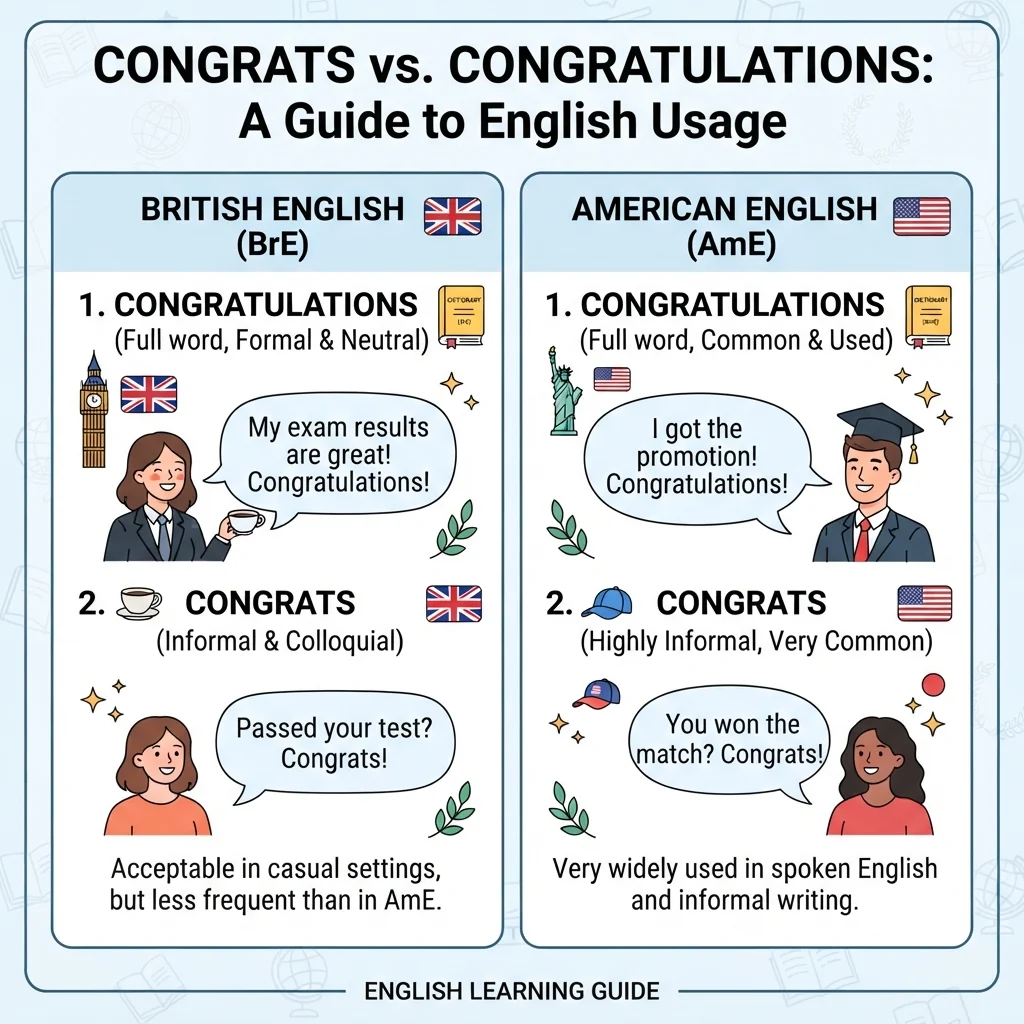
There is no major British-versus-American spelling difference between congrats and congratulations.
Both forms are used in American English and British English.
| English Variety | Formal Form | Informal Form |
|---|---|---|
| American English | Congratulations | Congrats |
| British English | Congratulations | Congrats |
| Canadian English | Congratulations | Congrats |
| Australian English | Congratulations | Congrats |
| Global English | Congratulations | Congrats |
The important difference is not spelling. It is formality and context.
For example:
American English:
“Congratulations on your promotion!”
British English:
“Congratulations on your promotion!”
The same sentence works naturally in both varieties.
Likewise:
American English:
“Congrats! You did it!”
British English:
“Congrats! You did it!”
So, if you are choosing between these two words, you usually do not need to worry about British versus American spelling.
Which Spelling Should You Use?

Choose the word based on your audience and the situation.
For American English
Both congrats and congratulations are common.
Use congrats for:
- Text messages
- Social media
- Friendly chats
- Casual comments
Use congratulations for:
- Business emails
- Formal letters
- Public announcements
- Professional messages
For British English
The same general rule applies.
Congrats is common in casual communication, while congratulations is safer for formal writing.
For Global English
If your audience comes from different countries, congratulations is usually the clearest choice.
It is the complete word and is easily understood in professional and international communication.
Simple rule:
When in doubt, write congratulations.
Common Mistakes with Congrats or Congratulations
Even though these words are simple, some common mistakes appear in everyday writing.
1. Treating “congrats” as formal
Incorrect for a formal setting:
“Congrats on your promotion, Mr. Smith.”
Better:
“Congratulations on your promotion, Mr. Smith.”
“Congrats” is not grammatically wrong, but it may sound too casual.
2. Adding an unnecessary apostrophe
Wrong:
“Congrat’s!”
Correct:
“Congrats!”
“Congrats” is not possessive. It does not need an apostrophe.
3. Misspelling congratulations
A common error is writing:
Congradulations ❌
The correct spelling is:
Congratulations ✅
Remember the “t” after “congratula.”
4. Using “congratulation” in the wrong way
When giving praise, English normally uses the plural:
Congratulations! ✅
For example:
“Congratulations on your graduation!”
5. Using “congrats” in every situation
“Congrats” is perfectly normal in casual writing, but congratulations is better when you want a polished or professional tone.
Congrats or Congratulations in Everyday Examples

The right choice often depends on where you are writing.
In Emails
Professional email:
Congratulations on your promotion. I wish you continued success in your new role.
Friendly email:
Congrats on the new job! You deserve it.
In News Writing
Formal news writing usually prefers the complete form:
Congratulations to the winners of this year’s competition.
The full word sounds more polished and neutral.
On Social Media
Short forms are very common:
Congrats! 🎉
Huge congrats on your graduation!
Social media often favors short, friendly language.
In Formal Writing
Use congratulations:
Please accept my congratulations on your outstanding achievement.
This sounds more professional than:
Please accept my congrats.
In Text Messages
Both work, but congrats is more natural for a quick message:
Congrats! So happy for you!
Congrats or Congratulations – Google Trends & Usage Data
Search interest for congrats and congratulations can change by country, season, and context.
People commonly search these terms when they are unsure about:
- Correct spelling
- Formal versus informal usage
- Short forms
- Email wording
- Social media language
- English usage differences
Congratulations has a broader use because it is the full word. It appears often in formal communication, announcements, cards, speeches, and professional writing.
Congrats is strongly connected with casual communication. It is especially natural in short online messages, comments, texts, and social posts.
Search patterns can also increase around events such as graduations, weddings, promotions, awards, competitions, and major achievements.
Because online search trends change over time, there is no single permanent popularity result for every country. The context matters as much as the location.
Congrats vs Congratulations: Side-by-Side Comparison
| Feature | Congrats | Congratulations |
|---|---|---|
| Form | Short form | Full form |
| Meaning | Praise for an achievement | Praise for an achievement |
| Grammar | Informal noun/interjection | Standard noun |
| Tone | Casual | Neutral to formal |
| Text messages | Excellent | Good |
| Social media | Excellent | Good |
| Friendly chats | Excellent | Good |
| Professional emails | Less suitable | Excellent |
| Formal letters | Less suitable | Excellent |
| Speeches | Usually too casual | Excellent |
| Cards | Casual cards | Formal or traditional cards |
FAQs About Congrats or Congratulations
1. Is “congrats” correct English?
Yes. “Congrats” is a correct informal form of “congratulations.” It is widely used in casual conversations, texts, and social media.
2. Is “congratulations” more formal than “congrats”?
Yes. Congratulations is the full form and sounds more formal or polished. Congrats is shorter and more casual.
3. Can I use “congrats” in a professional email?
You can, but congratulations is usually a better choice for professional emails because it sounds more polished.
4. Is “congrats” British or American?
It is used in both British and American English. It is an informal form rather than a spelling difference between the two varieties.
5. Is “congradulations” correct?
No. “Congradulations” is a common misspelling. The correct spelling is “congratulations.”
6. Should I say “congratulation” or “congratulations”?
When praising someone for an achievement, use “congratulations.” The plural form is the normal expression.
7. Which is better: “Congrats” or “Congratulations”?
Neither is always better. Congrats is better for casual situations, while congratulations is better for formal or professional situations.
Conclusion
The choice between congrats or congratulations is mainly about tone, not meaning. Both expressions show happiness and praise for someone’s achievement. The key difference is that congratulations is the complete form, while congrats is its shorter and more informal version.
Use congrats when talking with friends, sending a quick text, commenting on social media, or writing a casual message. It is short, friendly, and natural.
Use congratulations when writing a professional email, formal letter, announcement, speech, or other polished content. It is also the safest choice when you are unsure about your audience.
There is no major British or American spelling difference between these words. Both forms are used across English-speaking countries.
So, the simple rule is easy: use “congrats” for casual communication and “congratulations” for formal communication. When you need a professional tone, choose the full word.

Stella Gibbons writes creative English captions for funcaptionz.com, blending wit, clarity, and short ideas to inspire readers across social platforms daily use









