“Complimented” means praised or admired, while “complemented” means completed, matched, or enhanced something. One letter changes the meaning completely.
Complimented or complemented? These words look and sound almost identical, but using the wrong one can completely change your sentence. The easiest way to remember the difference is simple: complimented = praised, while complemented = completed, matched, or enhanced.
For example, if your friend says, “I love your new hairstyle,” they complimented you. But if you say, “Her earrings complemented her dress,” the earrings matched or enhanced her overall appearance. See the difference? One word is about praise, while the other is about making something work better together.
This tiny spelling difference causes confusion in emails, essays, assignments, conversations, and everyday writing. Once you know the simple connection between compliment and praise, and complement and complete, choosing the correct word becomes much easier.
In this guide, you’ll learn the exact difference between complimented and complemented, their meanings, origins, correct examples, common mistakes, and an easy memory trick that helps you remember the spelling instantly. If you’ve ever paused before typing one of these words, you’re in the right place—because after learning this simple distinction, you’ll know exactly which one to use every time.
Complimented or Complemented meanings
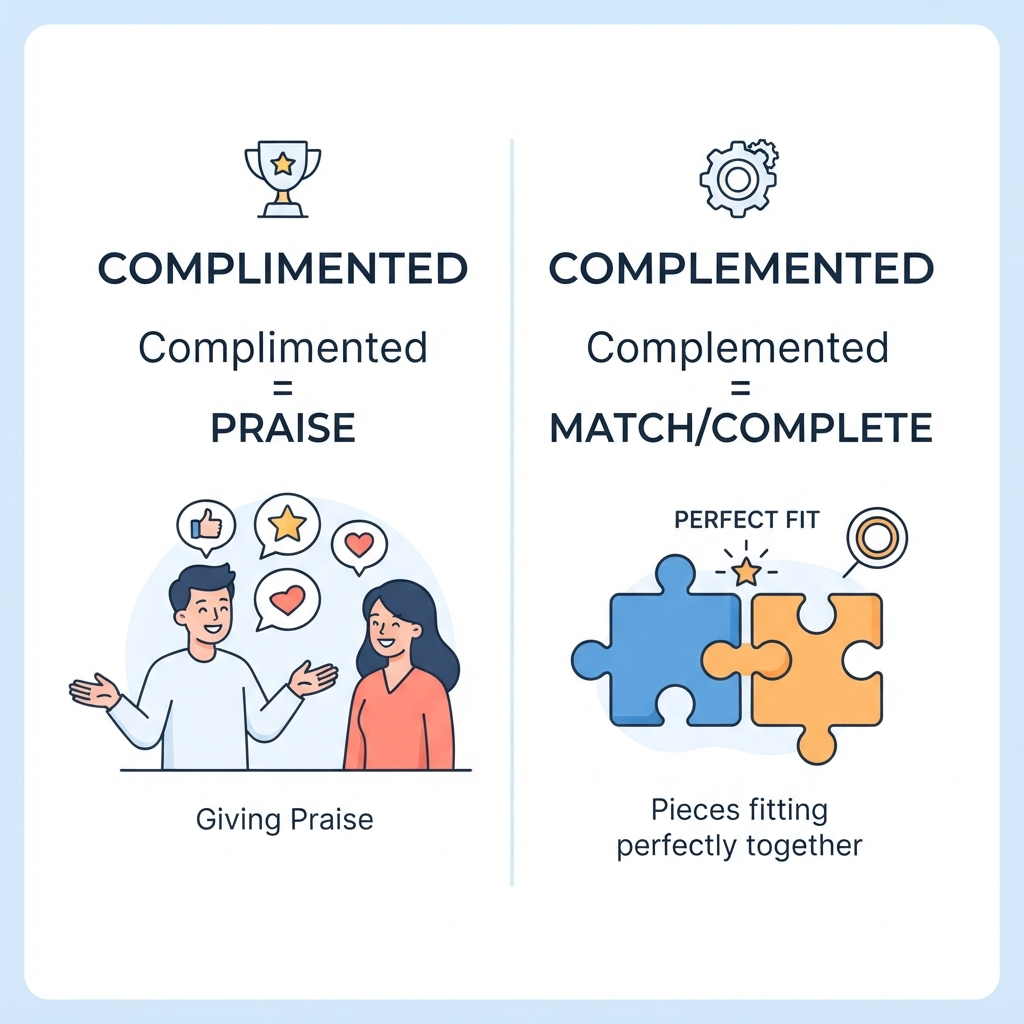
Complimented means praised or told something nice.
- Sarah complimented my new dress.
- The teacher complimented him on his work.
- Everyone complimented her beautiful voice.
Complemented means completed, improved, or matched well with something else.
- The blue shoes complemented her dress.
- The sauce complemented the meal.
- His skills complemented the team.
Easy Trick to Remember
Think:
Compliment = praise
Complement = complete or match
So, if someone says something nice, use complimented.
If two things work well together, use complemented.
The Origin of Complimented or Complemented
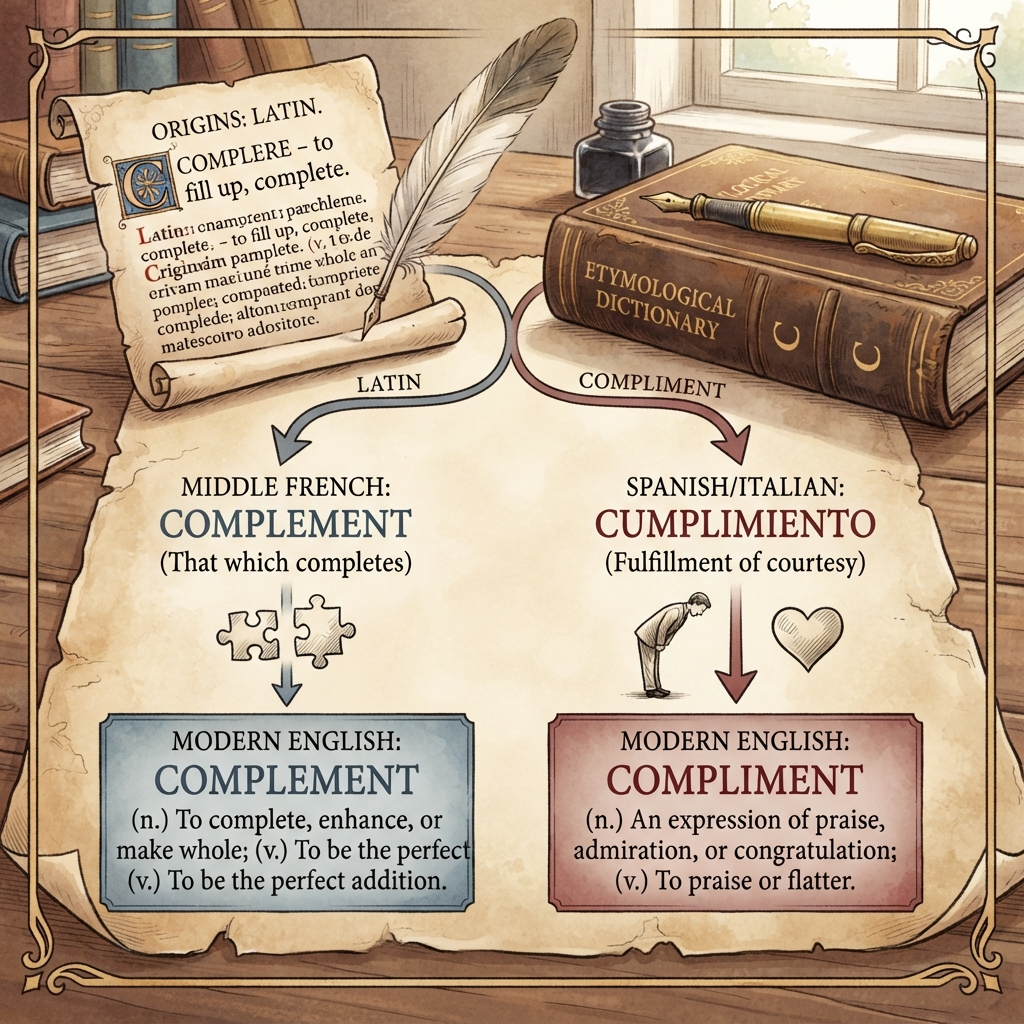
The words compliment and complement look similar because they share a long linguistic history.
Compliment comes from a word linked to showing politeness, respect, or kindness. Over time, its meaning became connected with words of praise or admiration.
Complement comes from the Latin word complere, meaning to fill up or complete. It later developed into the idea of something that completes or improves another thing.
Their similar spelling can cause confusion because both words entered English through related historical language paths. However, their meanings became different.
The key difference is still useful today:
- Compliment → praise
- Complement → complete or match
Their past may be connected, but their modern uses are clearly different.
British English vs American English Spelling
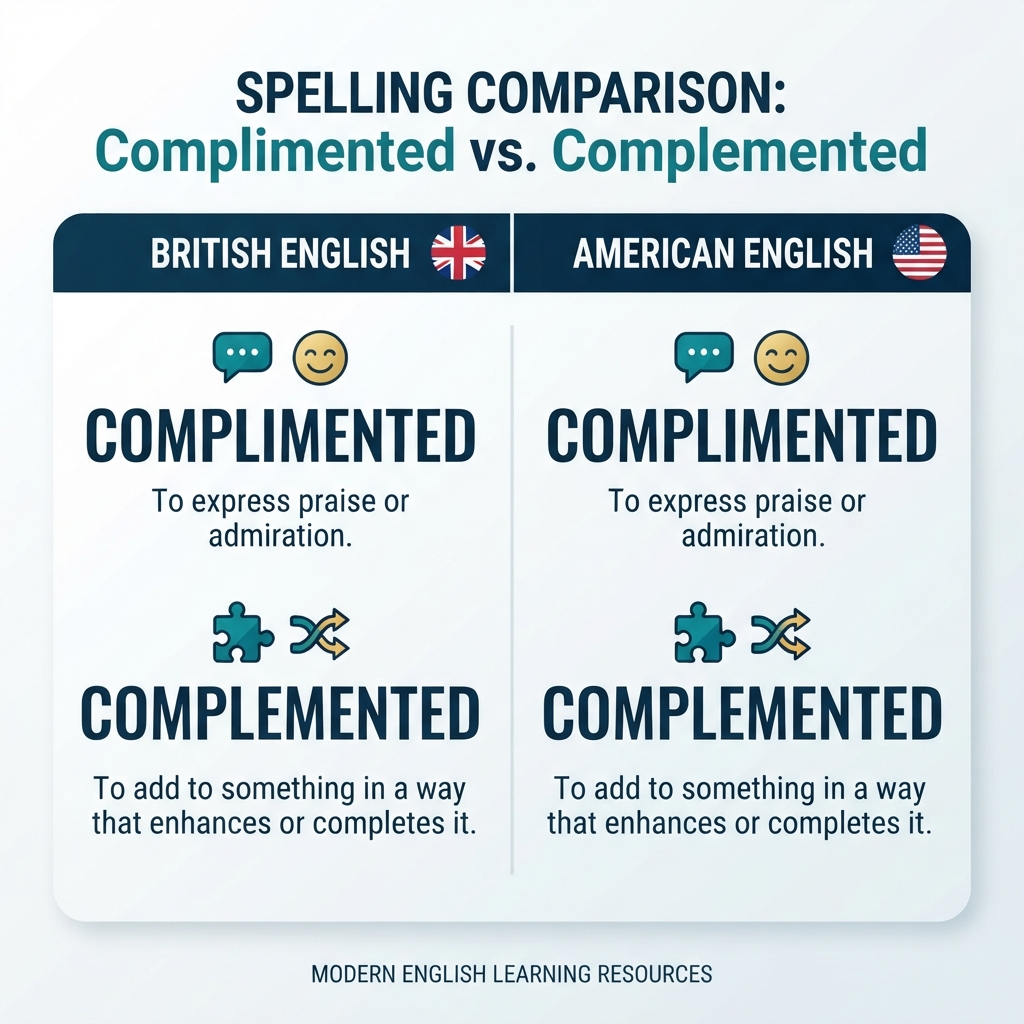
There is an important point here: British English and American English generally use the same spellings for complimented and complemented.
The difference is not mainly about British versus American spelling. Instead, the correct word depends on meaning.
| Meaning | British English | American English |
|---|---|---|
| Praised someone | Complimented | Complimented |
| Praised something | Complimented | Complimented |
| Completed or improved something | Complemented | Complemented |
| Matched well with something | Complemented | Complemented |
Examples
Praise:
The manager complimented Anna on her excellent work.
Matching:
The curtains complemented the room perfectly.
Both varieties of English use the same spelling in these examples.
Which Spelling Should You Use?
Your choice depends on what you mean, not where your reader lives.
For US English
Use complimented when someone gives praise.
Use complemented when something completes or matches another thing.
For UK and Commonwealth English
The same rule applies.
- Complimented = praised
- Complemented = completed, improved, or matched
For Global English
If you write for an international audience, these same meanings are easy to understand.
The best approach is to focus on the meaning of your sentence rather than trying to change the spelling for different countries.
Remember: this is not usually a British-versus-American spelling issue. It is a meaning issue.
Common Mistakes with Complimented or Complemented
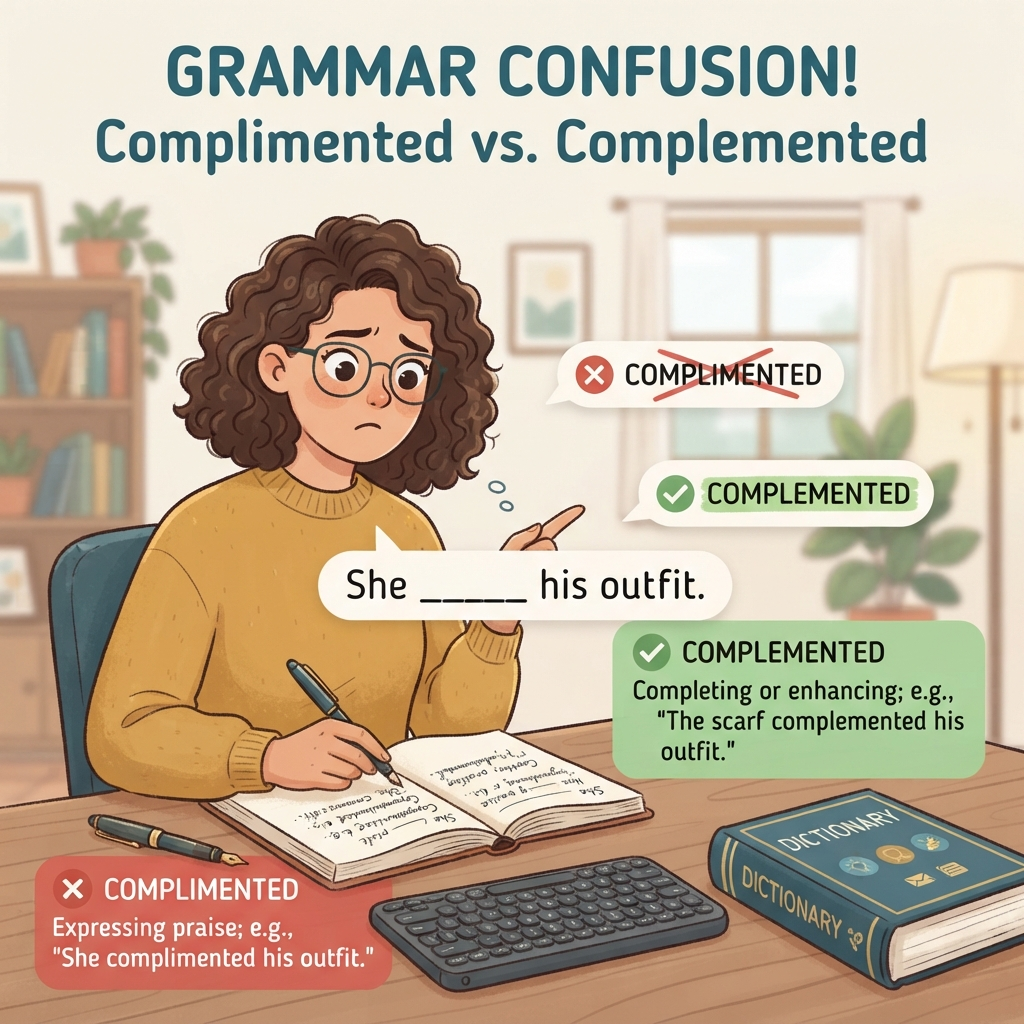
These words are often mixed up because they sound similar.
Mistake 1: Using “complemented” for praise
❌ She complemented my hairstyle.
✅ She complimented my hairstyle.
The person is giving praise, so complimented is correct.
Mistake 2: Using “complimented” for matching
❌ The shoes complimented her outfit.
✅ The shoes complemented her outfit.
The shoes match or improve the outfit, so complemented is correct.
Mistake 3: Thinking “complemented” means something nice
The word complemented does not mean praised.
It describes how one thing works with another thing.
Mistake 4: Confusing “compliment” with “complement”
This is the main problem.
Ask yourself:
Is someone praising something?
→ Use compliment.
Do two things complete or match each other?
→ Use complement.
Complimented or Complemented in Everyday Examples
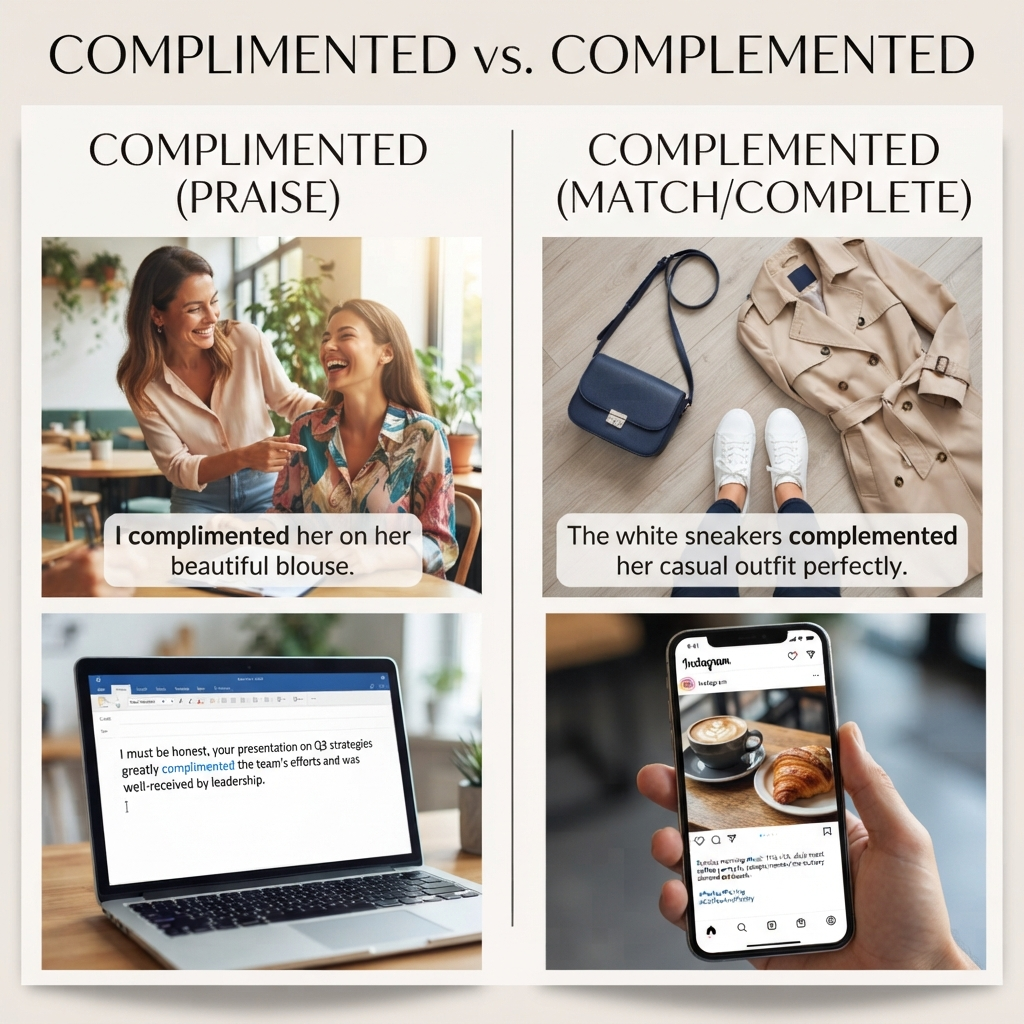
Seeing the words in real situations makes the difference easier to remember.
In Emails
Complimented:
I wanted to say that your presentation was excellent. Several team members complimented you on it.
Complemented:
The new design complemented our existing brand style.
In News Writing
Complimented:
The actor was complimented for his performance.
Complemented:
The new policy complemented the company’s existing strategy.
On Social Media
Complimented:
My friends complimented my new outfit today.
Complemented:
These shoes perfectly complemented my outfit.
In Formal Writing
Complimented:
The director complimented the staff for their hard work.
Complemented:
The new research complemented earlier findings.
Comparison
| Word | Meaning | Example |
|---|---|---|
| Complimented | Praised | She complimented my work. |
| Complemented | Matched or improved | The colors complemented each other. |
Complimented or Complemented – Google Trends & Usage Data
Searches for complimented or complemented often come from people who are unsure about the difference between these two similar words.
The search intent is mainly educational. Students, writers, professionals, and English learners may search the phrase when checking a sentence.
The words can appear in different contexts.
Complimented is common in conversations about:
- Praise
- Appearance
- Skills
- Work
- Performances
- Personal comments
Complemented is common in contexts involving:
- Colors
- Clothing
- Food
- Design
- Business
- Skills
- Ideas
- Research
Usage also varies by topic and country, but the spelling itself does not normally change between American and British English.
The most useful way to understand the data is to look at context, not simply search volume. A sentence about praise points toward complimented, while a sentence about matching or completing points toward complemented.
Complimented or Complemented: Comparison Table
| Feature | Complimented | Complemented |
|---|---|---|
| Base word | Compliment | Complement |
| Main meaning | Praised | Completed or improved |
| Common use | People and praise | Things working together |
| Memory clue | Praise | Complete |
| Example | He complimented her dress. | Her shoes complemented her dress. |
| British spelling | Complimented | Complemented |
| American spelling | Complimented | Complemented |
FAQs About Complimented or Complemented
1. Is it “complimented” or “complemented”?
Both words are correct, but they have different meanings. Complimented means praised, while complemented means completed, improved, or matched.
2. What does complimented mean?
Complimented means praised someone or something. For example, “She complimented my new haircut.”
3. What does complemented mean?
Complemented means that something completed, improved, or matched another thing. For example, “The colors complemented each other.”
4. Is “complemented” British spelling?
No. Complemented is not simply a British spelling. American and British English both use complemented when the meaning is to complete, improve, or match.
5. Is “complimented” used in American English?
Yes. Complimented is standard American English when you mean praised.
6. How can I remember the difference?
Use this simple trick:
Compliment = praise
Complement = complete
If someone says something nice, choose complimented. If two things work well together, choose complemented.
7. Can clothes be complimented or complemented?
Both can be correct, depending on the meaning.
She complimented my dress.
The shoes complemented my dress.
The first means she praised it. The second means the shoes matched it.
Conclusion
Choosing between complimented or complemented becomes easy once you focus on meaning. The two words look and sound similar, but they describe different ideas.
Use complimented when someone gives praise. If a person praises your outfit, work, appearance, skills, or performance, complimented is the correct choice.
Use complemented when something completes, improves, or matches something else. Colors can complement each other, shoes can complement an outfit, and skills can complement a team.
There is also no major British-versus-American spelling difference here. Both forms are used in both varieties of English. The important question is not where you are writing, but what you mean.
When you are unsure, remember the easiest rule: compliment means praise, while complement connects with complete. This small memory trick can help you choose the correct word in emails, articles, schoolwork, social media posts, and professional writing.

Elizabeth Bowen is a creative writer at funcaptionz.com, sharing thoughtful English captions, short content, and inspiring ideas for modern readers.









